
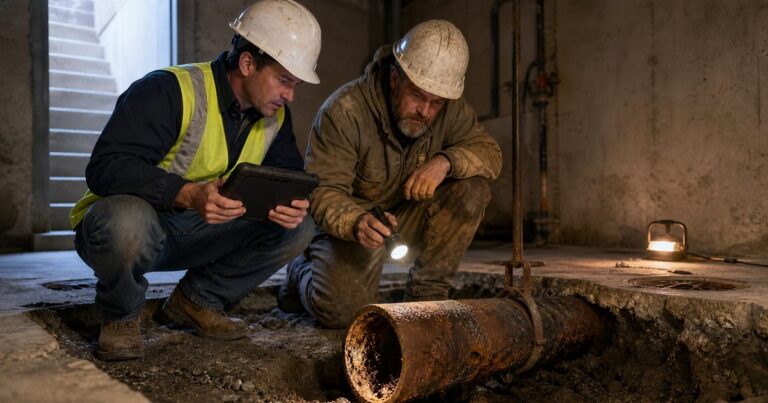
Bottom line: CIPP vs. cast iron is decided by the host pipe, not by the trade. CIPP fits cast iron that is still round with enough wall for a liner; replacement fits a pipe that is collapsed, badly deformed or missing its invert. A plumber judges one lateral, an engineer judges a whole network.
The disagreement is easier to settle than it looks. A cured-in-place pipe (CIPP) liner renews a cast iron pipe from the inside; cast iron replacement removes it and puts a new pipe in the ground. This guide compares CIPP vs. cast iron replacement on the evidence each trade actually uses: remaining wall thickness, ovality, tuberculation, root intrusion at joints, house lateral condition and the standards each side cites. It also marks where a liner stops being defensible, and says when pipe replacement is the honest answer.
Why Do Engineers and Plumbers Disagree About CIPP vs. Cast Iron?
Engineers and field contractors disagree about cast iron because each trade defines condition from different evidence. An asset engineer scores a whole run against NASSCO PACP; the crew on site judges the bore in front of them.
An engineer asks how quickly an asset is degrading across a network and which intervention is cheapest over a decade. A contractor asks what is blocking this line today and whether a fix survives the next winter. Both habits are learned from consequences, and neither is wrong.
The practical effect is that the same pipe can be labeled “lineable” by an asset plan and “replace it” by the crew standing in the basement.
- Engineer’s unit of analysis: a run, a district or a whole sewer network.
- Contractor’s unit of analysis: one house lateral and the property it serves.
- Engineer’s time horizon: decades of service life and capital planning.
- Contractor’s time horizon: this repair, this customer, this warranty call-back.
Bottom line: neither side owns the truth; the scope of evidence decides which recommendation is correct.
What Engineers Weigh Across a Whole Network
To an asset manager, a cast iron pipe is a depreciating item on a register, not a single object. Its replacement is judged against every other pipe competing for the same budget.
Engineers therefore favor interventions that restore service life without opening the road, and a structural liner is often the cheapest way to buy another few decades.
- Remaining wall thickness measured after cleaning, not before.
- Defect distribution from a closed-circuit television (CCTV) survey, scored with NASSCO PACP.
- Whole-life cost of lining against full excavation, including traffic and reinstatement.
- Risk of collateral damage when excavation crosses other buried services.
When a whole network is in scope, excavating one failed pipe while leaving its neighbors is rarely rational, so renovating a run at once usually wins, which is why engineers reach for a liner.
What a Plumber Sees Inside a Single Lateral
The field evidence is closer and coarser: what the camera shows in one lateral, and what the drain machine catches. Faced with a collapse under a driveway, many a plumber reaches for the phone to quote a dig, not a liner.
That instinct is earned: call-backs cost reputation faster than a higher first invoice.
- A sagging run that keeps holding water.
- Root intrusion entering at a cracked joint or a shifted hub.
- Offset joints and open hub gaps the camera shows clearly.
- A run too short or too irregular to line economically.
Field contractors apply a different risk model, and that model is usually right about call-backs. Where the pipe can be lined cleanly, a liner is the quieter answer, and a good installer says so.
The asset case scales across a network, and that scale has a blind spot: the plan scores the run it surveyed, while the failing section often sits under a slab the camera never reached. In our relining work, that gap drives the CIPP vs. cast iron call.

How Does Cast Iron Actually Fail?
Cast iron fails in two directions at once, which is why one inspection can look mild and another alarming.
From the inside, tuberculation narrows the bore as corrosion nodules build up, so flow drops long before the pipe is weak. From the outside, corrosion and graphitization eat wall thickness until the gray iron turns brittle and snaps rather than deforms.
Tuberculation and graphitization rarely arrive together in the same pipe. A pipe with heavy internal nodules may still hold a sound wall, and a thin, graphitized pipe can look almost clean on camera. That split sits at the root of the disagreement.
- Tuberculation: internal nodules that cut hydraulic capacity.
- Graphitization: loss of metallic iron that drains structural wall thickness.
- Root intrusion: roots exploiting joints and cracks the soil has opened.
- Brittle fracture: a sudden break in a pipe left with little ductility.
Bottom line: “bad” is not one condition, and lining treats some of them far better than others.

When Does CIPP Work Well on Cast Iron?
CIPP becomes defensible when the cast iron pipe still gives the liner something to sit against: a host that is round, continuous and strong enough to transfer load.
- The line is largely circular with no more than minor ovality.
- Remaining wall thickness is enough to support the liner during and after cure.
- Defects are surface-scale, not a collapsed section or a missing invert.
- The house lateral connection can be reopened and finished cleanly.
- A structural design to ASTM F1216 confirms the liner carries the required loads.
On projects we have delivered, the deciding question was rarely the pipe’s age. It was whether the cleaned bore held its shape, because a liner is only as good as the surface it presses against.
If you own a 1950s house with original cast iron under the slab, the test is remaining wall, not age.
For a deeper look at how a liner is designed to carry load rather than merely coat a pipe, the guide on how trenchless pipe rehabilitation works sets out the mechanics. Where the profile is not round, a CIPP vs pipe bursting vs slip lining comparison frames the alternatives.
When Is Replacement the Honest Answer?
CIPP applies to cast iron that holds its shape and wall. It does not restore grade: where the run has settled into a belly, the liner follows the low spot and waste keeps standing there. A plumber reads that ponding as a failed line; replacement is the answer.
- The pipe has collapsed or lost a large part of its cross-section.
- Ovality is so severe the liner cannot reach the wall without wrinkles.
- Remaining wall thickness cannot support the liner or resist external loads.
- Capacity must increase, which lining cannot deliver on its own.
Where the pipe has collapsed, lost its invert or run short of wall, pipe replacement is the only answer that restores a known wall, a known diameter and a clean line. Recommending it there is competence, not conservatism.
Who Decides Whether a Line Gets Lined or Replaced?
The owner decides; standards define how to design and install a liner, not which method to choose.
What the standards do is give both sides a shared language. A structural CIPP design follows ASTM F1216; a lateral connection can be renewed to ASTM F2561; a sectional repair fits ASTM F2599. Asset surveys are commonly scored with NASSCO PACP.
- ASTM F1216: the main design practice for cured-in-place pipe by the inversion method.
- ASTM F2561: renewal of a lateral connection from the main.
- ASTM F2599: sectional, inversion-based spot repair.
- NASSCO PACP: a common coding system for CCTV defect data.
The CIPP vs. cast iron decision itself stays with the asset owner, guided by survey data and lifecycle cost rather than by whichever trade is speaking loudest.
Who Carries the Cost and the Warranty?
Cost arguments swing both ways.
A liner usually carries a lower direct cost and needs less road space than an open trench. Pipe replacement costs more up front but returns a new pipe with a full wall and a clear diameter.
- Owner: pays once, but inherits whatever the host later becomes.
- Installer: carries the risk of a liner that fails a post-cure inspection.
- Property holder: cares about call-backs and access, not specification clauses.
Warranty terms are contractual, so ask who inspects the finished liner, what defect standard applies, and how long the installer stands behind the work.
A warranty file should hold four items: the pre-cure survey, the post-cure CCTV run, a thickness check on the liner, and a record of every lateral reopened.
How Do the Two Options Compare Side by Side?
| Dimension | CIPP lining | Cast iron replacement |
|---|---|---|
| Host condition needed | Round cast iron pipe with a sound remaining wall | Any condition, including collapsed |
| Diameter after works | Small diameter loss from liner thickness | Full, or larger if upsized |
| Disruption | Low; access at manholes or a small pit | Higher; open excavation and reinstatement |
| Root intrusion resilience | Sealed bore resists roots once connections are finished | New pipe resists roots until joints age |
| Smaller-line scope | Works from a manhole down a house lateral | Often a single run dug and swapped |
| What sets the lifespan | Resin, liner thickness and host condition | The new pipe’s wall, bedding and joints |
| Host wall after works | Original wall stays in place; the liner becomes the flow surface | Old pipe removed; a new wall carries the load |
| Direct cost | Usually the lower unit cost | Usually higher, plus pipe replacement downtime |

Four Decision Rules That Settle the Argument
When the two views on CIPP vs. cast iron collide, four rules turn a trade dispute into a decision.
- Survey before you argue. A scored CCTV run tells both sides what the pipe actually is.
- Check the wall, not the calendar. Remaining thickness decides whether a host can hold a liner.
- Match the method to the defect. Surface-scale faults suit lining; collapse and lost invert do not.
- Price the whole life, not the invoice. Include reinstatement, traffic and call-back risk on both sides.
Bottom line: the data, not the trade, should carry the decision, and a good brief lets either answer win.
Want a neutral read on CIPP vs. cast iron replacement for your own line? JSW reviews survey data, host condition and standards before recommending a direction, and is comfortable recommending replacement where lining is the wrong call.
Frequently Asked Questions
Can CIPP be installed inside aging cast iron?
Often yes, provided the host is still largely round and keeps enough wall to transfer load into the liner. A CCTV survey and a thickness check decide whether it qualifies.
When should a house lateral be replaced instead of lined?
Replace it when the line is collapsed, badly out of shape, or so corroded that the host cannot support a liner. Lining a broken run only hides a defect that will re-emerge.
Why does root intrusion return after lining?
Roots usually enter at a joint, a crack or the lateral connection. If those entry points are not sealed during the cure, roots find the same gap again, so reopening and finishing the connection matters.
Is a lined pipe as strong as a new one?
A structural liner designed to ASTM F1216 carries defined loads on its own, but it does not restore the original wall. It works with the remaining host, so strength depends on both.
Who holds the warranty on a CIPP liner in cast iron?
Warranty terms are contractual, not dictated by a code. Ask who inspects the completed liner, what defect standard applies, and how long the installer carries the risk.
Does CIPP still work if the cast iron has collapsed?
CIPP applies only where a host pipe exists to conform to. A collapsed or heavily deformed line falls outside that envelope, so excavation or a different trenchless method applies.
How long does CIPP last in a cast iron pipe?
Published service-life figures sit in a typical public range of several decades, but the real answer depends on resin, thickness, chemical exposure and the condition of the host pipe.
Who decides between lining and pipe replacement?
The asset owner holds the decision, guided by survey data, standards and lifecycle cost rather than the habit of any one trade. Both engineers and plumbers inform it.
Final Verdict: Which Option Fits Your Pipe?
On the evidence, the CIPP vs. cast iron decision is settled by three facts about your pipe: how round it still is, how much wall it retains, and what the defect actually is.
Where the pipe still holds shape and wall, a structural liner is a defensible, low-disruption answer that respects both the network view and the field view. Where it has collapsed, deformed or lost its invert, replacement is the honest answer.
A decision recorded against survey data, a design standard and a whole-life cost stands up to scrutiny from either trade. Our field crews work to that standard.
JSW supports owners, engineers and contractors with survey-led method reviews for cast iron rehabilitation, from single laterals to full runs. Bring your CCTV data and we will help you compare lining and replacement on evidence.
For the wider method picture, see what trenchless technologies are and the open-cut versus trenchless comparison. Our service pages cover trenchless pipe rehabilitation and trenchless pipeline repair.
Sources
- ASTM International – design and practice standards for cured-in-place pipe and lateral renewal.
- NASSCO – Pipeline Assessment and Certification Program (PACP) for CCTV condition coding.
- NASTT – trenchless technology education and method guidance.











 English
 Arabic
 Russian
 Spanish
 French
 Vietnamese
 Polish
 Thai
 Indonesian
 Turkish
 Portuguese