
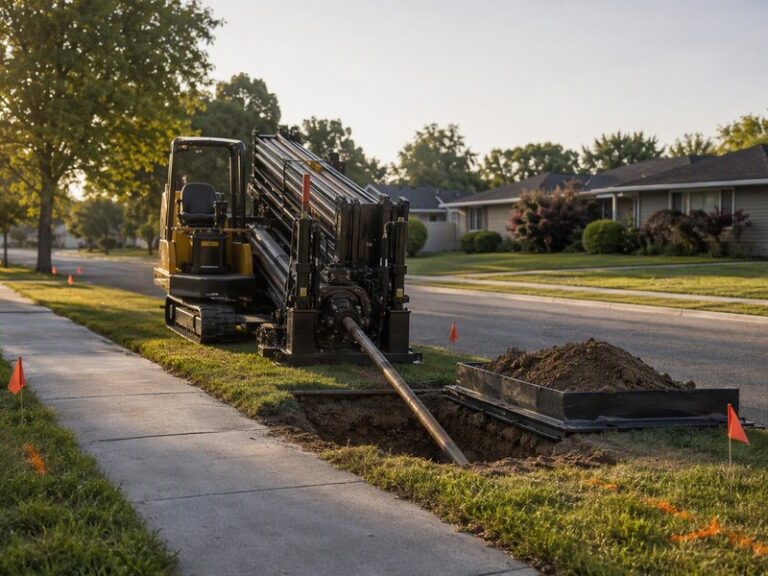
Directional drilling rates in 2026 range from about $15 to $60 per linear foot for small-diameter utility bores in standard soil, and they climb to $60-$100 per foot in rock and to $200-$500 per foot on large river crossings. The rate a contractor quotes depends more on project type, ground conditions and surface restoration than on the size of the drilling rig. This guide explains how directional drilling rates are built, what each project type should cost in 2026, which extras owners routinely overlook, and how to budget and compare bids on total installed cost.
What Are Directional Drilling Rates in 2026?
Directional drilling rates are the prices contractors charge, normally per linear foot of installed bore, to place pipe or cable underground with a horizontal directional drilling (HDD) rig. A quoted rate bundles the drill crew, rig and tooling, drilling fluid, locating and guidance, and contractor overhead, then adds project items such as mobilization, potholing, rock work, permits and restoration.
Demand supports firm pricing: analysts sized the global HDD market near $9-$10 billion in 2025-2026, with double-digit growth projected into the early 2030s on fiber buildouts, water and sewer replacement, and new energy lines. When regional crews run near full utilization, rates firm.
- Labor. Industry surveys put labor at 60-80% of installed cost on typical utility bores, so wage pressure moves rates most.
- Insurance and locates. Utility strikes average roughly $56,000 per incident in insurance industry data, so locate work, potholing and coverage are priced into every bid.
- Materials and permits. Steel casing, HDPE pipe, drilling additives, fuel, and widening permit fees and lead times all pass through to the owner.
How Directional Drilling Rates Are Quoted and What They Include
Most HDD work is quoted three ways: a per-foot rate for longer, repeatable bores, a lump sum for short residential or crossing work, or a day rate for unpredictable ground. Confirm the format before comparing numbers.
What a per-foot directional drilling rate includes
- Crew and operator on site.
- The rig, drill pipe, bits and reamers.
- Drilling fluid mixed on site.
- Locating and steering of the bore path.
Usually not included: product pipe and fittings, fusion or welding, pit excavation, locates and potholing, permits, pavement work, traffic control and restoration. An exclusion is only a trap when it is unwritten.
Which extras owners overlook most often
- Potholing at $700-$1,100 per hole to verify existing utilities.
- Restoration of lawns, pavement, curbs and landscaping at the pits.
- Traffic control with signs, flaggers and night-work allowances.
- Permits for highway access, right-of-way and railroad work.
- Contingency for rock, buried obstructions and weather stand-by.
In bid sets we review for owners, the spread between the lowest and highest per-foot number on the same bore routinely reaches 40-60% before scope is equalized; equalized scope usually cuts that spread by more than half.
2026 Directional Drilling Rates by Project Type
The table below consolidates planning benchmarks for the project types owners tender in 2026.
| Project type | Typical rate | Typical total installed cost | Main cost drivers |
|---|---|---|---|
| Residential water or sewer service line | $15-$30 per ft | $1,500-$4,000 | Short 50-150 ft runs; lawn restoration; locates |
| Fiber and telecom, suburban | $18-$35 per ft | $2,500-$8,000 per run | Bore length; pothole count; conduit size |
| Fiber and telecom, urban | $35-$75 per ft | $5,000-$25,000+ per run | Congestion; traffic control; hardscape restoration |
| Municipal water, sewer or gas line | $25-$60 per ft | $10,000-$100,000+ | Diameter and depth; sewer grade control; street restoration |
| Road or highway crossing | Base plus 20-40% | $3,000-$15,000 | Highway permits; traffic control; pavement at pits |
| Railroad crossing | Base plus $3,000-$8,000 | $15,000-$40,000 | Indemnity; flaggers; engineering review; casing |
| Rock or caliche, any type | Plus 15-40% | Up to $60-$100 per ft | Mud motors, rock bits; slower advance; extra reaming |
| River or creek crossing, large diameter (maxi-HDD) | $200-$500 per ft | $750,000-$2,500,000+ | Spread mobilization; steel casing; environmental compliance; survey |
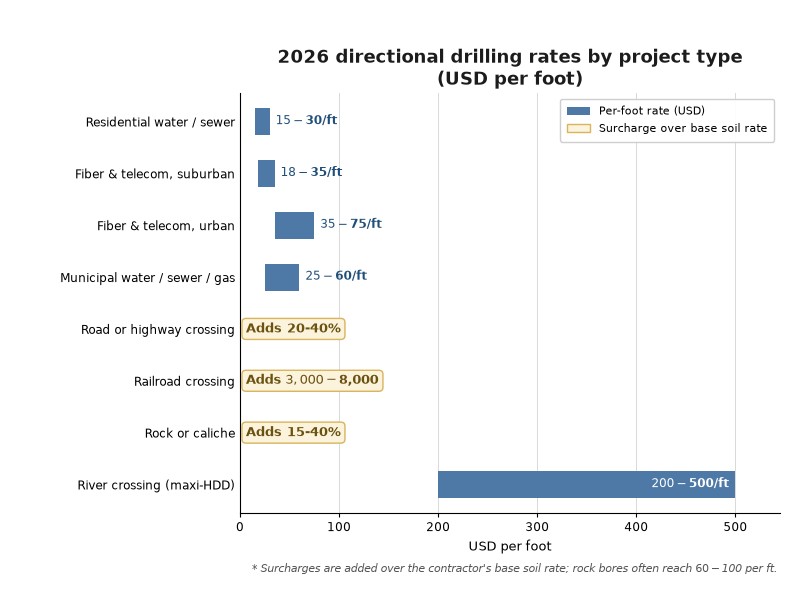
Ranges compile US contractor quotes and industry reporting reviewed in 2025-2026; they are planning references, not quotes, because soil, access and scope move every figure. For a per-foot breakdown by diameter and rig class, see our HDD cost per foot benchmark guide.
Residential Service Lines: $15-$30 per Foot, $1,500-$4,000 Total
Residential work is usually a water, sewer or storm service line, 50 to 150 ft long, bored from the street or easement to the house. Contractors usually quote a lump sum of $1,500-$4,000 rather than a pure per-foot price, with per-foot equivalents near $15-$30 in soil.
The total, not the per-foot math, decides the bill: mobilization, one or two potholes at $700-$1,100 each, locates and lawn restoration often exceed the drilling cost on a half-day job. Group the bore with the connection work so the crew visits once.
In open, unimproved yards a trencher at $5-$12 per foot plus simple restoration is usually cheaper, and a professional contractor will say so. Boring earns its price across driveways, sidewalks, patios, septic fields and mature landscaping, or where a utility refuses open cuts on its easement.
Fiber and Telecom Bores: $18-$75 per Foot
Fiber drives much of the demand. Industry survey data for 2024-2025 put the median underground fiber installation cost near $18.25 per linear foot versus about $6.55 per foot aerial, with labor 60-80% of the total; suburban bores commonly quote at $18-$35 per foot and congested urban corridors at $35-$75.
Potholing surprises owners most: verifying utilities at each crossing costs $700-$1,100 per hole, so a ten-crossing route can add $7,000-$11,000 before drilling starts. Accurate utility maps let the contractor route around conflicts.
A representative 600 ft suburban route with six to ten potholes typically totals $15,000-$30,000 before splicing and electronics. Our directional boring cost guide compares fiber, water and gas routes in more depth.
Municipal Water, Sewer and Gas Lines: $25-$60 per Foot
Municipal bores install 6 to 12 in. water mains, gravity sewer, storm lines and 2 to 4 in. gas distribution lines, usually 300 to 1,000 ft per run, at $25-$60 per foot in 2026. Projects commonly land between $10,000 and $100,000 because prevailing wage, traffic control, pit work and street restoration attach to every letting.
Gravity sewer is the hardest to price because it must hold line and grade; contractors quote slower reaming and extra survey control. Pressure systems such as water, gas and force mains tolerate depth variation and price more predictably.
Replacement funding keeps letting volumes high, which is one reason municipal directional drilling rates sit above residential work in most markets. For when boring beats open cut on municipal routes, see our HDD vs. open-cut cost risk review and our directional drilling vs. trenching cost guide.
Road and Highway Crossings: Budget a 20-40% Premium Plus Permits
Contractors typically add 20-40% over their base soil rate for road crossings, and state highway access permits alone run $500-$2,000 before traffic control plans and flaggers are added.
A 60 ft two-lane county road crossing at a $35 per foot base carries the bore at roughly $2,100, plus permits, traffic control and pavement restoration, and commonly totals $3,500-$8,000 all-in. The same crossing by open cut usually triggers full-width asphalt repair and lane closures, which is why directional drilling under roads pays for itself fastest on paved surfaces.
Confirm in writing whether the rate includes the crossing premium, and who holds the permit. Permit lead time, not price, most often delays road crossings, so start the application early.
Railroad Crossings: Add $3,000-$8,000 for Compliance
Railroads rarely permit open cuts, so directional drilling is usually the default under tracks. Beyond the base rate, owners should expect $3,000-$8,000 of compliance cost covering indemnity and insurance riders, flaggers and worker protection, engineering review and usually a steel casing.
A typical water, sewer or gas crossing under one or two tracks therefore lands between $15,000 and $40,000 even for a short bore, and approval cycles of 60 to 120 days add schedule cost. Fewer contractors carry railroad insurance and relationships, which narrows the bidding pool and supports the premium.
River Crossings and Large-Diameter Maxi-HDD: $200-$500 per Foot
At the far end of the envelope, maxi-rig projects install 24 to 48 in. and larger pipelines beneath rivers, canals and shore approaches. Large-diameter HDD rates run roughly $200-$500 per linear foot, about $650-$1,650 per meter, and a 2,000 to 4,000 ft crossing commonly totals $750,000-$2,500,000 or more before engineering.
The premium funds multi-week rig spread mobilization, large drilling fluid systems with recycling and disposal, environmental permitting and frac-out monitoring, steel coating, welding and inspection, and survey across the waterway.
Record-length crossings now exceed 17,000 ft; our review of record HDD crossings explains how those envelopes change route decisions. For very large finished diameters in soft ground, compare maxi-HDD against microtunneling before committing.
What Raises Rates in 2026: Soil, Rock and Site Access
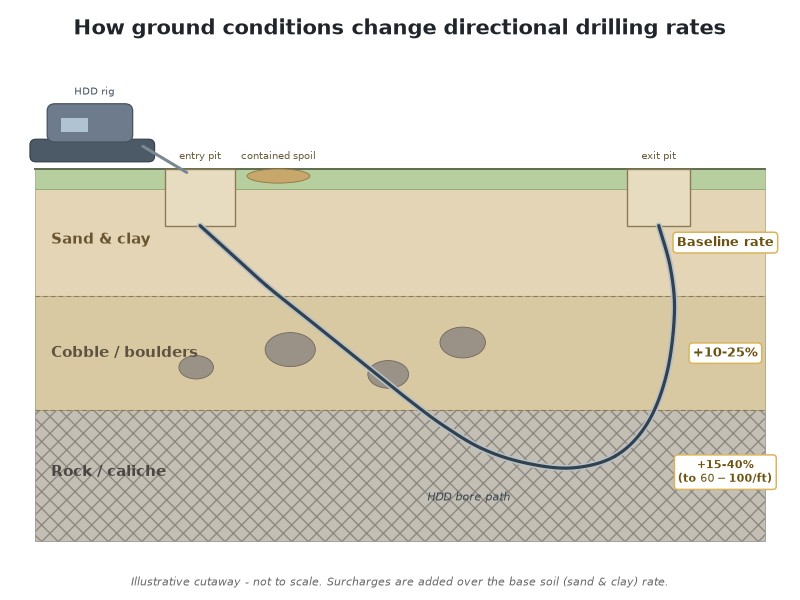
Ground conditions explain more rate variance than any other factor; the same 200 ft bore can draw quotes from $3,000 to $12,000 across different sites.
| Ground condition | Typical effect on rate |
|---|---|
| Sand and clay | Baseline rate; predictable advance with a standard mud program |
| Cobble, gravel or boulders | Plus 10-25%; harder steering, more fluid and tool wear |
| Rock or caliche | Plus 15-40%, often to $60-$100 per ft; mud motors and extra reaming |
| High groundwater | Fluid and disposal costs rise; possible dewatering at pits |
| Contaminated soil | Handling and disposal add project cost; safety plans required |
Mobilization is the second great variable: a fixed fee to move the rig, trucks and tooling to site and back. On short residential and driveway work it can equal or exceed the drilling price; on large maxi projects it is a rounding error.
Rock is where owners mis-budget most often: advance is measured in feet per hour, not tens of feet per hour, and mud motors, rock bits and extra reaming push surcharges of 15-40% and planning numbers of $60-$100 per foot in caliche or limestone. Send the geotechnical report to bidders so rock is priced before the contract, not in a change order.
How Owners Should Budget and Compare Bids in 2026
- Write the full scope. Length, depth, pits, pipe, crossings and included restoration.
- Send the geotechnical report so rock and groundwater are priced before bidding.
- Require itemized bids: per-foot drilling, mobilization, potholes, pipe, restoration, permits and contingency.
- Compare total installed cost, not per-foot numbers.
- Agree change-order terms for rock, obstructions, weather stand-by and utility surprises.
- Verify the contractor: pullback capacity, guidance system, insurance, locate practices and references.
- Hold a 10-15% contingency; ground-dependent work routinely lands inside this band.
Three comparable itemized bids are the minimum basis for a confident decision. When numbers sit far apart, the cause is usually scope; our questions to ask an HDD contractor and our HDD contractor vetting guide help close the gap.
Directional Drilling Rates FAQ
How much are directional drilling rates in 2026?
Directional drilling rates in 2026 run about $15-$60 per linear foot for small-diameter bores in soil, $60-$100 per foot in rock, and $200-$500 per foot on large river crossings. Budget on total installed cost, because directional drilling cost per foot excludes mobilization, potholing, permits, pipe and restoration.
Is directional drilling cheaper than open cut?
Open cut is cheaper in open ground, typically $5-$12 per foot before restoration, while directional drilling costs more per foot. Boring wins on total cost under roads, driveways, parking lots, rail and waterways, where pavement repair, traffic control and restoration exceed the bore price.
How much does it cost to bore under a driveway?
Boring under a driveway or sidewalk is usually flat-quoted at $500-$2,500, because mobilization, setup and one or two potholes dominate a few hours of work.
What is a directional drilling mobilization fee?
A mobilization fee is the fixed charge for moving the rig, trucks and tooling to site, setting up and demobilizing. Contractors fold it into the per-foot rate or bill it separately; on short residential or driveway work it can equal or exceed the drilling price.
How much does rock add to directional drilling cost?
Rock or caliche typically adds 15-40% over the soil rate and can push quotes to $60-$100 per foot or more, because hard rock advances in feet per hour and consumes mud motors, rock bits and extra reaming. Send the geotechnical report with the bid package.
Why do directional drilling quotes vary so much between bids?
Rates vary because scope varies: excluded restoration, permits, pipe, potholing and contingency resurface as change orders. Itemized bids on identical scope land in a much narrower band.
Do per-foot directional drilling quotes include pipe and materials?
Usually not. Per-foot rates cover crew, rig, operator, tooling and drilling fluid; product pipe, fittings, fusion or welding, pits, locates, permits and restoration are separate items.
How JSW Supports HDD and Pipeline Projects
JSW is a pipeline engineering and construction partner for owners and EPCs scoping, pricing and executing trenchless work. Around the bore we supply the pipe-string layer owners most often under-budget: pipeline automatic welding technology, pipeline cold bending, and pipeline hot tapping and plugging services for tie-ins on live lines.
Beyond routine envelopes we support microtunneling and shore approach engineering, and our pipeline construction services, trenchless pipeline repair technology and pipeline maintenance services cover the line through its operating life.
What distinguishes our cost support is integrated budgeting: we price bore, pipe string and tie-in as one system, itemize fluids, restoration and contingency, and document as-builts that survive audit. Send us the bore plan and quotes, and our engineers will flag scope gaps and unrealistic directional drilling rates in a technical review.
Planning a directional drilling project in 2026? Contact our engineering team via our contact form with bore length, pipe diameter and geotechnical data for a free technical review and a scoped budget benchmark within five working days.
Benchmarks in this guide compile US contractor quotes and industry reporting reviewed in 2025-2026. They are planning references, not quotes: regional markets, soil and scope move every figure.





































 English
  Arabic
  Russian
  Spanish
  French
  Vietnamese
  Polish
  Thai
Thai  Indonesian
  Turkish
  Portuguese