
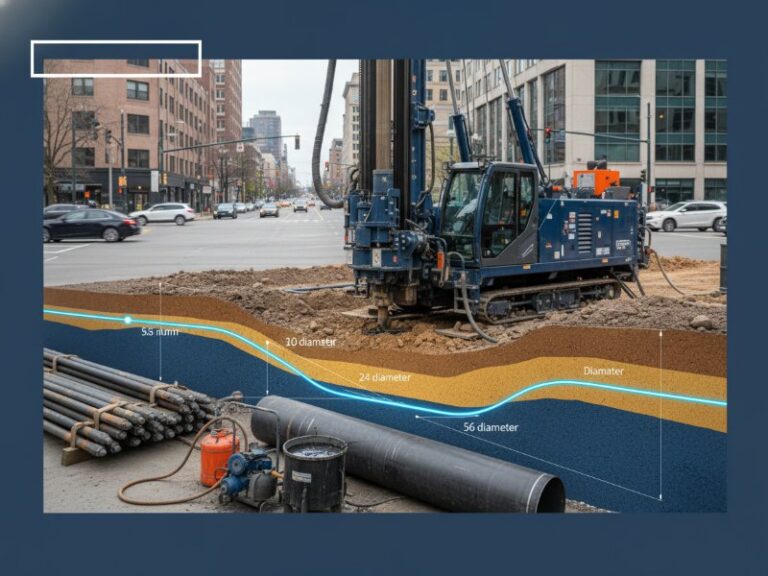
HDD drilling cost for pipeline projects typically ranges from $10 to $30 per linear foot for base drilling, while total installed cost often lands between $20 and $75 per linear foot depending on soil, pipe diameter, bore length, and site conditions. Urban crossings, rock formations, and deep bores can push costs higher, especially when restoration, permitting, and disposal are included.
Quick Cost Reference
Base drilling rate by soil type
| Soil condition | Base cost per linear foot | Typical production rate |
|---|---|---|
| Soft clay or sand | $8–$12 | 200–250 ft/day |
| Stiff clay or dense sand | $12–$18 | 150–200 ft/day |
| Mixed ground or gravel | $18–$30 | 120–180 ft/day |
| Weathered rock | $25–$40 | 100–150 ft/day |
| Hard rock such as granite or basalt | $40–$75 | 80–120 ft/day |
Soil conditions are one of the biggest cost drivers because harder formations slow production, increase tooling wear, and raise the risk of downtime.
Diameter multiplier by pipe size
| Pipe diameter | Diameter multiplier | Typical reaming passes |
|---|---|---|
| 2–4 inches | 0.7x | 1–2 |
| 6–8 inches | 1.0x | 2–3 |
| 10–12 inches | 1.5x | 3–4 |
| 16–20 inches | 2.2x | 4–5 |
| 24–30 inches | 3.0x | 5–6 |
| 30–48 inches | 4.0x–5.0x | 6–8 |
Larger diameters require more reaming, more drilling fluid, and more pullback force, which increases both time and cost.ndl.
Why Costs Change
Ground conditions and pipe diameter usually explain most of the price variation in HDD work. A project in soft soil with a smaller pipe may be completed quickly with standard tooling, while a large-diameter pipeline through rock can require specialized equipment, slower advance rates, and more frequent tool changes.
Bore length also matters because mobilization costs are spread over the total distance, so short bores often have a higher cost per foot than medium-length projects. In contrast, longer runs can be more economical per foot if the site conditions remain stable and the bore geometry is efficient.
Hidden Costs To Budget
Base drilling is only part of the total project cost. A complete HDD budget should also include mobilization, fluids, utility locating, engineering, permitting, restoration, and contingency.
- Mobilization and demobilization: $2,000–$15,000.
- Drilling fluids and disposal: $3–$8 per linear foot.
- Potholing and utility locating: $500–$2,500 per day.
- Engineering and design: $2,000–$15,000.
- Permitting: $1,000–$10,000.
- Pipe material: varies widely by diameter and specification.
- Site restoration: $500–$5,000.
- Contingency: 15%–25% of total.
Drilling fluid management and unexpected ground conditions are especially common sources of overruns, so it is best to treat them as core budget items rather than optional extras.
How To Estimate Cost
Use this simple formula for a first-pass estimate:
Length × Base rate × Diameter multiplier = Base drilling cost
For example, a 1,500-foot bore through mixed ground with 16-inch pipe can be estimated like this:
- Base rate: $20/ft
- Length: 1,500 ft
- Diameter multiplier: 2.2x
That gives a base drilling estimate of $66,000 before adding mobilization, fluids, permitting, restoration, pipe material, and contingency.
For budgeting, this is the best way to avoid underestimating the total installed cost. Contractors usually provide more accurate fixed pricing after reviewing a geotechnical report and site conditions.
HDD Vs. Open Trench
HDD often has a higher drilling rate than open-cut excavation, but the total installed cost can be lower when surface restoration, traffic control, and environmental mitigation are considered. That is why HDD is often preferred for road crossings, wetland crossings, urban corridors, and other sensitive sites.
| Cost component | Open trench per 1,000 ft | HDD per 1,000 ft |
|---|---|---|
| Excavation or directional drilling | $8,000–$15,000 | $12,000–$25,000 |
| Trench shoring and safety | $3,000–$8,000 | $0 |
| Pavement removal and replacement | $15,000–$40,000 | $0–$5,000 |
| Traffic control and lane closures | $5,000–$20,000 | $1,000–$3,000 |
| Landscaping and restoration | $4,000–$12,000 | $500–$2,000 |
| Environmental mitigation | $2,000–$10,000 | $500–$2,000 |
| Total installed cost | $37,000–$105,000 | $14,000–$37,000 |
Open trench may still be cheaper for very short runs in open farmland or undeveloped land with no pavement, traffic, or restoration requirements. For developed areas, HDD usually offers a better total-cost outcome.
When HDD Is Best
HDD is especially effective for:
- Road and highway crossings.
- River and wetland crossings.
- Developed urban areas.
- Environmentally sensitive sites.
- Railroad crossings.
- Projects with high restoration standards.
These are the situations where trenchless installation often saves the most money and reduces disruption.
What To Ask Contractors
To compare bids properly, ask each contractor to itemize:
- Base drilling rate by soil class.
- Mobilization and demobilization fee.
- Fluid cost and disposal method.
- Number of reaming passes included.
- Potholing cost per location.
- Permit responsibility.
- Restoration responsibility.
- Daily production estimate.
- Overage rate for worse-than-expected ground.
- Insurance and railroad crossing coverage.
Transparent bid items make it much easier to compare offers on an apples-to-apples basis.
FAQ
What is the average HDD cost per foot for a gas pipeline?
For 4–6 inch gas distribution lines, base drilling rates often fall around $12 to $25 per foot, with total installed cost usually higher once pipe, permits, and restoration are added.
How much does directional drilling cost for a water main?
For 8–12 inch water mains, base rates often range from $15 to $30 per foot, while total installed cost can reach $35 to $70 per foot depending on soil and site restoration.
Is HDD cheaper than open trench for long distances?
Often yes in developed areas, because the savings from reduced restoration and traffic management can outweigh the higher drilling cost.
What is the biggest hidden cost in HDD projects?
Drilling fluid disposal and unexpected rock are two of the most common budget risks, and both can materially increase project cost.
Can I get a fixed price for an HDD project?
Usually only after a contractor reviews a geotechnical report and site conditions. Without soil data, bids are often estimates with change provisions.










 English
  Arabic
  Russian
  Spanish
  French
  Vietnamese
  Polish
  Thai
Thai  Indonesian
  Turkish
  Portuguese