
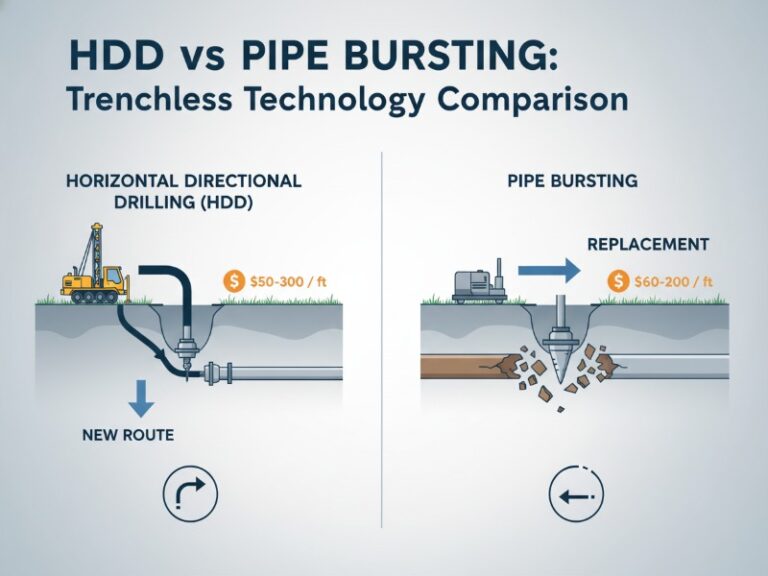
HDD vs pipe bursting costs range from $50-300/ft vs $60-200/ft depending on project type, soil conditions, and pipe diameter. Use this guide to understand when to choose HDD vs pipe bursting for your trenchless project. The core decision hinges on one factor: are you installing a new pipe on a custom path, or replacing a failing pipe along its existing alignment? Choose HDD for the former; choose pipe bursting for the latter. This comparison breaks down real-world costs, site-specific limitations, and technical trade-offs. Both methods avoid the destruction of open-trench excavation, but they operate on fundamentally different engineering principles.
Quick Decision Guide: HDD vs Pipe Bursting
This framework filters methods based on your project’s non-negotiable constraints.
| Condition | Recommended Method |
|---|---|
| ✅ New route needed, no existing pipe | Horizontal Directional Drilling (HDD) |
| ✅ Obstacle avoidance (river, highway) | Horizontal Directional Drilling (HDD) |
| ✅ Replacing a damaged existing pipe | Pipe Bursting |
| ✅ Pipe capacity upgrade on same alignment | Pipe Bursting |
| ❌ Unstable soil, hard rock, no geotech data | Avoid HDD |
| ❌ No existing host pipe available | Avoid Pipe Bursting |
How HDD Works
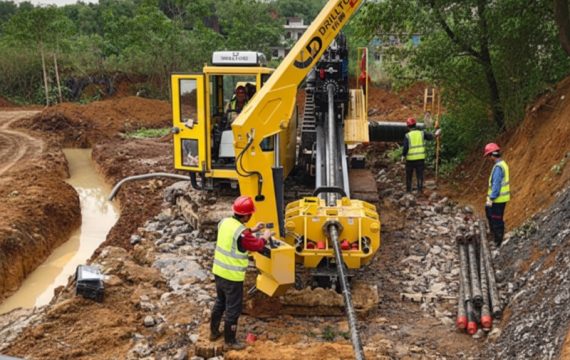
Horizontal Directional Drilling creates a new borehole along a steered path, making it ideal for custom routes where no previous utility exists. The process proceeds in three stages. A pilot bore launches with a steerable drill head tracked precisely from the surface. A reamer then enlarges the hole to approximately 1.2 to 1.5 times the product pipe diameter. Finally, the new pipe string is pulled into the enlarged bore. Drilling fluid transports cuttings and stabilizes the borehole wall. If fluid pressure exceeds the soil’s confining capacity, a frac-out occurs, creating an environmental liability requiring rigorous monitoring.
How Pipe Bursting Works
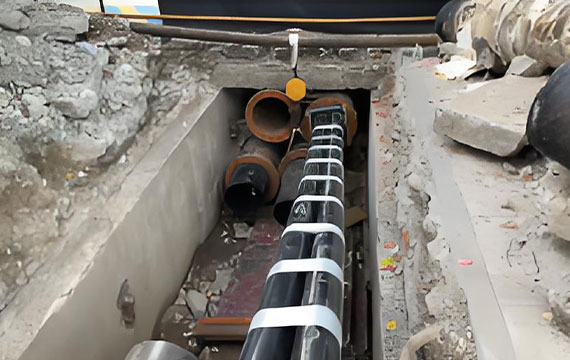
Pipe bursting uses the existing pipe path, fracturing the host pipe while pulling new HDPE into the same location. A bursting head, either a static splitter for brittle materials like clay or cast iron, or a pneumatic hammer for more ductile pipes, is pulled through the old line. High radial force breaks the host pipe outward, embedding fragments into surrounding soil. The new High-Density Polyethylene pipe follows the head directly into the void. This method requires access pits at both ends but eliminates extensive excavation between them. Pipe bursting saves 30-50% compared to open-cut replacement by removing trenching cost entirely, but it always requires an existing pipe to function as a guide.
Cost Comparison: HDD vs Pipe Bursting
The cost differential between HDD and pipe bursting depends on more than a per-foot rate. Mobilization, soil conditions, and surface restoration all shift the final invoice. HDD cost overruns most frequently trace back to unexpected ground conditions and drilling fluid management failures. Pipe bursting costs escalate when the existing host pipe contains unexpected repairs, concrete encasement, or collapsed sections.
| Cost Factor | HDD Cost Range | Pipe Bursting Cost Range |
|---|---|---|
| Per Foot (Length-Dependent) | $50 – $300 | $60 – $200 |
| Small Residential Project | $4,000 – $10,000 | $3,000 – $12,000 |
| Urban Mainline Replacement | $20,000 – $50,000+ | $15,000 – $40,000 |
| Primary Cost Driver | Length, diameter, soil hardness | Access pit complexity, host pipe condition |
| Typical Cost Overrun Cause | Frac-out remediation, tool wear in rock | Unplanned repairs to encased or collapsed sections |
| Note | Varies by soil and geology | Requires existing pipe |
Soil Compatibility: HDD vs Pipe Bursting
Ground conditions dictate whether a trenchless project remains profitable or spirals into delays. The HDD vs pipe bursting decision often hinges entirely on the geotechnical report.
HDD Soil Compatibility
HDD performs best in stable, cohesive soils like medium-to-stiff clays. These materials provide good borehole stability and respond predictably to drilling fluid pressure. Loose sands and gravels present significant challenges; maintaining an open borehole requires specialized drilling fluid additives and constant pressure monitoring. Hard rock reduces penetration rates severely and accelerates tooling wear, driving per-foot costs toward the top of the stated range. No HDD project should proceed without comprehensive geotechnical investigation; skipping this step accounts for the majority of budget overruns.
Pipe Bursting Soil Compatibility
Pipe bursting is more tolerant of varied soil conditions because the expanding action compacts and displaces soil rather than requiring a stable open bore. The critical variable is the condition of the existing host pipe. Point repairs with ductile materials, concrete encasements, or severely collapsed sections can stall the bursting head and require rescue excavation. Ground heave becomes a risk in shallow installations under rigid pavements; upward pressure from the bursting process can lift the road surface if cover depth is insufficient.
Best Use Cases: HDD vs Pipe Bursting
Both methods have operational theaters where they clearly dominate. Matching the method to the scenario prevents costly mid-project pivots.
Urban Utility Upgrades
In dense city corridors, pipe bursting offers a distinct advantage because it follows the known, already-ticketed path of the failing utility. The HDPE pipe occupies the exact same location, eliminating the risk of striking unmapped adjacent lines that plagues HDD operators in congested rights-of-way. HDD becomes necessary when the project requires a completely new service connection where no pipe exists, or when the design demands a significant alignment change.
Environmental and Obstacle Crossings
For river crossings, highway underpasses, and wetland installations, HDD is the standard approach. The ability to steer the drill path well below the environmentally sensitive zone, combined with precise depth control, makes it acceptable to regulators for high-stakes applications. Pipe bursting is rarely used in these scenarios unless a specific, existing crossing pipe has failed and must be replaced in-place.
Capacity Upgrades
Pipe bursting inherently supports a volumetric upsize. Replacing a deteriorated 4-inch clay sewer lateral with a smooth 6-inch HDPE line increases flow capacity while reducing infiltration. HDD offers greater flexibility for larger diameter changes since the borehole diameter is designed from scratch, but larger bores require more powerful rigs and larger work areas.
Common Risks and Limitations
Both trenchless methods carry inherent risks that honest project planning must address.
For HDD, the primary environmental risk is frac-out, when drilling fluid escapes to the surface through fractures in overlying soil. This is particularly dangerous in waterway crossings where bentonite release can damage aquatic ecosystems. Mechanical risk centers on tooling wear in hard or abrasive formations.
For pipe bursting, the main structural risk is incomplete fragmentation. If the host pipe does not fully fracture, the new HDPE line can be damaged during pull-in or constrained in ways that create stress points. Surface heave is the primary liability concern; shallow installations under paved roads or near building foundations require careful depth assessment.
Frequently Asked Questions
Q: What is the cost difference between HDD and pipe bursting?
A: HDD typically ranges from $50 to $300 per foot, while pipe bursting ranges from $60 to $200 per foot. Total project cost depends heavily on length, diameter, and soil conditions. A typical small residential project costs $4,000–$10,000 for HDD and $3,000–$12,000 for pipe bursting.
Q: Can pipe bursting increase pipe diameter?
A: Yes, pipe bursting can typically upsize a pipe by one to two nominal sizes. HDD offers more flexibility for larger diameter changes because the borehole is designed to the required dimensions from the start.
Q: Is HDD or pipe bursting better for rocky soil?
A: Pipe bursting generally handles rocky soil conditions better because the bursting process compacts and displaces material rather than requiring a stable open borehole. HDD in hard rock faces significantly reduced penetration rates and elevated tooling costs.
Q: Is HDD cheaper than pipe bursting?
A: Not consistently. At the per-foot level, pipe bursting is often less expensive, but the total cost equation includes mobilization, pit excavation, and surface restoration. For projects where a new route is required, HDD is the only available trenchless option, making the per-foot comparison irrelevant.
Q: What licenses or safety certifications are required for trenchless projects?
A: Both HDD and pipe bursting operations typically require utility locates before work begins, adherence to OSHA excavation safety standards, and operator training certifications. Specific licensing requirements vary by municipality and project type.









 English
  Arabic
  Russian
  Spanish
  French
  Vietnamese
  Polish
  Thai
Thai  Indonesian
  Turkish
  Portuguese