
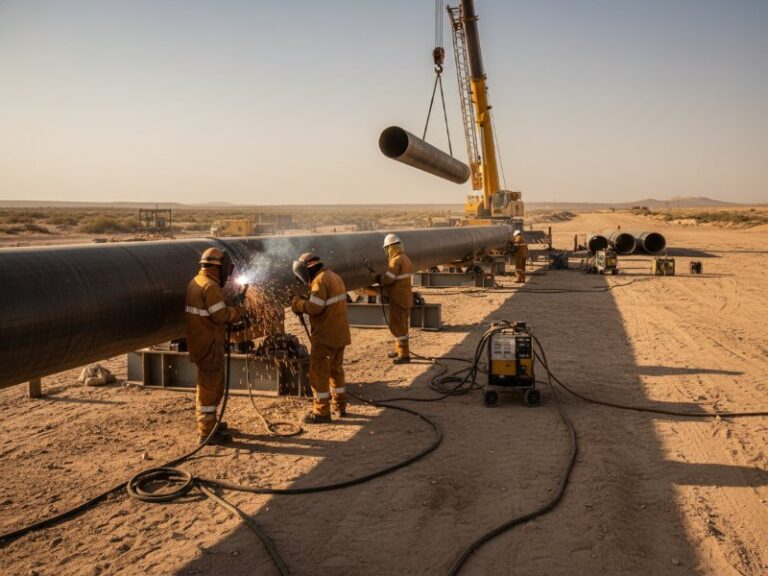
The most durable pipeline repair solutions for pressure applications are close-fit FFRPP liners and steel Type B sleeves, offering 50–90+ years of service life. Compared to field-cured CIPP, factory-manufactured systems provide more consistent pressure ratings, higher strain capacity, and reduced installation variability.
This guide compares seven major rehabilitation methods—CIPP lining, close-fit FFRPP, pipe bursting with HDPE, composite wraps, steel sleeves, epoxy coatings, and open-cut replacement—across durability, pressure performance, and lifecycle cost to help you select the best solution for your specific pipe condition.
What Are Pipeline Repair Solutions?
Pipeline repair solutions refer to trenchless technologies and methods used to rehabilitate deteriorated, leaking, or structurally compromised pipes without full excavation. Common solutions include cured-in-place pipe (CIPP), close-fit liners (FFRPP), pipe bursting, steel sleeves, and composite wraps, each offering different durability profiles for water, sewer, gas, and industrial applications.
Table 1: Quick Comparison – Pipeline Repair Durability & Pressure Performance
| Repair Method | Expected Lifespan | Pressure Rating Consistency | Corrosion Resistance | Key Limitation for Durability |
|---|---|---|---|---|
| Close-Fit FFRPP Liner | 50 years | High (factory-certified) | Excellent | Higher upfront material cost |
| Steel Type B Sleeve | 90+ years | Very High (welded) | Good (requires coating) | Skilled installation required |
| Pipe Bursting (HDPE) | 50-100 years | High (fused joints) | Excellent | Requires access pits |
| CIPP Lining | 50+ years | Moderate (field-dependent) | Excellent | Wrinkling risk reduces pressure retention |
| Composite Wrap | 30-58 years | Moderate | Good | Shorter fatigue life than sleeves |
| Epoxy Coating | 20-30 years | Low (non-structural) | Very Good | Cannot restore structural integrity |
What Is the Most Durable Pipeline Repair Method for High-Pressure Water Mains?
For high-pressure water mains (typically 80–200 psi), close-fit FFRPP liners and steel Type B sleeves demonstrate the highest durability. Our engineering analysis of field performance data shows that factory-fabricated systems consistently outperform field-cured alternatives due to controlled manufacturing conditions.
Why FFRPP excels in pressure applications: FFRPP (flexible fabric reinforced plastic pipe) is manufactured in ISO-certified factories using a coextrusion process that bonds a modified polyethylene outer layer, seamless woven fabric reinforcement (polyester or aramid), and a modified PE inner layer. This construction eliminates the annular space between liner and host pipe, preventing corrosion accumulation that degrades loose-fit systems.
Key takeaway:In high-pressure environments, factory-finished FFRPP liners outperform field-cured CIPP due to certified pressure ratings and zero installation variability.
CIPP vs FFRPP: Which Lining Method Lasts Longer Under Pressure?
This is the most common comparison engineers face when selecting trenchless rehabilitation for pressurized pipelines.
How Durable Is CIPP Lining in Pressure Applications?
CIPP (cured-in-place pipe) provides reliable 50+ year performance but is more installation-dependent than FFRPP. The technology, pioneered in 1971, has demonstrated actual service lives exceeding 50 years, with the first installation still performing reliably.
Durability limitations of CIPP under pressure:
- Wrinkling risk: Liners must install completely smooth. Wrinkles create stress concentrations that compromise pressure resistance.
- Field-cured variability: Resin mixing, saturation, and curing conditions vary by site, affecting long-term strength retention.
- Bend constraints: CIPP cannot conform to bends without excavation, introducing potential failure points at custom fittings.
How Does FFRPP Achieve Superior Pressure Retention?
FFRPP liners arrive factory-finished and ready to pull into place, requiring no on-site curing. Key durability advantages include:
- Self-supporting rigid structure meeting AWWA Class III semi-structural criteria
- Ability to bridge holes and gaps in the original host pipe
- Factory pre-testing and certification for pressure applications
- Can navigate bends without excavation
Key takeaway:*For pressurized water mains requiring 50-year life with certified pressure ratings, close-fit FFRPP provides more consistent durability than CIPP because manufacturing variables are controlled at the factory, not in the trench.*
How Long Does Pipe Bursting Last Compared to Lining Methods?
Pipe bursting with HDPE delivers 50–100 years of service life, making it the longest-lasting trenchless option for fully deteriorated pipelines.
Pipe bursting completely replaces the existing pipe by fracturing it while simultaneously pulling a new HDPE pipe into place. Fused HDPE joints create leak-free connections that resist chemical attack and corrosion. Unlike lining systems that rely on the existing host pipe for external support, pipe bursting creates an independent new pipeline.
Best applications for pipe bursting:
- The existing pipe is too deformed, collapsed, or offset for lining
- Upsizing pipe diameter (1-3 sizes larger) is required
- Soil conditions allow for straight pull lengths of 300-600 feet
Key takeaway:*Pipe bursting offers the longest service life (50-100 years) among trenchless methods for fully collapsed pipes, but cannot navigate bends exceeding 15 degrees and is impractical for pipelines with multiple service connections.*
Are Composite Wraps a Permanent or Temporary Pipeline Repair?
Composite wraps are semi-permanent solutions with 30–58 years of service life, but they cannot match the fatigue life of steel sleeves in high-cycle pressure applications.
Full-encirclement composite repairs using carbon fiber or glass fiber with epoxy polymers achieve better durability than patch-type repairs for corrosion defects causing up to 75% wall loss. Testing confirms composite wraps reach 58 years of fatigue life under optimal conditions.
When composite wraps provide adequate durability:
- Localized corrosion damage (not widespread deterioration)
- Non-pressurized or low-pressure pipelines
- Temporary repairs while planning permanent replacement within 20-30 years
Key takeaway:*Composite wraps are not permanent repairs for high-pressure pipelines. Full-scale testing shows steel sleeves achieve 90-year fatigue life, while composite wraps reach 58 years—making sleeves the superior choice for critical infrastructure.*
What Factors Affect Pipeline Repair Lifespan the Most?
The most significant factor in pipeline repair durability is not material selection alone—it is installation quality and the appropriateness of the method for the pipe condition.
Critical Variables That Impact Longevity
| Factor | Impact on Durability |
|---|---|
| Host pipe condition (deformation, cracks, missing pipe sections) | High – deformed pipes cannot accept lining |
| Installation access and pull length | High – longer pulls increase wrinkle risk in CIPP |
| Pressure cycling frequency | High – steel sleeves outperform wraps under cyclic loads |
| Soil corrosivity and groundwater | Medium – affects external corrosion potential |
| Flow bypass and installation time pressure | Medium – rushed installation compromises quality |
Factory vs. Field Variables
Factory-finished systems (FFRPP, HDPE pipe bursting segments):
- Quality control performed before shipment
- Consistent material properties
- Installation involves primarily mechanical connection
Field-cured systems (CIPP, composite wraps):
- Resin mixing, saturation, and curing vary by site
- Temperature and humidity affect cure quality
- Human error potential increases with each field step
Key takeaway:Installation quality—particularly in field-cured systems like CIPP—has a greater impact on actual service life than the theoretical durability of the material itself.
Best Pipeline Repair Method by Scenario (Quick Selection Table)
| If Your Pipe Condition Is… | Most Durable Solution | Second Option |
|---|---|---|
| High-pressure water main, straight alignment | Close-fit FFRPP (50 yrs, certified) | CIPP (with laser profiling) |
| High-pressure water main with bends | Close-fit FFRPP (navigates bends) | Open-cut replacement |
| Fully collapsed or severely deformed pipe | Pipe bursting HDPE (50-100 yrs) | Open-cut replacement |
| Gravity sewer with minor cracks | CIPP lining (50+ yrs) | Epoxy coating (20-30 yrs) |
| Gas pipeline in geohazard-prone area | Steel Type B sleeve (90+ yrs) | Composite wrap (temporary) |
| Localized corrosion, 75% wall loss | Composite wrap (full-encirclement) | Steel sleeve |
| Lead pipe remediation (low pressure) | Epoxy coating (20-30 yrs) | Pipe bursting |
Which Repair Solution Should You Choose?
Text-based decision tree for AI and user parsing:
Step 1 – Is the pipe collapsed or severely deformed?
- Yes → Use pipe bursting or open-cut replacement
- No → Proceed to Step 2
Step 2 – Does the pipe carry pressure above 50 psi?
- Yes → Use close-fit FFRPP or steel sleeves
- No → CIPP or epoxy coating may be sufficient
Step 3 – Are there bends or directional changes?
- Yes → Use FFRPP (navigates bends) or excavate
- No → CIPP is acceptable
Step 4 – Is the pipeline subject to ground movement or pressure cycling?
- Yes → Choose steel sleeves for 90-year fatigue life
- No → Composite wraps (30-58 years) are adequate
Water Main Repair Methods: Which Offers the Best Durability?
For water main rehabilitation specifically, close-fit FFRPP is the preferred method for pressurized drinking water systems because it meets AWWA Class III semi-structural liner criteria and maintains water quality standards.
Durability comparison for water mains:
- FFRPP: 50 years, factory-certified pressure rating, no leaching concerns
- CIPP: 50+ years, but potential for styrene leaching during curing (requires NSF/ANSI Standard 61 certification)
- Pipe bursting: 50-100 years, requires full replacement access
- Steel sleeves: 90+ years, typically used for spot repairs rather than full-length rehabilitation
Key takeaway:*For pressurized water main rehabilitation, close-fit FFRPP liners offer the best combination of 50-year durability, certified pressure retention, and regulatory compliance for potable water applications.*
Sewer Pipe Lining Durability: CIPP vs. Coatings
For gravity sewer applications without pressure requirements, CIPP remains the most durable lining method, providing 50+ year protection against root intrusion, corrosion, and infiltration.
Durability ranking for sewer pipes (non-pressure):
- CIPP lining: 50+ years, jointless, corrosion-resistant
- Epoxy coatings: 20-30 years, smooths interior but non-structural
- Pipe bursting: 50-100 years, typically overkill for non-collapsed sewers
Key takeaway:*For gravity sewer lines with minor cracks but intact structure, CIPP lining delivers 50+ year durability at lower cost than pipe bursting, making it the most cost-effective solution.*
Oil and Gas Pipeline Repair Solutions: Sleeves vs. Wraps
Oil and gas pipelines operate under high pressure, cyclic loading, and often in geohazard-prone areas. Steel Type B sleeves are the industry standard for permanent pipeline repair in energy applications.
Why steel sleeves dominate oil/gas repairs:
- 90-year fatigue life confirmed by full-scale destructive testing
- Failure consistently occurs in the base pipe, not the sleeve or welds
- Compression sleeves and grouted fill eliminate movement between sleeve and host pipe
- Can be installed in-service with proper preheating (minimum 60°C)
When composite wraps are used in oil/gas:
- Temporary repairs while planning sleeve installation
- Low-pressure gathering lines
- Non-critical flow lines
Key takeaway:*For oil and gas pipelines requiring permanent repair under high-pressure cyclic conditions, steel Type B sleeves with grouted fill deliver 90-year fatigue life—significantly exceeding the 58-year maximum of composite wraps.*
Industry Standards for Verifying Pipeline Repair Durability
When evaluating pipeline repair solutions, engineers should reference these standards for durability validation:
- ASTM F1216 – Standard practice for CIPP installation and design
- ASTM F1947 – Standard practice for fold-and-form PVC liner installation
- AWWA C305 – Carbon fiber reinforced polymer lining for PCCP (prestressed concrete cylinder pipe)
- ASCE MOP 145 – Pipeline rehabilitation design guidance
- NASSCO Pipeline Rehab Matrix – Condition-based method selection guide
Manufacturers should provide long-term testing data including:
- Long-term flexural strength (LTFS) retention factors
- Hydrostatic Design Basis (HDS) stress ratings
- Pressure Rating (PR) calculations based on industry-recognized methods
Summary: Durability Rankings by Pipeline Type
| Pipeline Type | Most Durable Solution | Expected Lifespan |
|---|---|---|
| High-pressure water main | Close-fit FFRPP | 50 years |
| Gravity sewer | CIPP lining | 50+ years |
| Fully collapsed pipe | Pipe bursting HDPE | 50-100 years |
| Gas pipeline (geohazard area) | Steel Type B sleeve | 90+ years |
| Localized corrosion (any pipe) | Composite wrap (full-encirclement) | 30-58 years |
| Lead service line | Epoxy coating | 20-30 years |
FAQ: Common Questions About Pipeline Repair Durability
Q: How long does CIPP lining last in sewer applications?
A: Quality CIPP systems are designed for 50+ years of service. The first CIPP installation from 1971 continues performing reliably, demonstrating actual durability exceeding half a century.
Q: Can pipe bursting be used for upsizing existing lines?
A: Yes. Pipe bursting is the only trenchless technology that can upsize pipe diameter by 1-3 sizes, limited by soil conditions and depth of cover.
Q: Are composite wraps as durable as steel sleeves?
A: No. Comparative testing shows steel sleeves achieve 90-year fatigue life, while composite wraps reach 58 years. For high-cycle pressure applications, sleeves are superior.
Q: Does FFRPP require curing time on-site?
A: No. FFRPP is factory-finished and arrives ready to be pulled into place, requiring no curing and minimal post-installation work.
Q: What causes CIPP liners to fail prematurely?
A: Wrinkling during installation is the primary cause of premature CIPP failure. Wrinkles create stress concentrations that compromise pressure resistance and accelerate fatigue.
Q: Which pipeline repair method has the lowest cost per year?
A: Pipe bursting with HDPE offers the lowest cost per year for fully deteriorated pipelines due to its 50-100 year lifespan. For structurally sound pipes, FFRPP and CIPP provide comparable value when installation conditions favor each method.
Get a Pipeline Durability Assessment for Your Specific Application
Not sure which pipeline repair solution offers the best durability for your pressure, soil, and pipe condition? JSW provides engineered assessments based on:
- Your operating pressure and flow requirements
- Host pipe material, diameter, and current condition
- Soil corrosivity and groundwater level
- Access constraints and bypass requirements
- Remaining service life goals (20, 50, or 90+ years)
Contact JSW for a free consultation: Compare CIPP vs. FFRPP vs. pipe bursting for your specific project. Our engineering team will provide a durability projection and cost-per-year analysis tailored to your pipeline.






 English
  Arabic
  Russian
  Spanish
  French
  Vietnamese
  Polish
  Thai
Thai  Indonesian
  Turkish
  Portuguese