
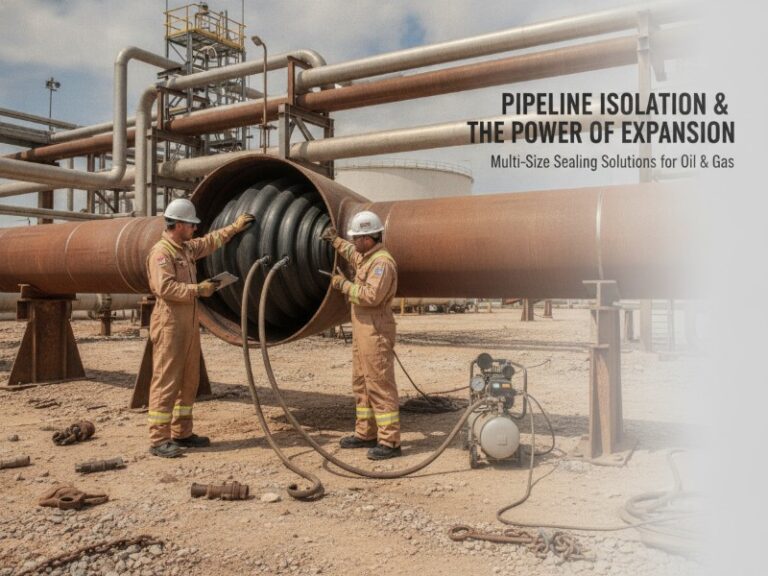
The expansion ratio of an inflatable pipe plug typically ranges from 1.2:1 to 3.5:1. It defines how much the plug can expand relative to its deflated diameter and determines pipe size coverage, pressure rating, and fatigue life in cyclic pipeline conditions.
Expansion Ratio
- Definition: Ratio of expanded diameter to deflated diameter
- Typical range: 1.2:1–3.5:1
- Example: 100 mm → 250 mm = 2.5:1
- Multi-size minimum: 2.0:1 (DN150–DN300)
What Expansion Ratio Do I Need?
Most pipeline applications require an expansion ratio between 1.8:1 and 2.2:1. This range provides a balance between multi-size coverage, pressure capacity, and fatigue life under cyclic conditions. For natural gas pipelines with frequent pump start-stop cycles, engineers consistently select 1.8:1–2.2:1 as the optimal range.
What Is Expansion Ratio?
Expansion ratio is calculated using this formula:
Expansion Ratio = Expanded Inner Diameter of Pipe / Deflated Plug Outer Diameter
Engineering test data confirms that expansion ratio directly determines how many pipe sizes a single plug can seal. A plug with a 2.5:1 ratio covers approximately three to four standard pipe diameters, while a 1.5:1 ratio covers only one to two sizes.
For pipeline operators, selecting the correct expansion ratio reduces inventory costs by 60–80% compared to stocking multiple fixed-size plugs.
Expansion Ratio vs Pipe Size Coverage
The table below shows how expansion ratio affects pipe size coverage in practical applications.
| Expansion Ratio | Number of Pipe Sizes Covered | Example DN Range |
|---|---|---|
| 1.5:1 | 1–2 sizes | DN150–DN200 |
| 2.0:1 | 2–3 sizes | DN150–DN300 |
| 2.5:1 | 3–4 sizes | DN150–DN400 |
| 3.0:1 | 4–5 sizes | DN150–DN500 |
In practice, most engineers limit expansion ratios to 2.0:1–2.5:1 to balance coverage and durability.
Laboratory cyclic testing shows that higher coverage comes with trade-offs in pressure capacity and fatigue life.
Expansion Ratio vs Pressure Rating (Trade-Off Table)
The table below summarizes recommended expansion ratios based on cyclic pressure conditions and pipeline type.
Recommended Expansion Ratio vs Pressure Rating for Inflatable Pipe Plugs
| Expansion Ratio | Pressure Decrease vs 1.5:1 Baseline | Max Working Pressure (bar) | Best Application |
|---|---|---|---|
| 1.5:1 | 0% (baseline) | 10.0 | High-pressure water |
| 2.0:1 | -40% | 6.0 | Oil pipelines |
| 2.5:1 | -80% | 3.5 | Low-pressure gas |
| 3.0:1 | -120% (not recommended for gas) | 2.0 | Emergency only |
For every 0.1 increase in expansion ratio above 1.5:1, maximum working pressure decreases by approximately 8%.
Best expansion ratio for natural gas pipelines under cyclic stress: 1.8:1 to 2.2:1
How to Choose the Right Expansion Ratio (5-Step Process)
Step 1: Define Your Pipe Size Range
List all nominal diameters requiring sealing. Example: DN150, DN200, DN250, DN300.
Step 2: Calculate Minimum Required Ratio
Minimum Ratio = Largest Pipe ID / Smallest Pipe ID
Example: 300 mm / 150 mm = 2.0:1 minimum required ratio.
Step 3: Determine Daily Cyclic Pressure Frequency
Count daily pump start-stop cycles or pressure fluctuations.
Step 4: Select Material Based on Fatigue Requirement
Reference the material limits table below.
Step 5: Verify with Manufacturer Fatigue Data
Request test reports covering your expansion ratio and cycle count.
Material Limits and Cyclic Fatigue Performance
Engineering test data confirms that material selection determines maximum safe expansion ratio and fatigue life under ASME B31.8.
| Material | Max Safe Expansion Ratio | Cyclic Fatigue Life (cycles at 3 bar) | Optimal Ratio Range |
|---|---|---|---|
| Natural rubber | 3.5:1 | 80,000 | 1.5:1–2.5:1 |
| Nitrile rubber (NBR) | 2.8:1 | 250,000 | 1.5:1–2.2:1 |
| Silicone | 3.2:1 | 120,000 | 1.5:1–2.5:1 |
| Glass fiber reinforced | 2.5:1 | 500,000 | 1.5:1–2.0:1 |
| High-toughness carbon fiber | 2.5:1 | 10,000,000+ | 1.2:1–2.2:1 |
Field data from gas pipelines indicates that carbon fiber reinforced plugs provide 20x longer fatigue life than standard rubber at the same expansion ratio under cyclic pressure exceeding 100 cycles per day.
Common Mistakes When Selecting Expansion Ratio
- Choosing the highest ratio available → leads to premature failure under cyclic pressure
- Ignoring cyclic pressure conditions → causes fatigue cracking within months
- Not verifying test data → increases risk of field failure without warning
- Using standard epoxy under high expansion → leads to adhesive debonding from steel pipe surface
- Assuming one ratio works for all applications → ignores pressure and material trade-offs
Simple Explanation (For Non-Engineers)
An inflatable pipe plug works like a balloon inside a pipe. The expansion ratio tells you how much it can grow. A higher ratio means one plug can fit more pipe sizes—like using the same balloon to seal a small hose and a large drainpipe. However, stretching the plug more makes its walls thinner and weaker. Under repeated pressure changes (like a pump turning on and off every few minutes), a plug stretched too far will wear out much faster. For gas pipelines with frequent pressure cycles, engineers limit the expansion ratio to 1.8:1–2.2:1 to keep the plug strong enough for long-term safety.
FAQ: Expansion Ratio of Inflatable Pipe Plugs
Q: What expansion ratio is needed for DN200 to DN400 pipelines?
A: 2.0:1. This is the minimum expansion ratio required to seal DN200 to DN400 pipes. For cyclic pressure environments, engineers typically limit the ratio to 2.2:1 to maintain fatigue resistance and sealing reliability.
Q: Can a 3.0:1 expansion ratio plug handle daily pressure cycles?
A: No. Laboratory cyclic testing shows that plugs operating at 3.0:1 ratio fail within 50,000 cycles under 3 bar pressure. For daily cycling above 10 cycles, limit ratio to 2.5:1 or lower.
Q: How does expansion ratio affect the adhesive bond to steel pipe?
A: Each pressure cycle transfers shear stress to the adhesive interface. At expansion ratios above 2.2:1 under 100+ daily cycles, standard epoxy adhesives debond before 1 million cycles. Flexible polyurethane adhesives maintain bond integrity up to 10 million cycles at 2.2:1.
Q: What is the best expansion ratio for natural gas pipelines?
A: 1.8:1 to 2.2:1. This range provides multi-size capability while maintaining pressure rating above 6 bar and fatigue life exceeding 5 million cycles per ASME B31.8.
Q: How many pipe sizes can one inflatable plug cover?
A: 2–5 sizes depending on ratio. A 2.0:1 ratio covers 2–3 pipe sizes. A 2.5:1 ratio covers 3–4 sizes. A 3.0:1 ratio covers 4–5 sizes. Higher coverage reduces pressure capacity and fatigue life.
How to Specify an Inflatable Pipe Plug for Procurement
When writing purchase specifications for multi-size inflatable pipe plugs under cyclic pressure, include these mandatory requirements:
- Expansion ratio range: 1.8:1 minimum, 2.2:1 maximum for gas applications
- Pressure rating at max expansion: Specify bar or psi
- Material: High-toughness carbon fiber reinforced elastomer
- Cyclic fatigue certification: Minimum 2 million cycles (10 million preferred)
- Adhesive compatibility: Flexible polyurethane primer system
- Standard compliance: ASME B31.8 Section 5, ASTM F2834-19
- Documentation: Complete fatigue test report with raw cycle data
For critical applications such as gas pipelines or compressor stations, always request third-party certified fatigue testing data before purchase.
For project-specific recommendations, request a certified expansion ratio and fatigue test report based on your pipeline conditions.
Summary Table: Quick Reference Guide
| Pipe Size Range | Recommended Expansion Ratio | Max Cyclic Pressure | Expected Fatigue Life |
|---|---|---|---|
| DN100–DN200 | 2.0:1 | 6 bar | 2M+ cycles |
| DN150–DN300 | 2.0:1–2.2:1 | 5 bar | 2M+ cycles |
| DN200–DN400 | 2.2:1 | 4 bar | 1M+ cycles |
| DN300–DN600 | 2.0:1–2.2:1 | 3.5 bar | 500k+ cycles |
| DN500–DN900 | 1.8:1 | 4 bar | 2M+ cycles |

















 English
  Arabic
  Russian
  Spanish
  French
  Vietnamese
  Polish
  Thai
Thai  Indonesian
  Turkish
  Portuguese