
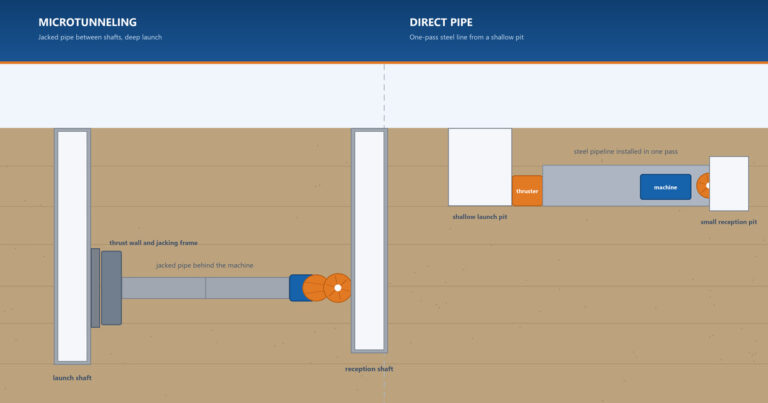
The microtunneling vs direct pipe choice is decided by the ground and the pipe, not by preference. Direct Pipe bores and installs a steel pipeline in one pass with only static pressure in the hole, so it handles unstable and mixed ground with a low blowout risk; microtunneling holds a tighter line and grade but needs deeper shafts and a supported face.
Direct Pipe and microtunneling are the two methods most often weighed against each other when a crossing passes through difficult ground without deep shafts. Direct Pipe excavates and installs the pipe in a single pass behind a pipe thruster, while microtunneling excavates behind a supported face and jacks a pipe between shafts. This guide compares them on ground compatibility, thrust and drive length, shafts and footprint, blowout and borehole support, cutter access and cost, so the choice follows the geology.
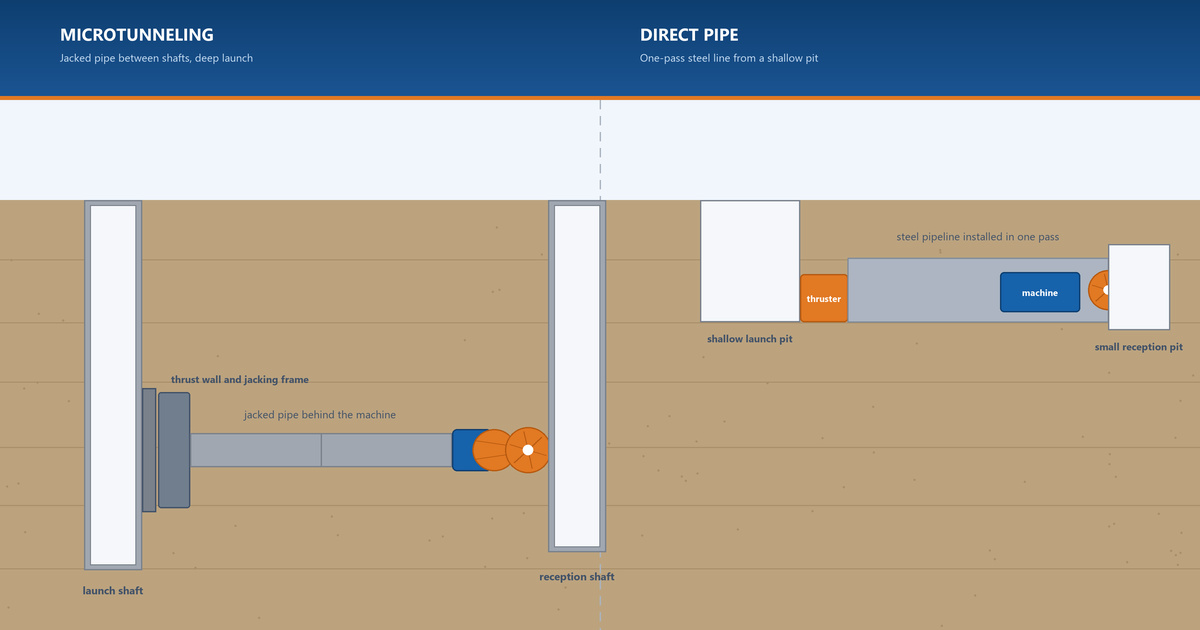
Which Method Handles Difficult Ground Better?
There is no single winner. Direct Pipe is stronger where the ground is variable, the crossing is long, or deep shafts are impractical; microtunneling is stronger where the line must hold a tight grade, the diameter is modest, and shafts can be built safely.
The rest of this guide shows where each advantage comes from, so the decision follows the geotechnical report rather than habit.
Direct Pipe suits variable or long crossings where deep shafts are the main risk. Microtunneling suits consistent ground where the line must hold a gravity grade.
Microtunneling vs. Direct Pipe: What Is Direct Pipe, and Why Is It Different?
Direct Pipe pairs a closed-face tunnel boring machine with the product pipe itself. The machine is launched inside a steel pipeline, the bore is excavated ahead of it, and the same pipe is installed in one pass as the machine advances, pushed and pulled by a pipe thruster at the launch side. This page is the detailed comparison; the method-selection overviews link here.
Because the pipe is installed as the bore is made, the hole is supported by the pipe itself, giving borehole support almost immediately. Typical Direct Pipe outside diameters run from 24 to 60 in. (OD 610-1,524 mm), across soft soil, mixed ground and rock.
The method runs from a near-surface launch pit with a small reception pit rather than deep shafts, with the equipment concentrated on the launch side. That single-pass sequence makes the Direct Pipe method different from a jacked installation, where the pipe follows a machine that has already excavated the ground. For the wider method family, see what trenchless technologies are.

What Microtunneling Does Differently
Microtunneling is chosen for control: it holds a tight line and grade, and it pays for that with a supported face and a shaft at each end. It excavates behind that supported face – slurry pressure or an earth pressure balance – and jacks the pipe behind the machine, using a launch shaft and a reception shaft with a thrust wall and a jacking frame. The cuttings return to a separation plant at the surface.
The arrangement gives microtunneling its precision: the machine is guided continuously and the pipe follows it on a controlled line and grade. The trade-off is fixed site work – shafts at both ends, a surface plant and a spoil stream to manage, and access to the cutterhead limited by the pipe diameter.
Which Ground Suits Which Method?
Ground conditions, more than any other factor, separate the two methods: each struggles in a different soil, and a geotechnical report turns a preference into a defensible choice.
| Ground condition | Microtunneling | Direct Pipe |
|---|---|---|
| Soft to firm homogeneous soil | Suitable | Suitable |
| Running or water-bearing sand | Supported face works, but shaft excavation is the risk | Preferred: the installed pipe supports the bore at once |
| Soil and rock in one face | Difficult: cutterhead design and wear | Preferred: one machine crosses variable ground |
| Hard rock | Slow; cutter wear and intervention dominate | Possible with a suitable cutterhead on shorter crossings |
| Cobbles and boulders | Handles obstructions with the right head | One-pass installation avoids leaving an open bore |
| Long crossing with deep cover | Shaft depth and jacking force dominate | Preferred: single pass with no deep shafts |
In practice, the ground type decides the microtunneling vs direct pipe comparison: variable and unstable strata favour the Direct Pipe method, while consistent strata and a tight line favour microtunneling. Rock and soil-rock faces are judged here at method level only; the cutterhead and wear mechanism belongs to microtunneling in rock and mixed ground.
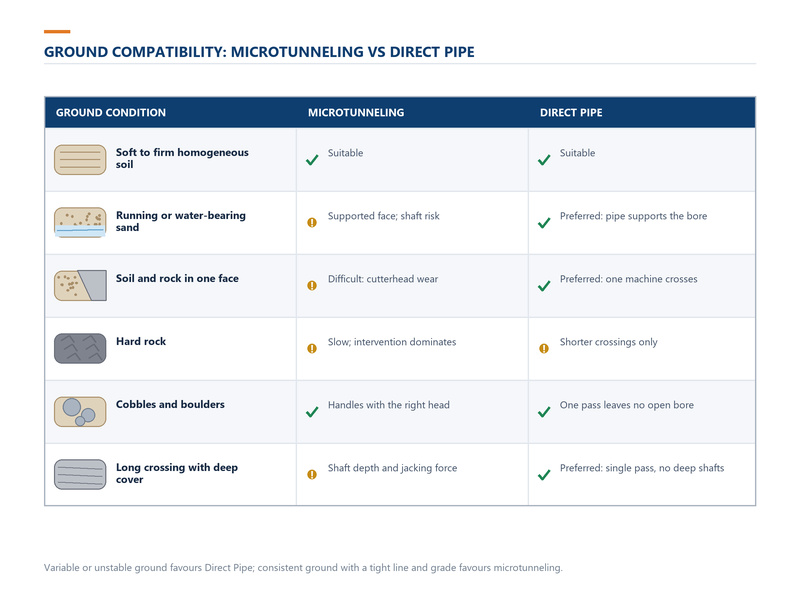
Bottom line: variable or unstable ground favours Direct Pipe; consistent ground with a tight line and grade favours microtunneling.
How Far Can Each Method Push?
In microtunneling, the pipe is pushed from a thrust wall in the launch shaft. Drive length is limited by jacking force, pipe compressive capacity and friction, and is extended on long drives by adding intermediate jacking stations. For a comparable HDD drive, see the maximum length and diameter for horizontal directional drilling.
Direct Pipe uses a thruster that both pushes and pulls the pipe string, so the force is applied through the installed pipe rather than against a shaft wall. Published project cases report roughly 550-1,100 t of combined push and pull across the 24-60 in. (OD 610-1,524 mm) envelope above. That figure is a published project case range, not a general guaranteed value: it moves with pipe diameter, geology and thruster unit configuration. A single-pass pull of that order is what allows long crossings in ground that will not stand open.
| Parameter | Microtunneling | Direct Pipe |
|---|---|---|
| Thrust source | Jacking frame against a thrust wall | Pipe thruster pushing and pulling the pipe string |
| Published capacity | Set by jacking force and pipe strength | Roughly 550-1,100 t of combined push and pull in published project cases (OD 610-1,524 mm); varies with pipe diameter, geology and thruster unit – not a guaranteed value |
| Typical drive | Extended with intermediate jacking stations | Long single-pass bores are common |
| What limits length | Jacking force and pipe compressive capacity | Thruster capacity and pipe string weight |
The 24-60 in. (OD 610-1,524 mm) envelope is Direct Pipe’s own; it overlaps the microtunneling range rather than replacing it, because the two methods install different pipe systems.
Bottom line: microtunneling lengthens a drive by adding jacking stations; Direct Pipe lengthens it with a more powerful one-pass pull.
Do Deep Shafts or Near-Surface Pits Decide the Method?
Microtunneling needs a launch shaft and a reception shaft, each sized to the machine and plant, often deep on trunk works. In running or water-bearing ground, building those shafts can carry more risk than the drive itself.
Direct Pipe needs only a near-surface launch pit at the machine side and a small reception pit at the far end. In difficult ground that is often the deciding factor, where deep excavation in unstable soil would be the largest single risk. Where the alternative is a deep jacked shaft, compare it with microtunneling vs jack and bore before pricing the drive.
The surface footprint also matters: microtunneling concentrates a plant, spoil handling and a jacking spread across both shafts, while Direct Pipe concentrates equipment on the launch side and leaves a small area at reception.
Where shafts are the hard part, Direct Pipe removes the hardest part of the job.
Where Do Blowouts and Cutter Access Matter Most?
In Direct Pipe, the only pressure acting in the bore is static, from the fluid column, so the risk of hydraulic fracturing and a blowout to the surface is markedly lower than in methods that pump fluid under dynamic pressure, such as horizontal directional drilling. Borehole support comes from the installed steel pipe rather than from a fluid filter cake, so unstable and permeable ground is held open mechanically. That advantage holds where cover and a contained fluid column are maintained.
Applicability: microtunneling face access requires an access door, which larger diameters allow; where the diameter is too small for a door, intervention means recovering the machine. Direct Pipe recovers the machine at the reception pit and removes it in short sections, which is easier to plan where the ground is unpredictable.
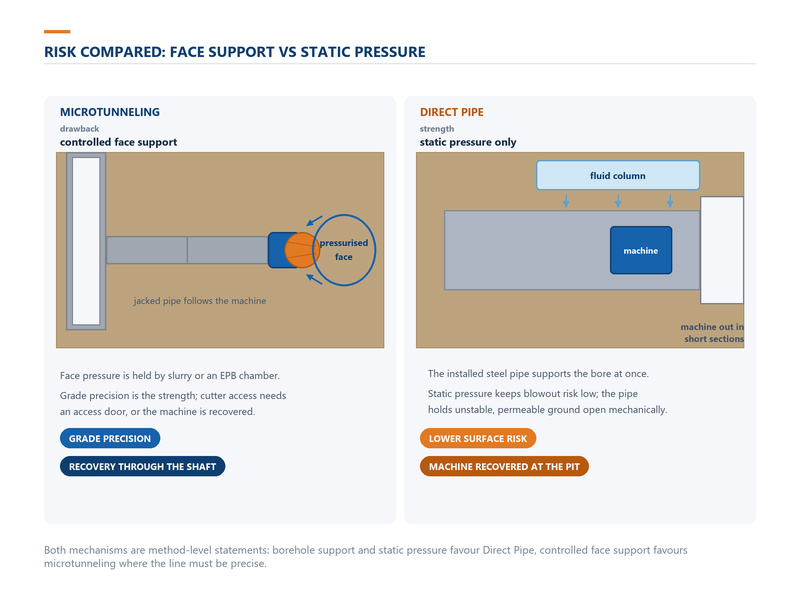
Bottom line: for surface risk and borehole stability, borehole support and static pressure favour Direct Pipe; for grade precision, controlled face support favours microtunneling.
Where Does the Money Go in Difficult Ground?
In difficult ground, microtunneling cost is driven by shaft construction and depth, dewatering, the face support plant and the risk of cutter intervention; those fixed items grow quickly in unstable ground.
Direct Pipe cost is driven by the pipe and the thruster spread, the launch pit and the cost of the steel main itself. It avoids deep shaft excavation, but it requires an acceptable steel pressure main; where a concrete or clay gravity line is fixed by the design, microtunneling is the applicable route.
On projects we have executed, the deciding factor is rarely the daily machine rate; it is whether the shafts can be built safely at the crossing. When they cannot, the Direct Pipe method moves ahead on risk alone.
Bottom line: compare the two on shaft risk first and on unit rates second; in difficult ground the fixed site work usually decides.
How Do the Two Methods Compare Side by Side?
The table below condenses the comparison into the criteria a method statement normally covers, so it can be lifted into a selection report.
| Criterion | Microtunneling | Direct Pipe |
|---|---|---|
| Suited to | Tight grade, modest diameter, buildable shafts | Variable or unstable ground, limited shaft access |
| Pipe material | Concrete, clay, steel or HDPE | Steel pipeline |
| Installation sequence | Excavate first, then jack the pipe behind the machine | Bore and install the pipe in one pass |
| Shaft depth typically required | Deep launch and reception shafts on trunk works | Near-surface launch pit and small reception pit |
| Recovery of the machine | Recovered through the reception shaft, subject to pipe diameter | Recovered at the reception pit and removed in sections |
| Cost driver | Shafts and face support plant | Pipe and thruster spread |
Read the table as a decision summary, not a mechanism: where deep shafts are the risk, the microtunneling vs direct pipe choice usually resolves toward Direct Pipe.
Not sure which method fits your site? Send your alignment data and geotechnical report for a free method review, and our engineers will tell you which method to bid.
Frequently Asked Questions
Which handles difficult ground better, microtunneling or Direct Pipe?
Neither method wins the microtunneling vs direct pipe question outright. Direct Pipe handles variable and unstable ground because it installs the pipe in one pass behind a thruster and needs only near-surface pits; microtunneling handles tight grades and modest diameters because it holds line and grade precisely behind a supported face.
Our 900 mm steel main has to cross 700 m of variable ground with 18 m of cover – is Direct Pipe or microtunneling the better bid?
For a 900 mm (about 36 in.) steel main over 700 m, both methods are technically open; the answer turns on shaft risk and grade. Typical Direct Pipe outside diameters run from 24 to 60 in. (OD 610-1,524 mm), across soft soil, mixed ground and rock. The Direct Pipe method is usually chosen where a steel pipeline is acceptable and the ground or the shaft conditions rule out an open bore.
Our route has shallow cover over soft, water-bearing ground – why is blowout risk lower with Direct Pipe?
The only pressure in the Direct Pipe bore is static, from the fluid column, so there is no dynamic pressure driving fluid to the surface. That reduces the risk of hydraulic fracturing and blowout compared with methods that pump fluid under dynamic pressure, and it holds where cover and borehole support keep the fluid column contained; shallow-cover sections still need their own assessment.
How much thrust does a pipe thruster provide?
Published project cases report roughly 550-1,100 t of combined push and pull across the 24-60 in. (OD 610-1,524 mm) envelope. The thruster both pushes and pulls the pipe string, which is what allows a long, single-pass crossing in ground that will not stand open. The figure depends on pipe diameter, geology and thruster unit configuration, and it is a published project case range rather than a guaranteed value.
The route passes under a rail embankment where we cannot build deep shafts – which method do we specify?
Specify Direct Pipe. It is launched from a near-surface launch pit and recovered from a small reception pit, so it avoids the deep launch and reception shafts that microtunneling requires. That is often the strongest reason in running or unstable ground.
Our sewer must hold a gravity grade through soft ground – which method holds it better?
General practice is that microtunneling holds line and grade tightly, which suits gravity lines, while Direct Pipe follows its bore and is chosen for pressure pipelines. Where a continuous gravity grade drives the design, that difference usually decides the method.
Our alignment crosses variable strata and we are unsure about cutter access – how do the two methods differ?
In microtunneling the crew works behind the machine and access to the cutterhead is limited by the pipe diameter, so intervention can mean recovering the machine. In Direct Pipe the machine is recovered at the reception pit and removed in short sections, which is easier to plan in difficult ground.
Our 700 m crossing is a steel pressure main in variable ground with no gravity grade – what does Direct Pipe require, and how many passes does it make?
The Direct Pipe method needs an acceptable steel pressure main; a concrete or clay gravity line usually points to microtunneling instead. Where a steel main is agreed, it bores and installs the steel pipeline in a single pass, where microtunneling excavates first and then jacks the pipe.
How Do You Evaluate Both Methods on Your Alignment?
A reliable microtunneling vs direct pipe comparison needs four inputs: the geotechnical report, the crossing length and depth, the pipe material and diameter, and the tolerance the design requires. The comparison closes on the tolerance figure: without it, one of the two methods cannot be ruled in or out.
If you are the owner, weigh the risk of deep shafts in unstable ground; if you are the operator, check whether a steel main suits the service; if you are pricing, check the thruster spread and starter pit size.
Then request two prices for the same alignment – the method the bidder recommends and the alternative – and ask each contractor to name the assumption that would change their answer.
Where the drive is jacked rather than one-pass, our microtunneling construction services cover delivery; for the wider option set, see microtunnel vs. HDD vs. direct pipe. Related background sits in microtunneling vs HDD: the key differences and HDD vs microtunneling: which is better for your project, with delivery covered by pipeline construction services and horizontal directional drilling services.
We run these checks in order, and we will say so plainly if the answer points to a method we do not offer.
Final Verdict: Which Handles Difficult Ground Better?
Neither method is better in principle. Choose Direct Pipe when the ground is variable or unstable, the crossing is long, steel pipe is acceptable, and building deep shafts safely is the main risk. Choose microtunneling when the ground is consistent, the line must hold a tight gravity grade, the diameter is modest, and shafts can be built without difficulty.
Where the microtunneling vs direct pipe answer is still unclear after those checks, the geotechnical report sets the first constraint and a contractor-quoted alternative on the same alignment sets the second. The decision comes down to which method the ground and the shaft conditions allow.
Get a second opinion at no cost. Send us the alignment and the ground data, and our engineers will tell you which method the difficult ground actually allows.
Related: microtunneling vs HDD and microtunneling in rock and mixed ground.
Sources
The diameter, thrust and pressure statements in this guide follow these published industry standards and guidance documents:
- ASCE/CI 36-15, Standard Construction Guidelines for Microtunneling.
- NASTT Good Practices Guidelines (Microtunneling and Trenchless Installation).
- Herrenknecht Direct Pipe technology reference.
- Akkerman trenchless equipment guidance on guided boring and microtunneling in unstable and variable ground.





































 English
  Arabic
  Russian
  Spanish
  French
  Vietnamese
  Polish
  Thai
Thai  Indonesian
  Turkish
  Portuguese