
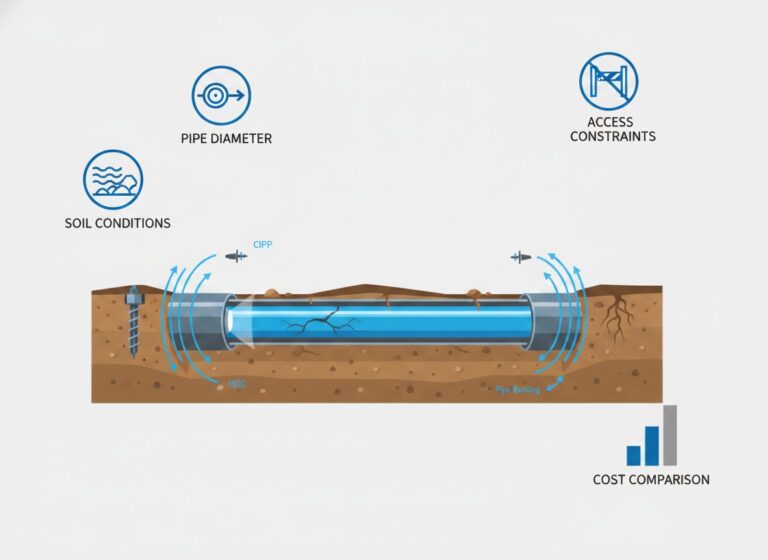
Trenchless gas pipeline repair costs typically range from $80 to $350 per linear foot, depending on the method chosen. For most residential and light commercial projects, total job costs commonly fall between $3,000 and $15,000, while large-diameter municipal main repairs can reach $40,000 or more per project. Cured-in-place pipe lining, the most widely used structural rehabilitation method, generally costs $100 to $250 per linear foot for common 4-to-6-inch lines. Pipe bursting for full replacement starts around $60 per linear foot and can exceed $200 per foot for challenging ground conditions. The four main cost drivers are pipe diameter, soil conditions, access requirements, and technology selection. This guide breaks down what you can expect to pay for CIPP lining, pipe bursting, horizontal directional drilling, and spray-on epoxy coating, and explains which method fits your budget and site constraints.
How Much Does Trenchless Gas Pipeline Repair Cost by Method?
Each trenchless technology occupies a distinct price band. The table below summarizes typical project costs so you can quickly compare options.
Table: Trenchless Gas Pipeline Repair Costs by Method
| Method | Typical Cost per Linear Foot | Small Project (10–25 ft) | Standard Project (40–60 ft) | Best Use Case |
|---|---|---|---|---|
| CIPP Lining | $100–$250 | $3,000–$8,000 | $5,000–$15,000 | Structural rehab of existing pipe |
| Pipe Bursting | $60–$200 | $3,000–$7,000 | $5,000–$12,000 | Full replacement, same or larger diameter |
| HDD Replacement | $50–$300 | $4,000–$10,000 | $8,000–$25,000 | New line installation avoiding surface obstacles |
| Spray-On Epoxy Coating | $40–$150 | $2,500–$6,000 | $4,000–$10,000 | Internal corrosion protection, non-structural |
These ranges reflect national averages. Actual quotes will vary significantly by region, ground conditions, and project-specific requirements. Always request itemized bids that separate cleaning, materials, installation, and surface restoration.
CIPP Lining Costs
Cured-in-place pipe lining is the dominant trenchless method for gas pipeline rehabilitation. The process inserts a resin-saturated liner into the cleaned host pipe and cures it to form a structurally independent new pipe. For typical 4-to-6-inch gas distribution laterals, CIPP lining costs range from $100 to $250 per linear foot. Small-diameter residential lines at 3 to 4 inches can start as low as $80 per foot, while large mains above 8 inches may reach $350 per foot.
The total project cost depends heavily on length. A short 15-foot repair might cost $3,500 to $6,000 once mobilization, cleaning, and curing are included. A standard 50-foot lateral typically lands between $6,000 and $14,000. Longer commercial runs of 100 feet or more can reach $20,000 to $35,000. CIPP is most cost-effective when the existing pipe is still structurally sound enough to act as a host, because full replacement would require far more excavation and surface restoration.
Pipe Bursting Costs
Pipe bursting pulls a bursting head through the old pipe, fragmenting it outward while simultaneously pulling in a new HDPE pipe. This method typically costs $60 to $200 per linear foot. The lower end of the range applies to small-diameter residential laterals in favorable soil, while the upper end covers large-diameter lines, difficult ground conditions, or projects requiring significant upsizing.
For a typical gas service replacement, the total job cost commonly falls between $3,000 and $7,000, with the work completing in a single day. This compares favorably to traditional excavation-based replacement, which often costs $8,000 to $10,000 for the same scope and requires two to three days of work with extensive surface damage. The biggest cost advantage of pipe bursting appears in landscaped areas, under driveways, and in finished basements where restoration costs for open-cut methods would be substantial.
Horizontal Directional Drilling Costs
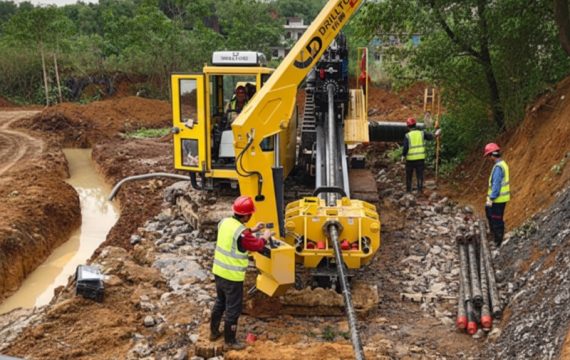
Horizontal directional drilling installs new gas pipe along a pre-drilled curved path. This is the go-to method for river crossings, highway underpasses, and congested utility corridors where open trenches are not feasible. HDD costs start around $50 per linear foot for straightforward installations in favorable soil and can exceed $300 per foot for large-diameter crossings in hard rock.
The high variability reflects geology more than any other factor. Simple sand and clay conditions allow fast drilling with minimal tool wear, keeping costs near the low end. Hard rock formations such as granite or dense limestone slow production significantly, increase tooling costs, and push per-foot rates toward the upper range. Small HDD projects for residential gas service connections typically cost $4,000 to $10,000 total, while large-diameter municipal crossings can reach $25,000 to $50,000 or more depending on length and complexity.
Spray-On Epoxy Coating Costs
Spray-on epoxy coating uses a robotic applicator to apply a protective internal coating that seals minor leaks and provides corrosion resistance. This is a non-structural solution best suited for extending the life of pipes that are still structurally sound. Costs typically range from $40 to $150 per linear foot. Small-diameter projects start around $2,500 total, with standard residential laterals falling in the $4,000 to $10,000 range.
The primary advantage of epoxy coating is speed and minimal site impact. No curing time is needed beyond the coating’s set time, and the robotic applicator can coat several hundred feet per day. However, this method cannot address significant structural defects, collapsed sections, or heavy root intrusion. It is best viewed as a preventive maintenance solution rather than a structural repair.
What Factors Affect Trenchless Gas Pipeline Repair Costs?
The price of any trenchless gas pipeline repair is driven by four main variables. Understanding these will help you evaluate quotes and avoid surprise costs.
Pipe Diameter and Project Length
Diameter is the single largest cost driver. Small residential pipes of 3 to 4 inches cost significantly less to line or burst than 8-to-12-inch municipal mains because they require less material, smaller equipment, and shorter installation time. Per-foot costs for large-diameter pipes increase because resin consumption, curing time, and equipment requirements all scale non-linearly with diameter.
Length affects total project cost directly, but the per-foot rate often decreases on longer runs because mobilization, setup, and demobilization costs spread across more linear feet. A 20-foot repair may carry a high per-foot rate due to minimum job charges, while a 100-foot repair on the same diameter pipe will typically have a lower per-foot cost.
Soil Conditions and Geology
The ground beneath the worksite has an outsized influence on trenchless costs, particularly for pipe bursting and directional drilling. Simple soil conditions such as sand, clay, and loose fill allow faster installation with minimal wear on cutting tools. Mixed-face conditions, cobbles, or weathered rock can slow production by 20% to 40% and increase tooling costs. Hard bedrock presents the most expensive scenario, requiring specialized drill bits, slower advance rates, and more frequent tool changes that can add 50% or more to the per-foot rate compared to favorable ground.
Access and Site Logistics
Trenchless does not mean no-dig; it means minimal-dig. Most methods require entry pits or access points. Working in congested urban environments with multiple underground utilities, limited workspace, and traffic control requirements adds cost. Site preparation, concrete cutting, asphalt restoration, and landscape repair are often excluded from base per-foot pricing and should be confirmed in writing. Urban projects may also require traffic control plans, police details, or nighttime work windows that carry premium labor rates.
Pipe Condition and Cleaning Requirements
The internal condition of the existing pipe directly affects preparation costs. Pipes with heavy corrosion, thick scale buildup, or extensive root intrusion require additional cleaning before trenchless rehabilitation can proceed. High-pressure water jetting and mechanical cleaning can add $500 to $2,000 or more to a project depending on severity. Significant structural defects such as collapsed sections or offset joints may require spot repairs before lining, which adds cost and complexity.
Trenchless vs. Open-Cut: What Is the Real Cost Difference?
When comparing trenchless gas pipeline repair costs to traditional excavation, the full project economics extend well beyond the direct construction bid.
Open-cut replacement in urban areas involves significant surface restoration, traffic management, and utility relocation costs that can double or triple the direct pipe installation expense. For municipal main replacement, trenchless methods can reduce total project costs by approximately 20% when restoration and indirect costs are included, according to published case studies that account for avoided demolition, green space repair, and traffic rerouting.
For individual service line replacements, the difference is equally stark. A traditional gas service replacement involving excavation commonly costs $8,000 to $10,000 and requires two to three days of work with substantial property damage. The trenchless equivalent for pipe bursting on the same scope typically costs $3,000 to $7,000 and completes in a single day with minimal surface disturbance. The cost advantage is even greater on properties with mature landscaping, paved driveways, or finished interior spaces where restoration costs would be significant.
Beyond direct costs, trenchless methods generate substantially less disruption. Construction timelines are shorter, noise and dust are reduced, and carbon emissions can be over 90% lower than open-cut methods due to reduced heavy equipment hours and material transport. For municipalities subject to environmental regulations, these reductions translate into measurable compliance cost savings.
How to Get an Accurate Quote for Trenchless Gas Pipeline Repair
Obtaining reliable pricing requires more than requesting a per-foot rate. Follow these steps to ensure quotes are complete and comparable.
Start with a professional CCTV pipe inspection. This documents the complete pipe interior: diameter, material, joint conditions, corrosion severity, and structural defects. Camera footage provides the objective basis for all cost calculations and method recommendations. Without it, any quote is an estimate at best.
Request itemized bids that separate cleaning, lining or replacement, curing, post-installation inspection, and surface restoration. A bundled per-foot price may exclude critical items such as root removal, spot repairs on collapsed sections, or concrete replacement. Two quotes with similar headline rates can produce very different final invoices depending on inclusions.
Ask about mobilization charges, traffic control, and subcontractor costs. These line items often appear after the initial quote. Confirming them upfront prevents budget surprises.
For large projects, consider a pilot section. Testing the chosen method on a small section first verifies performance under site-specific conditions and allows the contractor to calibrate productivity assumptions. This data can support volume pricing negotiations for the full project.
Frequently Asked Questions
How long does trenchless gas pipeline repair last?
When properly installed, CIPP liners for gas pipelines are designed to extend service life by 30 years or more. Modern epoxy and resin systems meet rigorous standards for chemical resistance, bonding strength, and long-term durability. Rehabilitated pipes can experience increased flow capacity due to the smoother internal surface compared to corroded steel or iron. Actual lifespan depends on installation quality, operating conditions, and adherence to manufacturer specifications.
Does insurance cover trenchless gas pipeline repair?
Most trenchless contractors provide workmanship warranties ranging from one to ten years, and material manufacturers typically back liner products with 10-year to 50-year warranties when installed by certified applicators. These cover defects in materials and installation. They generally do not cover damage from third-party strikes, ground movement, or operating conditions outside design parameters. Gas utilities typically fund rehabilitation through capital improvement budgets. Commercial property owners should verify warranty terms and confirm that work meets applicable standards for gas pipeline rehabilitation.
Can CIPP be used on all gas pipelines?
Not universally. CIPP is widely used for gas distribution lines operating at standard distribution pressures, but specific liner materials must be approved for gas service compatibility. Some jurisdictions restrict CIPP use for high-pressure transmission lines or require additional testing and certification. Regulations vary by region. Always confirm that your contractor has direct experience with gas pipeline applications specifically—not just sewer or water line rehabilitation—and verify that the proposed materials meet all local code requirements.
Which method is most cost-effective?
There is no single answer; the most cost-effective method depends on pipe condition, diameter, and project goals. For structurally sound pipes needing internal corrosion protection, epoxy coating offers the lowest cost. For pipes requiring structural renewal, CIPP provides long-term rehabilitation without full replacement. For pipes too damaged to line, pipe bursting enables same-diameter replacement at substantial savings compared to open-cut. A professional CCTV inspection and feasibility assessment is the essential first step.
About JSW Trenchless Solutions
JSW provides integrated trenchless gas pipeline repair services backed by in-house equipment and experienced engineering teams. Our core capabilities include CIPP structural lining, pipe bursting for full-diameter replacement, horizontal directional drilling for new installations, and robotic epoxy coating for corrosion protection.
In-house equipment advantage: We own and maintain our full inventory of trenchless equipment—CIPP inversion systems, bursting rigs, HDD rigs, CCTV inspection cameras, and pipe cleaning systems. This means faster mobilization, consistent quality control, and cost certainty without third-party rental markups.
Gas pipeline specialization: Our engineering team has extensive experience with gas distribution and transmission applications. Each project begins with a thorough inspection and feasibility assessment, followed by a site-specific work plan that addresses technical requirements, regulatory compliance, and operational continuity.
Transparent quoting: We provide itemized proposals with clear scope definition, cost breakdowns by line item, and documented assumptions. Post-installation testing and reporting are standard on every project.
Contact JSW today to discuss your gas pipeline repair needs and request a project-specific cost estimate.








 English
  Arabic
  Russian
  Spanish
  French
  Vietnamese
  Polish
  Thai
Thai  Indonesian
  Turkish
  Portuguese