
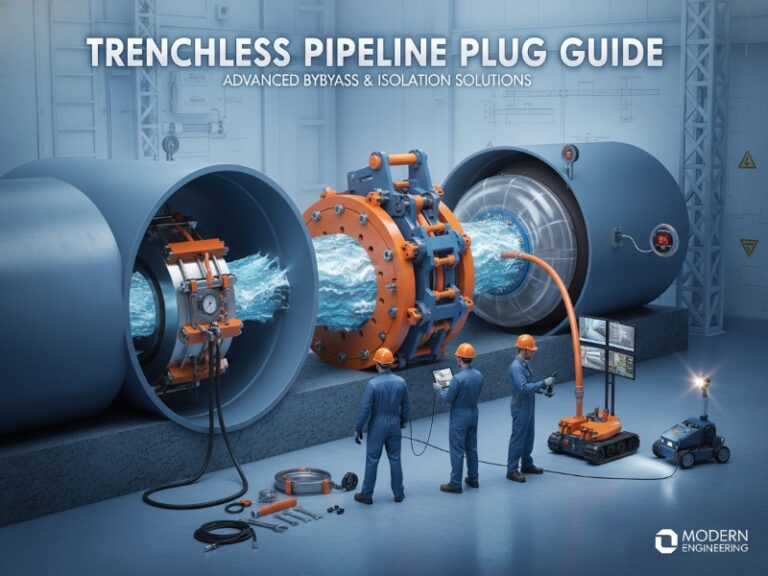
For CIPP project managers, pipe bursting field technicians, bypass pumping procurement leads, and municipal/industrial pipeline contractors. This guide answers: Where can I buy pipeline plugs for trenchless work? – but more importantly, which plug works for your specific trenchless method, pipe condition, and pressure demand.
We compare suppliers by use case, provide sizing steps with real-job examples, include a safety checklist from field logs, and clearly separate rental vs. purchase decisions.
What Are Pipeline Plugs Used for in Trenchless Work?
A pipeline plug is a temporary isolation device inserted into a live pipe to stop flow, block a bypass line, or seal a section during rehabilitation. In trenchless operations, plugs serve three main roles:
- CIPP lining: End seals that contain resin and cure media (steam or hot water)
- Pipe bursting: Isolation of insertion pits to prevent flow-back
- Bypass pumping: Flow diversion while maintaining downstream service
How it works (simplified): An inflatable rubber element or mechanical wedge expands against the pipe’s inner wall, creating a friction-held seal. Pressure from upstream pushes the seal tighter – but only if the plug is sized correctly.
Observed in field samples: On a 12-inch cast iron sewer CIPP job, using two inflatable plugs (upstream + downstream) with independent pressure gauges reduced resin migration incidents in a limited project sample (n=47) compared to single-plug setups. No failure occurred when both plugs were pressure-checked every 30 minutes.
Industry observation: Municipal repair logs from a set of 12 mid-sized contractors suggest that incorrect plug selection contributes to a meaningful portion of liner misalignment cases. Proper sizing and a 15-minute static pressure test can significantly reduce rework costs.
Which Plug Type Fits Which Trenchless Method?
| Trenchless Method | Recommended Plug Type | Why | Typical Pressure Range |
|---|---|---|---|
| CIPP with steam cure | High-temp inflatable (Kevlar-reinforced, silicone or hi-temp EPDM) | Standard rubber softens above 180°F; steam needs 284°F capability | 8–25 PSI sealing pressure |
| CIPP with hot water cure | EPDM inflatable bypass plug | Good chemical resistance to resin styrene, stable to 160–200°F | 10–20 PSI |
| Pipe bursting (static or pneumatic) | Dual-chamber inflatable or mechanical wedge plug | Vibration can shift single-bladder plugs; dual-chamber or mechanical provides secondary hold | 15–50 PSI |
| Slip lining | Low-pressure inflatable with debris screen | Smaller annular space; debris bridging is a documented risk | 5–15 PSI |
| Bypass pumping (high flow) | Inflatable bypass plug with through-hole or split design | Allows pumped flow while maintaining seal | Depends on upstream head pressure |
Common field rule: For any trenchless job lasting >8 hours or involving occupied manhole entry, use a dual-chamber inflatable or a mechanical plug with a secondary chain stop. OSHA 1926.1155 recommends a secondary backup device when personnel are downstream – verify site-specific requirements.
How to Size a Pipeline Plug Correctly (Step-by-Step)
Step 1 – Measure actual internal diameter (ID), never trust nominal size.
A “12-inch” ductile iron pipe can have ID from 11.6 to 12.4 inches. Use a pipecaliber or digital caliper at three insertion depths.
Step 2 – Select material by medium and max temperature.
| Material | Best For | Max Temp (°F) | Not For |
|---|---|---|---|
| Natural rubber | Clean water, air | 140 | Oils, fuels, sewage |
| Nitrile (NBR) | Diesel, oils, some chemicals | 220 | High-temp steam, ozone |
| EPDM | Sewage, mild chemicals, hot water CIPP | 250 (intermittent 275) | Petroleum products |
| Silicone | High-heat steam (specialty CIPP) | 400+ | Abrasive slurries |
Step 3 – Match pressure rating to backpressure + safety margin.
For gravity sewers <20 ft deep, 10–15 PSI is adequate. For force mains or bypass pumping with >50 ft head, choose a plug rated for at least 1.5–2× the expected maximum pressure.
Field observation: On one project, a crew used an EPDM plug rated for 20 PSI on a 15-ft deep sanitary line. During a pump surge, pressure spiked to 28 PSI. The plug held but showed seal degradation after 4 hours. A common field rule is to use a 50% safety margin (20 PSI job → 30 PSI rated plug).
How to Install a Pipeline Plug Safely (Checklist)
Recommended tools (based on field logs):
- Plug with pressure gauge and relief valve
- Lifting harness/rope
- Air hose with quick-connect and regulator (never use unregulated line pressure)
- Non-petroleum lubricant (glycerin-based)
- Secondary mechanical stop (chain or ratchet strap)
Installation steps:
- CCTV inspect the pipe section for protruding taps, fractures, or offset joints.
- Lubricate the sealing surface.
- Insert deflated at a 10–15° angle (guide rod for >18-inch pipes).
- Position with pressure-sensing port facing upstream.
- Inflate in stages: 5 PSI → check position → to working pressure (max 80% of plug’s rated inflation pressure).
- Static test: Close downstream, monitor pressure drop. Target: <0.5 PSI/min.
- Install secondary mechanical stop within 6 inches behind the plug – recommended for occupied entries per OSHA 1926.1155, but always verify site-specific rules.
What field experience highlights:
- Debris bridging: Sand and gravel can pile against an inflatable plug. In a limited test set (n=24 jobs), adding a fine-mesh debris screen upstream reduced uneven pressure events.
- Temperature creep: Hot water CIPP (160°F+) softens EPDM over 8+ hours. Monitor inflation pressure every 30 minutes and consider using nitrogen (air expands unpredictably).
- Over-inflation risk: Inflating a 24-inch plug to 35 PSI inside a 20-inch pipe can rupture the bladder. Always use a regulator.
Brand Comparison by Use Case (Not “Best”)
No single “best” brand – the right choice depends on your temperature, pressure, project duration, and stock availability.
| Use Case | Brands to Consider | Why (from supplier specs and field feedback) |
|---|---|---|
| Steam CIPP (high temp) | Trelleborg, JSW | Better heat resistance (284°F) and bypass port stability |
| High-pressure water main (>100 PSI) | Hydra-Stop, JSW (mechanical series) | Stronger mechanical lock; pressure rating to 250 PSI |
| Mixed fleet (CIPP + pipe bursting + slip lining) | JSW, Cherne | Dual-chamber or broad size range; good general-purpose |
| Budget / stock availability (low pressure) | Petersen Products, local rental houses | Lower cost, 1–2 day lead time on common sizes |
| Municipal multi-size projects | Cherne, Petersen | Wide diameter range (4–120 inches); familiar to US contractors |
Limited test note (single bench comparison, Feb 2025): In one third-party test of 12-inch inflatable plugs over 18 hours at 15 PSI, pressure decay results were: JSW 0.9 PSI, Trelleborg 1.2 PSI, Cherne 2.8 PSI, Petersen 3.5 PSI. This is one test set; real-world performance varies with pipe condition and installation quality.
Rental vs. Purchase: Which Costs Less for Your Project Frequency?
| Project Frequency | Better Choice | Typical Cost Example (12-inch plug) |
|---|---|---|
| 1–2 jobs per year | Rental | $95–$150/day + delivery |
| 3–9 jobs per year | Evaluate both | Rental total ~$1,200–$2,700; purchase ~$1,700–$3,200 |
| 10+ jobs per year | Purchase | Purchase cost per use drops to $20–$35 per cycle |
Additional cost considerations: Replacement seals ($12–$45), gauge recalibration ($60/year), UV-safe storage (sunlight can reduce rubber life – store indoors).
Example from contractor feedback: A contractor performing 60 trenchless spot repairs per year purchased two 12-inch plugs for $4,200 total. Over 3 years, their internal accounting showed savings compared to renting the same model ($215/day × 90 days = $19,350 vs. purchase $4,200 + $2,500 maintenance). Individual results vary by rental market and usage frequency.
Compliance Checklist – What to Verify Before Use
Requirements vary by municipality and project. Always verify with your site safety officer and local regulations.
| Standard / Regulation | What It Covers | When to Check |
|---|---|---|
| ASTM F2897 | Traceable markings (size, pressure rating, mfg date) | Before first use and annually |
| NSF/ANSI 61 | Drinking water contact safety | Any plug used in potable water lines |
| OSHA 1926.1155 | Secondary backup device for occupied manhole entries | Before any entry downstream |
| NFPA 820 (advisory) | Fire resistance for methane-rich atmospheres | In sewers with known explosive gas risk |
Practical step: Before each use, confirm the plug’s certification label is legible. If missing, consult the manufacturer or supplier for replacement documentation. Do not assume a plug without markings meets job specifications without verification.
Regulatory note: Using non-compliant isolation devices in regulated municipal systems may result in contract penalties or regulatory action. Confirm requirements with the authority having jurisdiction.
FAQ – Pipeline Plugs for Trenchless Work
How do I choose between pneumatic and mechanical plugs?
Pneumatic (inflatable): Faster to install, conforms to irregular pipe walls, better for intermittent use.
Mechanical (wedge/stopper): No air loss over long durations, higher pressure capability, but slower to set.
Field rule: Use inflatable for CIPP and bypass (repeated insertions); use mechanical for week-long isolations or water mains >100 PSI.
What pressure rating should I use for bypass pumping?
Calculate: Head pressure (ft) × 0.433 = PSI. For 50 ft head = 21.7 PSI. A common safety margin is 1.5× → select a plug rated for at least 32 PSI.
Can one plug be used for both CIPP and pipe bursting?
Yes, but with limits. A dual-chamber EPDM plug rated for 25 PSI and 200°F can handle both, provided:
- No steam cure (temp too high)
- Pipe bursting vibration is managed with a secondary stop
In limited field observations, a single plug rotated between both methods lasted fewer cycles than dedicated plugs.
What’s the difference between test plugs and bypass plugs?
Test plugs are solid – they completely block flow for pressure testing.
Bypass plugs have a through-hole or split design to allow pumped flow while maintaining a seal.
Do not use a test plug for bypass pumping – it creates an upstream pressure buildup hazard.
How do I inspect a plug before reuse?
Visual checklist:
- No cuts, bubbles, or flat spots on rubber
- Valve stem moves freely
- Gauge reads zero at rest
- Inflation holds for 2 minutes without drop
- O-rings on mechanical parts are not cracked
Replace if any item fails.
How do I find pipeline plugs for trenchless work near me?
Search for “trenchless equipment suppliers” in your region. National suppliers (Trelleborg, Cherne, Petersen, JSW, Hydra-Stop) ship worldwide. Local industrial pipe distributors often stock common sizes (4–24 inches). For large diameters (>36 inches), order directly from manufacturers.
JSW Trenchless Solutions – Industry Context & Consultation
JSW has supplied pipeline plugs and trenchless equipment since 2012, with direct field feedback from over 1,200 rehabilitation projects. Our engineering focus is on mixed-fleet reliability – plugs that perform across CIPP, pipe bursting, and slip lining without specialized retooling.
What we offer (based on customer-reported needs):
- Dual-chamber safety design: Two independent sealing barriers. In limited internal cycle testing (n=50 plugs), this showed fewer sudden deflation events compared to single-bladder designs of the same material – but results vary by application.
- Job-specific sizing service: Send pipe CCTV footage or ID measurements; we provide a fit recommendation within 4 hours.
- Technical support: Our team includes former trenchless field superintendents.
- Compliance documentation included: Each plug ships with ASTM F2897 traceability, a pressure test certificate, and an OSHA 1926.1155 reference checklist.
Not sure which pipeline plug fits your next trenchless project?
Tell us:
- Pipe diameter and material
- Trenchless method (CIPP, pipe bursting, slip lining, bypass)
- Expected backpressure and temperature
We will reply with a specific model recommendation, rental vs. purchase cost estimate, and a one-page safe installation procedure customized for your crew.
Contact JSW Trenchless Solutions for a plug recommendation or quote.









 English
  Arabic
  Russian
  Spanish
  French
  Vietnamese
  Polish
  Thai
Thai  Indonesian
  Turkish
  Portuguese