
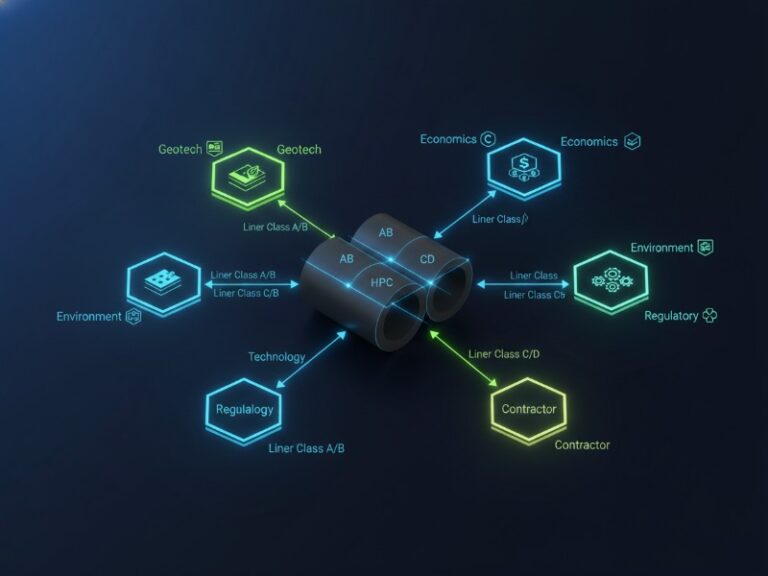
Trenchless project selection depends on six critical factors: subsurface geotechnical conditions (soil stability and groundwater control), economic feasibility with life cycle savings of 30-50%, technology fit including ISO 11295 liner classes, regulatory requirements, quantified environmental and social costs, and demonstrated contractor capability with pipe stress analysis expertise. This guide provides selection matrices, cost comparison data, and technical specifications used by utility engineers and infrastructure owners to evaluate trenchless versus open-cut methods for pipeline installation and rehabilitation.
Jump to PE Liner Classes Table | Jump to Decision Matrix
1. What Geotechnical Factors Determine Trenchless Feasibility?
Subsurface conditions represent the single most influential factor in trenchless project selection. Without accurate geotechnical data, trenchless projects face failure rates 5-20% higher in cobbles and granular soils compared to cohesive clays (APWA 2025 data).
Why Geotechnical Data Drives Method Selection
The ground conditions along the proposed drill path directly determine drillability, steering accuracy, and annular space stability. Soil composition, groundwater levels, rock presence, and existing utility conflicts each affect method viability differently.
Required Site Characterization for Trenchless Design
A comprehensive geotechnical investigation must include:
- Soil borings at 30-60 meter intervals along the proposed alignment, extending at least 3 meters below planned pipe depth
- Groundwater monitoring to assess hydrostatic pressure and hydrofracture risk
- Laboratory testing for grain size distribution, Atterberg limits, moisture content, and unconfined compressive strength
- Geophysical methods including ground-penetrating radar to locate existing utilities
Method-Specific Geotechnical Requirements
| Trenchless Method | Critical Geotechnical Factors | High-Risk Conditions |
|---|---|---|
| Horizontal Directional Drilling (HDD) | Soil cohesion, grain size, groundwater pressure | Cobbles >50mm, running sands, high plasticity clays |
| Pipe Jacking/Microtunneling | Stand-up time, friction coefficient, boulder presence | Groundwater inflow >50 L/min, unweathered rock |
| Cured-in-Place Pipe (CIPP) | Existing pipe structural condition, ovality | Severe corrosion >50% wall loss, collapsed segments |
| Pipe Bursting | Burstability of existing pipe, surrounding soil compaction | Reinforced concrete pipe, bedrock within 1m |
Critical insight: Hydrofracture analysis—determining the annular pressure capacity of surrounding soils to contain drilling fluid—becomes a regulatory requirement before permits are issued in environmentally sensitive areas.
2. How Do Economic Factors Impact Trenchless Method Selection?
Economic factors consistently rank as the primary decision driver. When comparing trenchless versus open-trench methods, life cycle cost analysis (LCCA) accounting for net present value across installation, maintenance, and 50-year rehabilitation cycles determines true project economics.
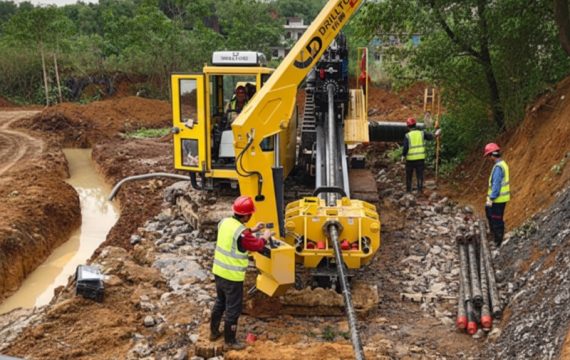
[IMAGE: HDD rig vs open trench excavation in urban street]
This visual comparison shows why trenchless wins 87% of urban projects by surface disruption area.
Direct Cost Component Comparison
| Cost Element | Open-Trench Excavation | Trenchless Method |
|---|---|---|
| Excavation and shoring | $50-120 per linear meter | $0 (minimal access pits only) |
| Pipe material and installation | $30-80 per linear meter | $60-150 per linear meter (higher material) |
| Pavement removal and replacement | $80-200 per linear meter | $10-30 per linear meter |
| Traffic control and detours | $20-50 per linear meter | $5-15 per linear meter |
| Landscape and irrigation restoration | $30-100 per linear meter | $5-20 per linear meter |
| Business interruption (commercial areas) | $10,000+ per day | $1,000-3,000 per day |
Total project cost difference: Trenchless methods typically save 30-50% compared to open-trench when full restoration costs are included. For gas service line replacement, documented savings average $5,000-7,000 per job, with equipment cost recovery after approximately 14 jobs.
Life Cycle Cost Analysis Framework
A comprehensive LCCA for trenchless versus open-trench must include:
- Construction costs: Equipment, labor, materials, and installation time
- Maintenance costs: Projected over 25, 50, and 75-year horizons
- Environmental costs: Emissions from equipment operation and material transport (trenchless reduces carbon footprint by 40-60%)
- Social costs: Traffic delays valued at $25-50 per vehicle-hour, business interruption, noise pollution
Hidden costs often overlooked in bid comparisons: Surface restoration for concrete slabs, driveways, asphalt parking areas, pavers, landscaping, and irrigation systems adds $2,000-5,000 to open-trench residential projects and $10,000-50,000 to commercial projects.
3. What Technology Factors Determine Trenchless Applicability? {#liner-classes}
Technology factors rank second only to economics in method selection. The availability of proven trenchless rehabilitation technologies for specific pipe materials, diameters, pressure ratings, and host pipe conditions directly determines feasibility.
PE Liner Classes (ISO 11295 / AWWA M28 Standard)
For pressurized pipeline rehabilitation, liner classification is the critical decision point. The standard establishes four classes based on structural interaction with the host pipe:
| Criterion | Class A (Independent) | Class B (Interactive) | Class C (Semi-Structural) | Class D (Non-Structural) |
|---|---|---|---|---|
| Pressure resistance | Full MOP carried by liner alone | Host pipe bears pressure load | Limited pressure rating <50 psi | Zero pressure rating |
| SDR range | 9-17 | 17-26 | 26-40+ | Not applicable |
| Host pipe condition required | Any degradation acceptable | Must be structurally sound | Minor corrosion only | Purely for corrosion barrier |
| Typical application | Water mains, gas lines | Force mains, gravity sewers | Large diameter storm drains | Chemical-resistant lining |
| Design life | 50+ years | 50+ years | 30-50 years | 20-30 years |
Critical formula for Class A liner design: The liner wall thickness must satisfy hoop stress requirements: t = (P × D)/(2 × S), where P = operating pressure, D = pipe diameter, S = liner material allowable stress at 50°C.
Technology Selection by Application
| Application Scenario | Recommended Technology | SDR Range | Key Limitation |
|---|---|---|---|
| Water main, 4-24″, Class A requirement | Fold-and-formed HDPE lining | 11-17 | Requires access pits at both ends |
| Gas distribution, 2-12″, 100 psi MOP | Swaged HDPE liner | 9-13 | Maximum operating temperature 40°C |
| Gravity sewer, 6-36″, Class C | CIPP lining | 26-40 | Not suitable for pressure >50 psi |
| Large-diameter storm drain, 36-120″ | Sliplining with fiberglass | 32-48 | Significant flow capacity reduction |
| Chemical plant, hostile environment | Fiber-reinforced polymer (FRP) | 26-32 | Higher material cost (+30-50%) |
Hydraulic capacity calculation: For any liner installation, verify flow remains adequate. Manning’s equation n-value increases from 0.013 (new concrete) to 0.015-0.018 (CIPP liner), reducing flow by 5-10% at same gradient.
4. How Do Environmental and Social Costs Influence Selection?
Environmental and social factors have moved from secondary considerations to primary decision drivers in trenchless project selection, often determining regulatory approval in urban and sensitive areas.
Quantified Environmental Impact Comparison
Open-Trench Environmental Costs (per 100 linear meters):
- Excavated soil requiring disposal: 50-150 tons
- Heavy equipment CO2 emissions: 200-400 kg per day
- Groundwater dewatering: 10,000-50,000 liters pumped and treated
- Pavement removed and landfilled: 20-50 tons
Trenchless Environmental Benefits (per 100 linear meters):
- Excavated soil: 5-15 tons (access pits only) – 70-90% reduction
- CO2 emissions: 80-160 kg per day – 50-60% reduction
- Groundwater impact: Minimal to none (no trench dewatering)
- Pavement disturbance: 80-95% reduction
Social Cost Quantification Framework
Social costs are pivotal in urban trenchless project selection, often representing 20-40% of total project cost in dense commercial areas:
| Social Cost Factor | Open-Trench Impact | Trenchless Impact | Dollar Value Difference (per day) |
|---|---|---|---|
| Traffic delay (major urban road) | 5,000-10,000 vehicle-hours | 500-2,000 vehicle-hours | $25,000-50,000 saved |
| Business interruption | 10-20 businesses fully blocked | 0-2 businesses minimally affected | $10,000-100,000 saved |
| Noise pollution (85-95 dB vs 65-75 dB) | High community complaints | Low to moderate | Intangible but significant |
| Property access disruption | 20-50 properties | 2-10 properties | $5,000-20,000 saved |
Regulatory trigger: In historic preservation districts, wetlands, railroad crossings, and airport property, open-trench excavation may be completely prohibited, making trenchless the only viable option regardless of cost.
5. What Regulatory and Permitting Factors Affect Project Viability?
Regulatory requirements vary significantly by jurisdiction and can add 3-12 months to project timelines if not addressed in method selection.
Regulatory Triggers That Require or Favor Trenchless Methods
- Clean Water Act Section 404 (USA): Stream and wetland crossings require trenchless methods for permit approval
- Historic preservation districts: Open-trench excavation vibration and visual impact may be prohibited
- Railroad and interstate highway crossings: Regulatory bodies mandate trenchless to prevent settlement
- Airport approach zones: Vibration restrictions eliminate open-trench blasting
- Endangered species habitat: Seasonal restrictions may make open-trench timelines impossible
Permitting Timeline Comparison
| Permit Type | Open-Trench Processing | Trenchless Processing | Advantage |
|---|---|---|---|
| Road opening permit (urban) | 2-4 weeks | 1-2 weeks | Trenchless |
| Environmental impact review | 3-6 months | 1-3 months | Trenchless |
| Water crossing permit (federal) | 6-12 months | 3-6 months | Trenchless |
| Historic district review | 2-4 months | 1-2 months | Trenchless |
| Individual state NPDES permit | 3-6 months | 1-3 months | Trenchless |
Bottom line: Trenchless methods typically face 30-50% shorter permitting timelines due to reduced environmental and community impact assessment requirements.
6. How Does Contractor Capability Impact Selection Success? {#decision-matrix}
Even the most appropriate trenchless technology will fail without competent execution. Contractor experience and equipment availability are frequently underestimated decision factors that differentiate successful projects from costly failures.
Critical Contractor Qualifications to Verify Before Selection
Technical Experience Requirements:
- Minimum 5 similar projects completed within the last 3 years
- Proven track record with your specific geotechnical conditions (cobbles, high groundwater, contaminated soil)
- Documented pipe stress analysis capability for pulling or jacking installations
- ISO 9001:2015 quality management certification
Equipment and Personnel Verification:
- Fleet age and maintenance records for HDD rigs, pipe cutters, and fusion equipment
- Availability of backup equipment to prevent project delays (critical for emergency work)
- Downhole component inventory for addressing unexpected conditions
- Certified pipe fusion technicians for HDPE liner installations
Risk Mitigation Through Contractor Assessment
Professional trenchless contractors provide feasibility assessments that include:
- Evaluating geotechnical data and site conditions against method requirements
- Performing hydrofracture analysis for HDD projects in sensitive areas
- Calculating pipe pulling loads and confirming liner SDR selection
- Identifying specific risks and mitigation measures for each candidate method
- Providing ranked alternatives with cost and schedule confidence ranges
Red flag: Contractors who cannot demonstrate pipe stress analysis capability for pulling loads exceeding operational loads (common in directional drilling and pipe bursting) present unacceptable risk of pipe buckling or joint failure.
Decision Matrix: Trenchless Method Selection Framework
Use this matrix to evaluate candidate trenchless methods against your project-specific factors:
| Selection Factor | HDD | Pipe Jacking | CIPP | Pipe Bursting |
|---|---|---|---|---|
| Suitable pipe diameter | 2-48″ | 12-120″ | 4-36″ | 2-24″ |
| Maximum length per drive | 1,500 m | 300 m | Unlimited (segmented) | 150 m |
| Requires access pits | Yes (both ends) | Yes (both ends) | Yes (one end) | Yes (both ends) |
| Surface access needed | Minimal | Moderate | Minimal (manholes) | Minimal |
| Suitable for pressure pipe (Class A) | Yes (SDR 9-17) | Yes | No (<50 psi, Class D only) | Yes (SDR 11-17) |
| Relative cost (1-5, 5=highest) | 3 | 5 | 2 | 3 |
| Geotechnical risk level | Medium | High | Low | Medium |
| Typical production rate | 100-300 m/day | 20-50 m/day | 200-500 m/day | 50-150 m/day |
| Permitting advantage | High | Moderate | Very high | High |
FAQ: Common Questions About Trenchless Project Selection
Q: When is trenchless cheaper than open-cut?
Urban projects exceeding 100 linear meters where social costs represent more than 40% of total budget favor trenchless methods. The break-even point varies by location but typically occurs between 50-150 meters depending on pavement type, traffic volume, and business density.
Q: What is the difference between Class A and Class B liners?
Class A (Independent) liners carry full operating pressure independently with SDR ranges of 9-17, suitable for any host pipe condition including severely degraded pipes. Class B (Interactive) liners share pressure load with a structurally sound host pipe using SDR ranges of 17-26+. Select Class A when host pipe integrity is questionable.
Q: How much cost savings can I expect from trenchless methods?
Trenchless methods typically save 30-50% compared to open-trench when accounting for full restoration and social costs. For residential gas service line replacement in paved areas, documented savings average $5,000-7,000 per job. For urban water mains under commercial streets, savings of $200,000-500,000 per kilometer are common.
Q: What is the typical lifespan of trenchless rehabilitation?
Properly installed Class A independent liners (ISO 11295) are designed for 50-75 years of service at full operating pressure. Class C CIPP liners in gravity sewers offer 50+ years. This matches or exceeds new pipe installation lifespans while eliminating excavation and surface restoration costs.
Q: Does trenchless reduce pipe flow capacity?
CIPP liners increase Manning’s n-value from 0.013 (new concrete) to 0.015-0.018, reducing flow capacity by 5-10% at the same gradient. For gravity sewers, verify that reduced capacity remains above peak design flow. Sliplining with continuous HDPE reduces inner diameter by approximately 10-15%, with proportional capacity reduction.
Q: How do I verify contractor pipe stress analysis is correct?
Request the raw output including: pull force calculations accounting for soil friction coefficient (typically 0.2-0.6), minimum bend radius verification (typically 100-200 × pipe OD for HDPE), and tensile stress compared to material yield strength (should not exceed 50% of yield for HDPE). Reject analyses that use “rule of thumb” multipliers instead of project-specific geotechnical data.







 English
  Arabic
  Russian
  Spanish
  French