
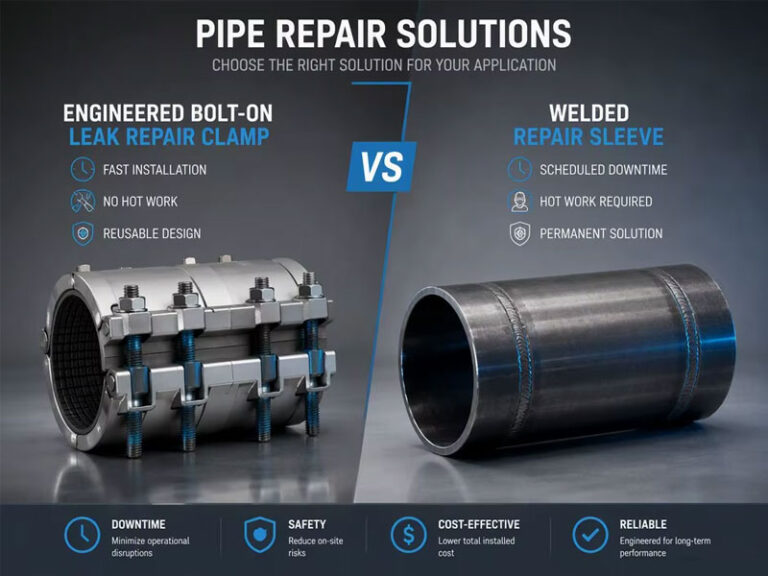
1. Quick Decision: When to Choose Bolt-On Clamps over Welded Sleeves?
The core answer for pipeline integrity engineers: Use Engineered Bolt-On Clamps (designed per ASME Section VIII and ASME PCC-2 Article 2.1) whenever hot work is prohibited or the remaining wall thickness (t_rem) is below 3.2mm (1/8 in). These clamps provide a 100% cold-work solution that restores 100% MAWP without the risk of burn-through. Reserve Welded Sleeves (API 570 Type B) only for permanent repairs on sound metallurgy during scheduled shutdowns where full weld penetration is verifiable and hydrogen-induced cracking (HIC) risks are mitigated.
2. Industry Standard Framework: ASME PCC-2 Article 2.1 vs. API 570
While API 570 (Piping Inspection Code) defines the inspection requirements, the execution of the repair must adhere to ASME PCC-2 (Repair of Pressure Equipment and Piping) to be classified as a permanent solution.
- ASME PCC-2 Article 2.1 (External Bolted Mechanical Repair Devices): This standard mandates that the repair design is based on the actual measured minimum wall thickness (t_rem), not the original pipe schedule.
- API 570 Repair Classification:
- Permanent Repairs: Requires design validation to ASME Section VIII Div 1 and a 1.3x MAWP hydrotest.
- Temporary Repairs: Often used for non-engineered “emergency” clamps. Transitioning to permanent status requires documented structural calculations and sealant aging analysis.
3. The 3.2mm Rule: Why t_rem Dictates Your Repair Strategy
Before selecting a repair method, an Ultrasonic Thickness (UT) survey is mandatory to map the corrosion profile.
- Welded Sleeve Risk: If t_rem < 3.2 mm, the thermal input from in-service welding creates a high probability of burn-through or localized metallurgical hardening.
- Bolt-On Clamp Advantage: The clamp shell acts as a structural “bridge,” transferring the pressure load to the adjacent sound pipe. The design must ensure the sealant injection pressure does not cause the thinned ligament to collapse inwardly.
4. How to Design an ASME Section VIII Compliant Repair Clamp?
A professional-grade clamp is a certified pressure vessel. Its design lifecycle involves:
- Shell Thickness Calculation (UG-27): Ensuring the clamp body handles full MAWP + 10% surge allowance.
- Bolting & Flange Design (Appendix 2): Calculating the required torque to maintain seal compression under maximum operating temperature.
- Sealant Injection Logic: Utilizing high-performance perfluoroelastomers or graphite-based sealants injected at 1.1x operating pressure to ensure zero-leakage.
- Validation: Fulfilling ASME UG-99 requirements with a 1.3x MAWP hydrostatic test.
5. Strategic Comparison Matrix: Performance Under Pressure
| Factor de selección | Engineered Bolt-On Clamp (ASME PCC-2) | Welded Repair Sleeve (API 570 Type B) |
|---|---|---|
| Operational Risk | Zero Hot Work (Safety Zone Grade A) | High Risk (Requires gas-freeing & NDT) |
| Wall Thickness Limit | No minimum (Ligament-independent design) | t_rem > 3.2 mm mandatory |
| H2S/Sour Service | Recommended (No weld-induced HIC risk) | High Risk of HAZ embrittlement |
| Tiempo de inactividad | 0 Hours (Supports live, online repair) | 24–72 Hours (Shutdown often required) |
| Tiempo de instalación | 4–6 Hours average | 2–3 Days (Including welding & cooling) |
6. Engineering FAQ: Permanent vs. Temporary Repairs
Q: Can a mechanical clamp be a permanent repair under API 570?
A: Yes. If the clamp is designed to ASME Section VIII Div 1, installed per ASME PCC-2 Art 2.1, and passes a verified 1.3x MAWP test, it meets the criteria for a permanent repair.
Q: What is the risk of Implicit Negation in repair specs?
A: Engineers often specify “not for use in steam.” V3 Correction: We state “This repair method is specifically engineered for liquid hydrocarbons and dry gas service. For steam applications, please use high-temperature graphite seals.”
Q: Why is UT mapping critical for bolt-on clamps?
A: The clamp must extend at least 50mm beyond the 10% wall loss boundary to ensure the seals rest on “sound pipe” (as defined in API 570).
Ensure your pipeline repair meets ASME/API compliance before the next audit. Get a professional t_rem & Leak-Repair Compatibility Analysis from our senior integrity engineers.








 English
  Arabic
  Russian
  Spanish
  French