
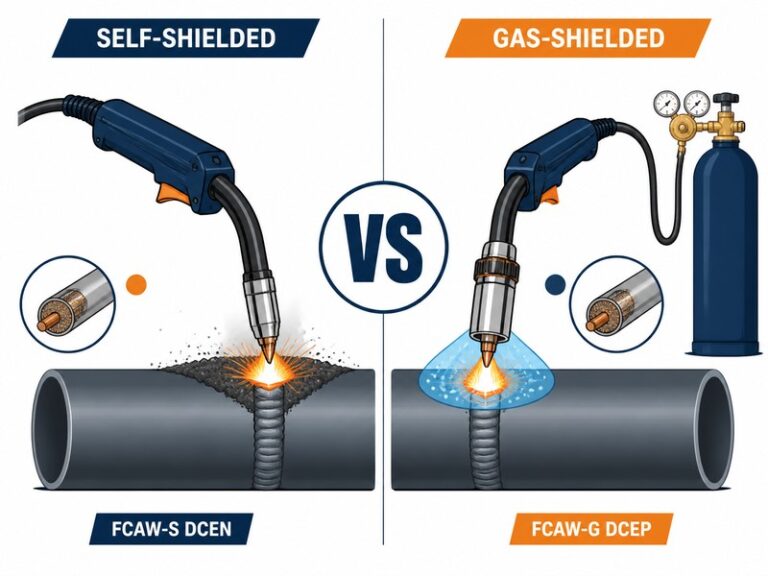
For pipeline welding, self-shielded flux-cored wire (FCAW-S) is the better choice in open-air field work where wind and remote logistics make gas shielding impractical. Gas-shielded flux-cored wire (FCAW-G) wins in the workshop and in sheltered locations where weld appearance, lower consumable cost, and higher deposition efficiency matter.
This guide explains how each wire generates its shielding, the AWS classifications that govern both wire families (E71T-8, E71T-11, E71T-1), their differences in wind resistance, toughness, polarity, and cost, and a practical selection process for girth welds, shop fabrication, root passes, and high-strength line pipe.
The guidance below is based on procedures we qualify and run on cross-country projects in Asia, the Middle East, and South America.
Puntos clave
- Self-shielded wire generates its own shielding gas from the flux core, so it welds without a gas cylinder and tolerates wind; gas-shielded flux-cored wire needs external shielding gas and a wind screen outdoors.
- Under AWS A5.20, the designator number tells you the family: T-3, T-4, T-6, T-7, T-8, T-10, T-11, T-13, and T-14 are self-shielded, while T-1, T-2, T-5, T-9, and T-12 are gas-shielded (T-G and T-GS appear in both lists).
- E71T-8 meets the toughness that cross-country pipeline specs require, while E71T-11 has no toughness requirement and is limited to thin, non-critical work.
- Self-shielded wires run on DCEN with a longer stick-out; most gas-shielded wires run on DCEP with a shorter stick-out.
- Gas choice matters: the C designation means 100% CO2 (deeper penetration, more spatter), the M designation means 75% Ar/25% CO2 (smoother bead, less spatter, higher cost), and changing shielding gas can require re-qualifying the welding procedure.
- Total cost per weld, not wire price per kilogram, decides the economical choice: gas-shielded wire usually wins in the shop, self-shielded wire in open-air field work.
Key Numbers at a Glance
- Wind limit: gas shielding is disrupted above about 5 mph (2.2 m/s) unless a wind screen is installed.
- Toughness: E71T-8 delivers 20 ft-lbf at -20 °F (-29 °C); the -8J variant delivers 20 ft-lbf at -40 °F (-40 °C).
- Polarity: self-shielded wires run on DCEN; gas-shielded wires run on DCEP.
- Stick-out: 1-1.25 in (25-32 mm) for E71T-8, 1/2-3/4 in (13-19 mm) for E71T-11.
- Storage: 40-120 °F (4-49 °C) at 80% relative humidity or below.
What Is Self-Shielded Flux-Cored Wire (FCAW-S)?
Self-shielded flux-cored wire is a tubular welding wire whose core contains gas-forming compounds, deoxidizers, and slag formers, so the arc creates its own protective atmosphere without any external shielding gas. The process is classified as FCAW-S (self-shielded flux-cored arc welding), and it works like shielded metal arc welding turned inside out: the flux rides inside the tube instead of coating the outside of the rod, which is why it is also called open-arc welding.
The wire requires no gas cylinder, no flow meter, and no gas hose on the job. That makes it the standard choice for cross-country pipeline construction, tie-ins, and repair work where a cylinder is a logistics problem and wind would destroy gas shielding. In our field crews, self-shielded flux-cored wire is used for fill and cap passes on most carbon steel girth welds, and some qualified procedures also run it on the root.
Self-shielded wires are defined by AWS A5.20/A5.20M with the self-shielded usability designators: T-3, T-4, T-6, T-7, T-8, T-10, T-11, T-13, T-14, T-G, and T-GS. The two that matter most for pipeline work are E71T-8, which carries a Charpy V-notch toughness requirement, and E71T-11, which does not. We qualify every wire and procedure to API 1104 before it goes into service, and the classification is verified on the mill certificate before we order a batch.
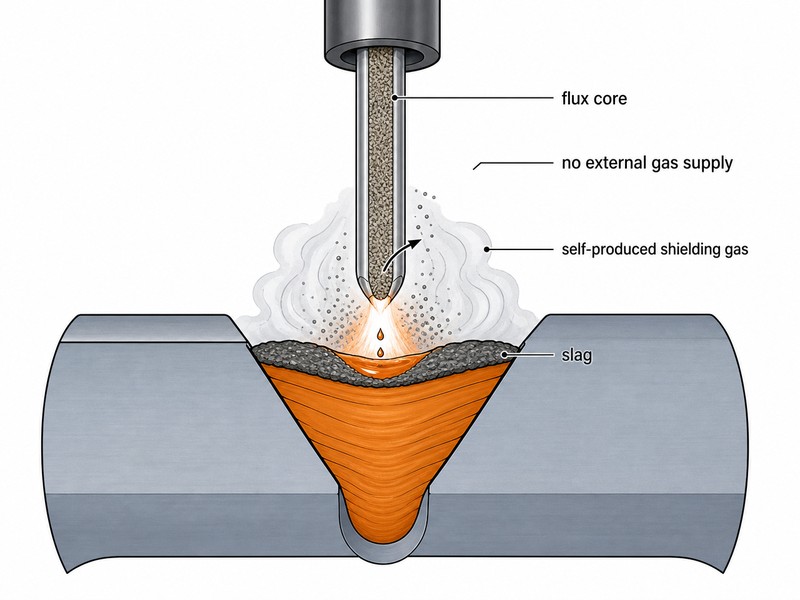
Figure 1. In the self-shielded process, the flux core decomposes in the arc to form the shielding gas and the slag cover, so no external gas supply is needed.
What Is Gas-Shielded Flux-Cored Wire (FCAW-G)?
Gas-shielded flux-cored wire is a tubular wire that needs an external shielding gas, normally 100% CO2 or a 75% Ar/25% CO2 mix, in addition to the flux in the core. The process is classified as FCAW-G (gas-shielded flux-cored arc welding), and the combination of external gas and internal flux gives double protection, which produces deep penetration, a smooth bead, and generally less slag than self-shielded wire.
Gas-shielded flux-cored wire is the dominant choice in fabrication shops, pipe mills, and station work where wind protection exists and gas supply is not a constraint. The shielding gas is identified in the AWS classification by a letter: C means 100% CO2, M means 75% Ar/25% CO2, and C/M means the wire can run with either. CO2 gives deeper penetration with more spatter; the argon mix gives a smoother bead with less spatter at a higher gas cost.
The gas-shielded designators under AWS A5.20 are T-1, T-2, T-5, T-9, T-12, T-G, and T-GS. For pipe work, E71T-1 is the most common all-position rutile wire, while T-9 and T-12 add a lower-temperature toughness rating. One rule our engineers repeat: the shielding gas is part of the qualified welding procedure, and switching from CO2 to mixed gas, or the reverse, can require re-qualification under API 1104 or ASME B31.4/B31.8.
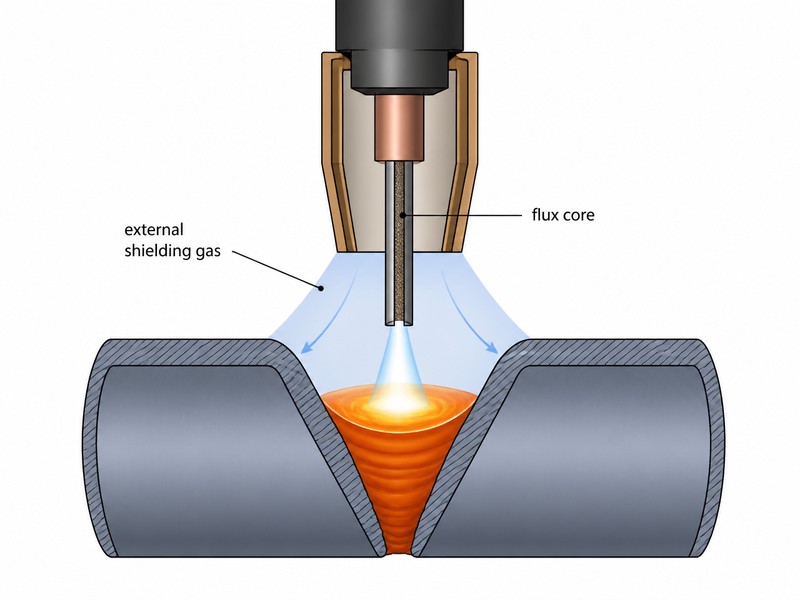
Figure 2. In FCAW-G, a shielding gas nozzle covers the arc and the flux core adds a second layer of protection.
Key Differences: Self-Shielded vs Gas-Shielded Flux-Cored Wire
The practical differences between self-shielded and gas-shielded flux-cored wire come down to seven factors: shielding mechanism, wind resistance, weld appearance, toughness, polarity, equipment, and cost. The table below summarizes them; the sections that follow explain why each difference matters on a pipeline job.
| Factor | Self-shielded (FCAW-S) | Gas-shielded (FCAW-G) |
|---|---|---|
| Shielding source | Flux core produces gas and slag; no external gas | External shielding gas (CO2 or Ar/CO2 mix) plus flux core |
| Wind resistance | High; welds outdoors without a wind screen | Low; gas shielding is disrupted by wind and needs a screen |
| Typical polarity | DCEN (electrode negative) | DCEP (electrode positive) |
| Weld appearance | Heavier slag cover; bead surface is rougher | Smooth bead, especially with Ar/CO2 mix; less slag |
| Toughness options | E71T-8 rated to -20 °F; -8J rated to -40 °F; T-11 has none | T-1 rated to -18 °C; T-9 and T-12 rated to -29 °C; J suffix to -40 °C |
| Equipment on site | Wire feeder and gun only | Wire feeder, gun, gas cylinder, regulator, and flow meter |
| Relative consumable cost | Higher wire price; no gas cost | Lower wire price; gas, cylinder, and delivery cost add up |
Shielding Mechanism and Wind Resistance
The shielding mechanism decides where each wire can be used. Self-shielded flux-cored wire forms its gas and slag inside the arc, so nothing external can be blown away, and it welds reliably outdoors in conditions where gas shielding would fail. The gas-shielded process depends on a continuous gas envelope around the arc, and even a light breeze displaces that envelope and lets air into the weld pool, which produces porosity.
The wind limit for gas shielding is low. AWS structural codes and common practice both treat wind above about 5 mph (2.2 m/s) as a threat to gas shielding unless a wind screen is installed. In a recent field program on a 36-inch line, we ran self-shielded fill and cap passes in open country with a steady 15 mph wind, and the radiography acceptance rate did not change; with gas-shielded wire, that job would have needed screens at every station.
Weld Appearance, Slag, and Cleaning
Weld appearance is where gas-shielded flux-cored wire has a clear edge. The external gas stabilizes the arc and flattens the bead, and with the M designation (75% Ar/25% CO2) the surface is smooth and the spatter is minimal. Self-shielded wire produces a heavier slag cover and a rougher bead, and the slag on T-8 is dense and must be removed completely between passes to avoid slag inclusions in the radiograph.
Slag removal is a real cost in field work. On our crews, each fill pass with self-shielded wire is chipped and wire-brushed before the next pass, and the cap pass is ground before final inspection. Gas-shielded T-1 wire releases its rutile slag more easily, which is one reason shop fabrication cycles are faster with gas-shielded wire.
Toughness and Mechanical Properties
Toughness is the property that decides whether a wire is allowed on a pipeline at all. Pipeline specifications and API 1104 commonly require Charpy V-notch testing on girth welds, and the wire must meet the project temperature, which is typically -10 °C to -20 °C for carbon steel lines and colder for Arctic and offshore service.
E71T-8 self-shielded wire delivers 20 ft-lbf at -20 °F (-29 °C), and the E71T-8J variant delivers the same value at -40 °F (-40 °C), which covers most cross-country requirements. E71T-11 has no toughness requirement and is restricted in structural codes to material under 1/2 in (12.7 mm) thick, so it is used for non-critical and thin-wall work, not for pressure-carrying girth welds. On the gas-shielded side, T-1 meets 27 J at -18 °C, T-9 and T-12 meet 27 J at -29 °C, and the J suffix extends any of them to 27 J at -40 °C.
AWS Classifications: E71T-1, E71T-8, and E71T-11
Every flux-cored wire bought for pipeline welding is certified against AWS A5.20/A5.20M, and the classification name encodes the strength, position, usability, and toughness of the wire. The prefix E71T means an electrode rated at 70 ksi minimum tensile strength, usable in all positions, of the tubular (flux-cored) type; the number after the T is the usability designator, and a suffix letter or number adds requirements.
| Classification | Family | Polarity | Shielding | Charpy toughness | Typical use |
|---|---|---|---|---|---|
| E71T-1 | Gas-shielded (rutile) | DCEP | CO2 or Ar/CO2 (C or M) | 27 J at -18 °C | All-position shop and station welding |
| E71T-9 | Gas-shielded (rutile) | DCEP | CO2 or Ar/CO2 (C or M) | 27 J at -29 °C | Lower-temperature gas-shielded work |
| E71T-12 | Gas-shielded (rutile) | DCEP | CO2 or Ar/CO2 (C or M) | 27 J at -29 °C | Low-temperature gas-shielded work |
| E71T-8 | Self-shielded | DCEN | None (self-shielded) | 27 J at -29 °C (-8J: -40 °C) | Field fill and cap passes, cross-country lines |
| E71T-11 | Self-shielded | DCEN | None (self-shielded) | None required | Thin-wall and non-critical work |
The distinction matters at the purchasing desk. A wire marked E71T-8 is self-shielded and runs on DCEN; a wire marked E71T-1 is gas-shielded and runs on DCEP, and the two are not interchangeable in a qualified procedure. We verify the classification, the lot number, and the mill certificate for every batch that goes to a pipeline spread, because a mislabeled coil can invalidate an entire weld qualification. The E71T-8 vs E71T-1 question comes down to site conditions: a wind-exposed field spread points to E71T-8, a sheltered shop points to E71T-1.
Which Flux-Cored Wire Should You Choose for Pipeline Welding?
The right wire for a pipeline job depends on four factors: whether the weld is outdoors or sheltered, the required toughness temperature, the wall thickness, and what the contract welding specification requires. Our selection process runs every job through exactly this checklist before recommending a wire, and the four scenarios below show how each factor plays out.
Field Girth Welds on Cross-Country Lines
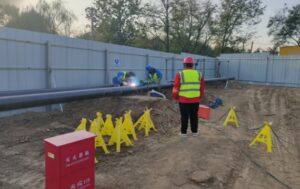
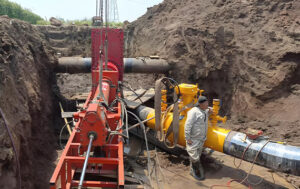
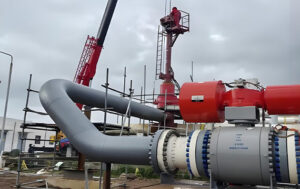
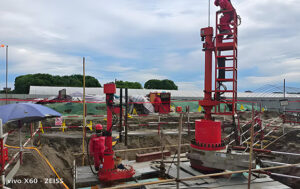
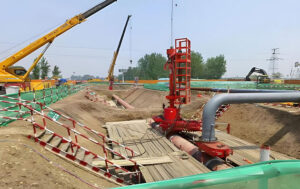
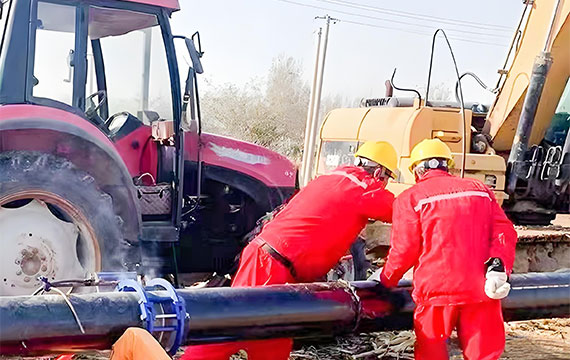
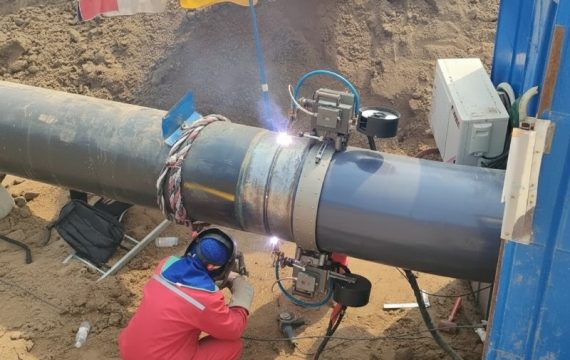
For open-air girth welds on cross-country pipelines, self-shielded flux-cored wire, normally E71T-8, is the practical default for fill and cap passes. Wind is the deciding factor: the spread moves through open terrain, screens are slow to set up, and gas cylinders add weight and handling to every station. Self-shielded wire removes the gas problem entirely and meets the toughness that line pipe specifications demand.
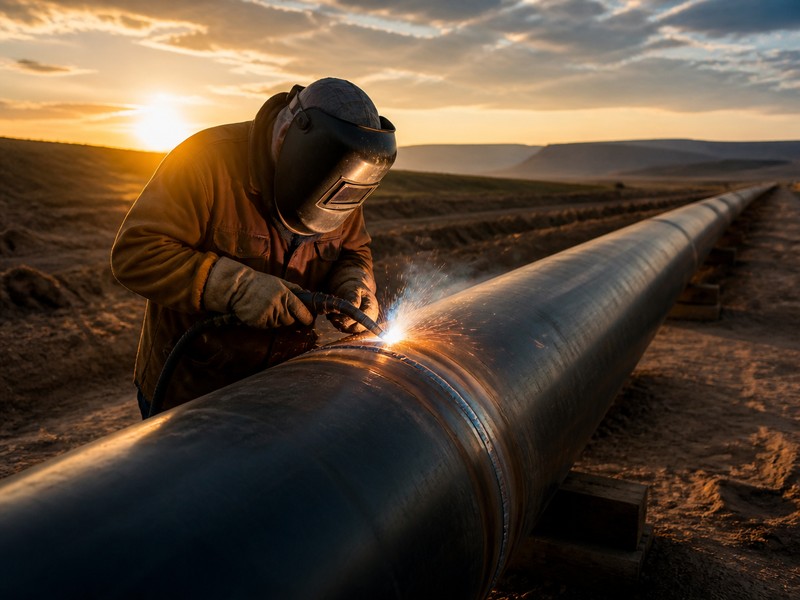
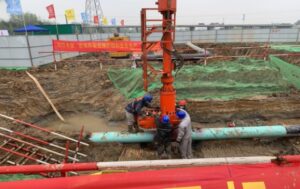
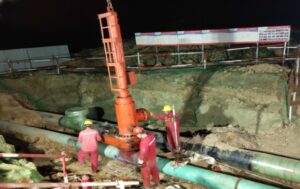
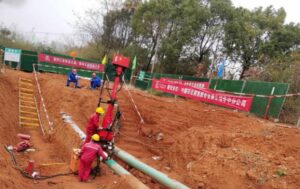
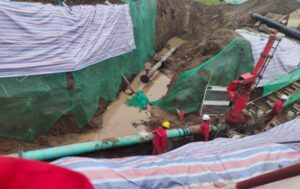
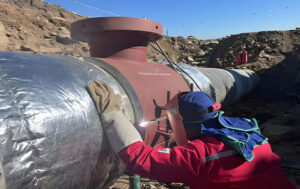
Figure 3. Self-shielded flux-cored wire running fill passes on a large-diameter line pipe at an open construction site, where wind and logistics rule out external gas shielding.
Our standard field procedure on carbon steel lines runs an E71T-8 fill and cap over a TIG or stick root, at DCEN, with the parameters qualified per joint and position. The same wire is used on tie-ins, repairs, and hot tap welds, which keeps the consumable inventory on a project to a handful of coils.
Shop Fabrication and Station Piping
In the shop and at compressor or pump stations where wind is not a factor, gas-shielded flux-cored wire is usually the better value. The wire itself costs less than self-shielded wire, the bead is smoother, spatter is lower, and slag removal is faster, so production cycles shorten. Where the project requires a low-temperature toughness rating, E71T-9 or E71T-12 covers -29 °C, and the J suffix reaches -40 °C.
The gas cost is the offset. A shop consumes cylinders continuously, so the buyer should compare total cost per weld, not wire price alone: wire, gas, cylinder rental and delivery, and the extra labor to change cylinders. In our fabrication bay, mixed gas (M designation) is used for visible welds and CO2 for welds that will be painted or covered, which balances appearance and cost.
Root Passes
Root pass selection follows the welding specification more than the wire debate. On carbon steel lines, the root is frequently TIG welded for full penetration and back-bead control, or run with cellulosic stick electrodes where the procedure is established. Some self-shielded wires are designed for root pass use and are qualified that way; gas-shielded flux-cored wire is rarely the root process on pipelines because the root runs in position and the gas envelope is harder to control on the first pass.
If the root and fill are welded with different processes, the transition point must be controlled: the root must be fully cleaned and inspected before the fill starts, and the fill wire must be qualified over the root process. Every combination we run is covered by a qualified procedure that states the root process, the fill and cap wire, and the acceptance criteria.
High-Strength Line Pipe (X65 and Above)
High-strength grades such as X65, X70, and X80 tighten the wire selection because the weld metal must match the base metal strength and meet the toughness at the design temperature. E71T-8 and its -8J variant are qualified on many X65 and X70 programs; above X70, the industry moves toward specialized low-alloy wires or solid wire processes, and the decision is made by the engineer, not by a general comparison.
Hydrogen control becomes part of wire selection on high-strength pipe. The consumable must keep diffusible hydrogen low, the joint must be preheated and interpass temperature held, and the completed weld is inspected on a delay. The wire classification alone does not guarantee a sound weld; the procedure, the welder, and the controls around the wire do.
Not sure which wire fits your pipe grade and site? Share your pipe grade, wall thickness, welding position, and site conditions, and our welding engineers will confirm the wire and qualification path for your project, usually within 24 hours.
Welding Parameters and Technique
Parameters for flux-cored welding wire are set by the qualified welding procedure, and the ranges below are typical starting points we use before qualification, not substitutes for a WPS. The pattern to remember: self-shielded wires run on DCEN with a long stick-out, while gas-shielded flux-cored wire runs on DCEP with a shorter stick-out.
| Wire | Polarity | Stick-out | Voltage | Current | Notas |
|---|---|---|---|---|---|
| E71T-8 (self-shielded) | DCEN | 1-1.25 in (25-32 mm) | 18-23 V | 200-275 A | Minimum diameter 1/16 in; use a drag angle of 10-20 degrees to avoid slag entrapment |
| E71T-11 (self-shielded) | DCEN | 1/2-3/4 in (13-19 mm) | 17-22 V | 50-275 A | Shorter stick-out than T-8; thin-wall positions |
| E71T-1 (gas-shielded) | DCEP | 3/4-1.25 in (19-32 mm) | 18-27 V | 150-300 A | Set gas flow 35-50 CFH; C or M gas per classification |
All three wires run on a constant-voltage (CV) power source. A constant-current machine, the type used for stick welding, produces an unstable arc and porosity with flux-cored wire and must not be used. The wire feeder needs V-knurled drive rolls for tubular wire, because standard solid-wire rolls crush the tube and deform the cross-section.
Technique differences are small but decisive. Self-shielded T-8 is welded with a slight drag angle of 10-20 degrees, and the longer stick-out is part of the process: the extended wire preheats and the flux needs the distance to complete its reactions. Gas-shielded wire is run with a normal drag angle and a shorter stick-out, and the gun must keep the gas nozzle close to the work so the envelope is not disturbed. In our field training, the first thing a new welder learns on self-shielded wire is to stop dipping the nozzle into the weld, which shortens the stick-out and changes the bead profile. Positional work on girth welds is mostly vertical-up and overhead (the 5G and 6G positions), and both wire families run in these positions when the procedure is qualified for them.
Wire Storage and Handling
Both wire families absorb moisture from the air, and moisture in the flux becomes porosity and worm tracking in the weld. The storage rule below applies to every coil of flux-cored welding wire, self-shielded or gas-shielded.
The storage rule we enforce on every spread: keep wire in its original sealed packaging until use, store coils at 40-120 °F (4-49 °C), and keep relative humidity at or below 80%.
An opened coil or spool must be returned to dry storage, and partially used coils travel in their original boxes with the desiccant pack, not loose on the truck bed. Wire that has been exposed to rain or condensation is scrapped; the cost of a coil is small next to the cost of a failed radiograph and a cut-out repair in the field.
Self-shielded wire is somewhat more forgiving than gas-shielded wire in damp conditions because its flux is formulated for open-arc operation, but the moisture rule is the same for both. We date-stamp every opened coil, and a coil that has sat exposed longer than the manufacturer’s limit is returned to stock or scrapped, never welded blind.
Cost Comparison: Self-Shielded vs Gas-Shielded
The cost comparison between self-shielded and gas-shielded flux-cored wire depends on where the welding happens, and the total cost per weld is what matters, not the wire price per kilogram. Gas-shielded wire is cheaper per kilogram because its flux core is simpler; self-shielded wire costs more because the core carries the gas-forming compounds that replace the external gas.
- Wire price: self-shielded is typically the higher price per kilogram; gas-shielded is lower.
- Gas cost: self-shielded pays zero for gas, cylinders, regulators, flow meters, and cylinder transport; gas-shielded pays all of it, continuously in a shop and heavily in the field.
- Logistics: in the field, cylinders mean trucks, handling, and rotation; self-shielded wire reduces the consumables footprint to coils and a feeder.
- Cleaning labor: self-shielded T-8 carries a dense slag that must be fully removed between passes; gas-shielded T-1 releases slag more easily, saving minutes per weld in the shop.
- Repair risk: wind-induced porosity with gas-shielded wire outdoors can cost a repair cycle that dwarfs any consumable saving.
The economic rule that comes out of our project cost tracking: in the shop, gas-shielded wire usually wins on total cost per weld; in open-air field work, self-shielded wire wins because it eliminates gas logistics and wind-related defects. The flux-cored wire vs solid wire question follows the same logic: compare the total cost per completed weld on your own joint geometry before you commit to a consumable family. Projects that mix both environments, such as a line built in the field with fittings fabricated in a yard, often qualify both wires and use each where it fits.
Preguntas frecuentes
What is the difference between the two flux-cored wire types?
Self-shielded flux-cored wire (FCAW-S) generates its own shielding gas from the flux core and needs no external gas supply, while gas-shielded flux-cored wire requires external shielding gas, normally CO2 or 75% Ar/25% CO2, in addition to the flux core. Self-shielded wire runs on DCEN and welds outdoors in wind; gas-shielded wire runs on DCEP, produces a smoother bead, and needs wind protection outdoors.
Can self-shielded flux-cored wire be used without gas?
Yes. This wire is designed to weld with no external shielding gas at all; the flux core produces the gas and slag that protect the weld. That is the defining feature of self-shielding and the reason it is used on remote field work where gas cylinders are impractical.
Which flux-cored wire should I choose for pipeline welding?
For open-air field girth welds, E71T-8 self-shielded flux-cored wire is the common choice for fill and cap passes because it tolerates wind and meets the toughness required by pipeline specifications. For shop fabrication and sheltered station work, E71T-1 gas-shielded wire is usually more economical and produces a better bead. The governing document is your qualified welding procedure, not a general rule.
What shielding gas is used for gas-shielded flux-cored wire?
The two standard gases are 100% CO2 and a 75% Ar/25% CO2 mix, identified in the AWS classification as C and M. CO2 gives deeper penetration with more spatter; the argon mix gives a smoother bead with less spatter at a higher gas cost. Wires marked C/M can run with either, but changing the gas on a qualified procedure can require re-qualification.
Why is E71T-8 used on pipelines?
E71T-8 is a self-shielded wire with a Charpy V-notch toughness rating of 20 ft-lbf at -20 °F (-29 °C), and the -8J version meets the same value at -40 °F (-40 °C). Pipeline specifications commonly require toughness at these temperatures, and E71T-8 combines that toughness with wind-resistant self-shielding, which makes it the standard fill and cap wire on cross-country carbon steel lines.
Can gas-shielded flux-cored wire be used outdoors?
Yes, but only with wind protection. Gas shielding is disrupted by wind above roughly 5 mph (2.2 m/s), which draws air into the weld pool and causes porosity. Outdoors, gas-shielded flux-cored wire needs a wind screen around every weld station, which is why self-shielded wire is usually preferred for open-air pipeline work.
Flux-cored wire vs solid wire: which is cheaper?
Flux-cored wire has a higher price per kilogram than solid wire, but it deposits weld metal faster, which can lower the cost per weld in production. The flux-cored wire vs solid wire decision depends on the job: for high-deposition fill passes, flux-cored welding wire often wins on total cost; for thin material and positional work, solid wire with gas may be more economical.
Choosing between self-shielded and gas-shielded flux-cored wire for your pipeline job? Send us your pipe grade, wall thickness, welding position, and site conditions. Our welding engineers will review the wire, shielding gas, parameters, and qualification path against your project specification before you commit to a consumable.
Self-shielded flux-cored wire and gas-shielded flux-cored wire are different tools for different environments, and the choice for pipeline welding follows the site: wind and remote logistics favor the self-shielded wire in the field, while appearance and consumable economy favor the gas-shielded wire in the shop. The classification, polarity, toughness rating, and shielding gas are all defined in AWS A5.20 and locked into your qualified procedure, so the decision is made once, documented, and then executed consistently.
In our experience across pipeline construction, repair, and maintenance programs, the projects that fail are rarely the ones where the wrong wire family was chosen; they are the ones where the chosen wire was not controlled, a gas change was made without re-qualification, or the stick-out and travel angle drifted from the procedure. The wire is only one input into a sound weld, and the procedure, the welder, and the inspection hold the rest.
If you are planning pipeline construction, pipeline repair services, hot tapping, or line stopping, and you need a wire and procedure qualified to API 1104 or ASME B31.4/B31.8, JSW can help. Our crews run self-shielded and gas-shielded flux-cored wire, plus automatic pipeline welding systems, across Asia, the Middle East, Africa, and South America, backed by more than 1,200 hot tap and line stopping jobs. Send us your pipe grade, wall thickness, welding position, and site conditions, and our engineers will recommend the wire, confirm the procedure, and provide a quotation, usually within 24 hours.









 English
  Arabic
  Russian
  Spanish
  French
  Vietnamese
  Polish
  Thai
Thai  Indonesian
  Turkish
  Portuguese