
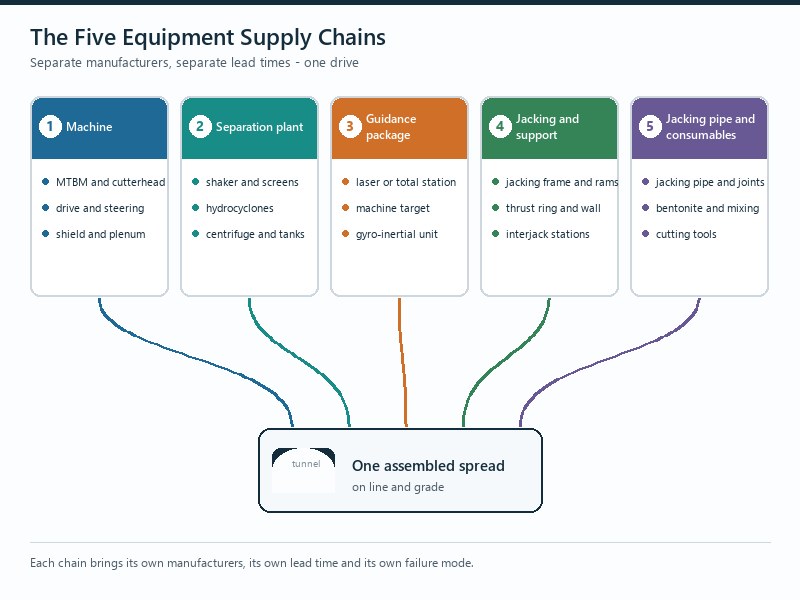
Microtunneling equipment manufacturers do not form a single market. A working drive is assembled from five separate supply chains – the machine, the slurry separation plant, the guidance and steering package, the jacking and support equipment, and the jacking pipe – and the companies that lead one category rarely lead all of them.
This guide maps the supply landscape by equipment category and machine class, explains where the regional manufacturing centers are and why lead time so often outweighs specification, sets out a five-step shortlisting method with twelve questions that expose a weak offer, and compares the procurement routes contractors use – purchase, rental, lease and package supply – along with the true cost of ownership over a drive.
Who Makes Microtunneling Equipment, and Why the List Is Longer Than You Expect
The list of microtunneling equipment manufacturers is long because the equipment itself is not one product. Published market estimates for the microtunneling machine market range from roughly USD 0.7 billion to about USD 3.8 billion for recent years, depending on whether separation plants, guidance and support equipment are counted, with forecasts commonly quoted between about USD 1.5 billion and USD 6.7 billion.
For a buyer, the practical consequence is that the answer to “who makes it” has to be asked five times. Equipment procurement for a drive splits into five categories:
- machine builders: Japanese, European and a small North American group
- separation plants: solids-control specialists
- guidance packages: survey-instrumentation suppliers
- jacking equipment: pipe jacking specialists
- pipe and tooling: wear-part manufacturers
The Five Supply Chains Behind One Microtunneling Drive
Every drive needs the same five categories of equipment, and each has its own manufacturers, its own specification language and its own lead-time behavior. Splitting the equipment procurement this way makes it obvious which items are on the critical path and which can be substituted at short notice. This mapping also shows which categories of microtunneling equipment manufacturers are genuinely competitive.
| Categoría | What it covers | Who typically supplies it | What to evaluate |
|---|---|---|---|
| Machine (MTBM or shield) | Cutterhead, drive, face support, steering, instrumentation | Specialist tunnel machine manufacturers | Machine class, tooling compatibility, intervention capability, spares |
| Separation plant and slurry circuit | Shakers, desanders, desilters, centrifuges, pumps, lines and valves | Solids-control and slurry-treatment specialists | Throughput against peak excavation rate, cut points, wear resistance |
| Guidance and steering package | Laser target, total-station or gyro survey, inclinometers, software and display | Guidance and survey instrumentation specialists | Achievable tolerance, update interval, audit method, curve capability |
| Jacking and support equipment | Jacking frame, thrust ring, thrust wall design, interjacks, lubrication system, pipe spacers | Pipe jacking equipment suppliers and specialist fabricators | Thrust capacity, stroke, load distribution, interjack interfaces |
| Jacking pipe and consumables | Jacking pipe, joints and seals, bentonite and polymers, cutter tooling | Pipe manufacturers and consumable suppliers | Pipe strength and joint detail, tolerance of deflection, wear-part availability |
Machine Manufacturers: The Main Families and Their Origins
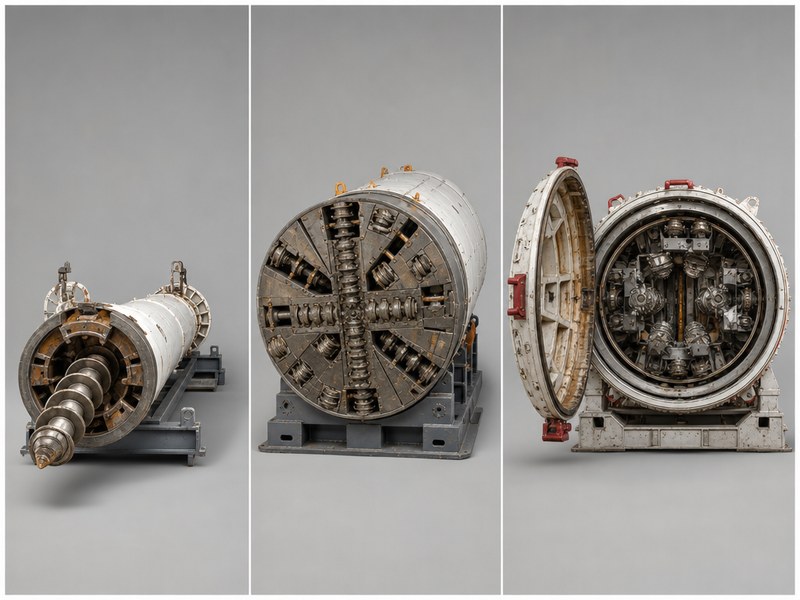
Machine manufacturing – the microtunnel boring machine (MTBM) category – has two long-established centers and a set of regional players. Japanese-origin and European-origin lines dominate the technical literature, and the differences between them are mostly historical rather than practical: both build machines that meet the same published performance requirements. For a buyer, the useful question is which microtunneling equipment manufacturers can supply your class with support in your region, not which origin is technically superior.
Alongside these two centers, market participants include mts Perforator (Germany), Terratec (Australia and Japan), Robbins (United States) and JIM Technology (Japan).
Japanese-origin and Japanese-linked lines
Microtunneling was developed in Japan in the early 1970s, and Japanese manufacturers remain central to the machine market. Iseki Poly-Tech, established in Tokyo in 1971, built a global reputation for tunnel boring and trenchless equipment, and its UNCLEMOLE microtunneling system has been on the market for more than four decades. Public company information places its re-entry to the North American market around 2015, after a period of limited presence there, and Japanese corporate groups continue to build machines through combined engineering entities. Those groups rank among the largest tunnel boring machine manufacturers by volume in the Japanese market.
European-origin lines
The European machine market is led by German manufacturers. Herrenknecht, for example, describes its AVN machine as the technology for tunneling in non-accessible areas, publishes a current range covering the AVN 250 to 1200 series, and reports more than 850 utility tunneling machines in operation. The same manufacturer has developed cutterheads with a fold-away mechanism for blind-hole tunnels, where the machine ends in the ground and cannot be recovered conventionally – a reminder that machine supply is not only about the standard catalog. For a water-bearing sand or gravel drive, a slurry shield machine proven in that ground family is the benchmark to ask about, not the newest model in the series.
North American and Australian manufacturers
Outside the two main centers, North America is served by a relatively small number of manufacturers. Published industry descriptions present Akkerman as the only North American manufacturer of both pilot tube and slurry microtunneling equipment systems, and Australian and Australian-Japanese entities also build machines for the mid-diameter and microtunneling segments. China builds significant volumes for its domestic market and for export. Taken together, the tunnel boring machine manufacturers relevant to a microtunneling shortlist are therefore a small global group with materially different regional reach. Note also that a pilot tube system is normally bought as a complete guidance-and-casing package rather than as a machine on its own, which puts it on a different supply chain again.
Separation Plant, Guidance and Jacking Equipment Suppliers
This section covers the separation, guidance and jacking supply chains – the categories where a shortlist most often goes thin, because they are bought late and specified loosely. The reason is structural: microtunneling equipment manufacturers compete in five markets, and only one of them is the machine.
- Separation plant. Suppliers in this category build staged systems combining coarse screen shakers, desanders, fine screen shakers, mud cleaners, desilters and centrifuges. The sizing question is arithmetic – throughput against peak excavation rate, and cut points that match the particle size distribution of the ground.
- Guidance. Guidance suppliers provide laser target systems, automated total-station or azimuth systems and gyro packages. Published specification guidance treats laser target systems and gyro systems as the two standard options, with laser target systems indicated for drives to roughly 200 m and gyro for drives beyond that.
- Jacking equipment. Jacking frames and support equipment are generally supplied by pipe jacking equipment specialists rather than by machine manufacturers, even though the two have to work together. Frames of this class are built with hydraulic cylinders delivering up to about 1,200 t of thrust, and the frame has to be matched to the machine, the pipe diameter and the shaft.
- Lubrication and consumables. Automatic lubrication systems and the bentonite or polymer supply are a separate purchase again, and their performance directly sets the friction the jacking equipment has to overcome.
Capability Classes, Not Brand Ranks
A useful shortlist sorts suppliers by capability class rather than reputation. Offerings from two tunnel boring machine manufacturers can look similar in a brochure and be entirely different in the field once drive length, ground and intervention requirement are applied. Whatever the class, a microtunneling machine supplier should be asked for the nearest working machine to your specification rather than the nearest catalog entry. In our experience, sorting by capability class is more useful than ranking microtunneling equipment manufacturers.
| Machine class | Typical outside diameter coverage | Ground family | Drive character |
|---|---|---|---|
| Small closed-face machine | Lower end of the published 30 in to 114 in (about 760 to 2,900 mm) size range | Soft to medium soils, mixed sandy ground | Short to medium drives, gravity sewer work |
| Mid-size slurry shield machine | Mid range of the published 30 in to 114 in (about 760 to 2,900 mm) size range | Water-bearing sands and gravels, mixed face | Medium to long drives with active face support |
| Large peripheral drive machine with face access | Upper end of the published 30 in to 114 in (about 760 to 2,900 mm) size range | Abrasive and mixed ground, cobbles, rock intervals | Long drives where tooling access is essential |
| Pilot tube system | Smaller product pipe diameters, typically up to about 48 in flush wall jacking pipe | Displaceable soils, shallow water table or low permeability ground | Short drives, typically of the order of 400 ft or less, with the tightest accuracy |
| Auger machine | Small to mid diameters | Dry, stable ground only | Short drives without active face support |
Applies to: owners, contractors, bidders and EPC firms building a tender list at procurement stage. Not applicable where: the method or machine family is still being chosen, or where the drive conditions are not yet defined. Supplier capability, availability and commercial terms must be confirmed with each supplier for the specific drive.
Shortlisting a Tender List – and the Twelve Questions That Expose a Weak Offer
- Fix the capability class first. Convert the drive into diameter, ground family, drive length, tolerance and intervention requirement, then keep only suppliers that build machines in that class.
- Filter by ground evidence, not by claimed ground range. Ask for drives completed in comparable ground, with the machine model and the tooling used. A microtunneling machine supplier that cannot name a comparable drive in writing should be dropped at this stage.
- Check regional support reach. Identify who supplies spares, wear parts and field service in the project region, and how quickly they can attend.
- Check lead time on the long items. Cutter tooling, guidance packages, separation plant components and pipes usually set the program, not the machine.
- Filter by the intervention answer. If the drive may need tooling changed mid-way, a supplier that cannot offer access has to be removed at this stage.
The fastest way to test an equipment offer is to ask twelve questions that each require a checkable answer. A supplier that cannot answer them in writing is not necessarily a poor supplier, but the gaps have to be priced as risk.
| Pregunta | What a weak answer looks like |
|---|---|
| What thrust and torque are guaranteed at my diameter? | A family maximum taken from a larger machine |
| Which comparable drives has this class completed in this ground? | Reference to a different ground condition |
| What tooling list is proposed, and expected wear? | A generic tooling list with no consumption estimate |
| Can tooling be changed from inside the machine? | An answer that depends on the drive not needing it |
| What is the achievable line and grade tolerance, and how is it verified? | A tolerance quoted without a verification method |
| Which guidance system, and does it work on curves? | Line-of-sight guidance offered for a curved drive |
| What face pressure control band, and what happens on power loss? | A control figure without a failure mode |
| What separation plant throughput does the machine require? | No number, or a number quoted as average only |
| What is the interjack interface and spacing? | Interjacks treated as an optional extra |
| What is the wear-part list and delivery lead time? | Indicative lead times with no stock position |
| What is demonstrated at factory and at site acceptance? | A commissioning procedure without hold points |
| Who attends, and how fast, if the machine stops? | A call center rather than a named field service arrangement |
Purchase, Rental, Lease or Package Supply
Equipment procurement route choice is driven by utilization: the same machine class can be the right buy for one contractor and the wrong buy for another on identical work, because what differs is the forward pipeline of comparable drives.
- Purchase. Justified where there is a confirmed pipeline of drives in the same class, in-house operating and maintenance crews, and the yard, transport and insurance capacity to hold the asset between projects.
- Rental. Transfers utilization risk and is usually the default for one-off drives and for contractors whose next comparable drive is not yet awarded.
- Lease. Suits a multi-year program where the machine is working most of the time but ownership capital is better deployed on the works.
- Package supply. Some suppliers will supply a machine with separation plant, guidance and support equipment as a package; this simplifies interfaces but narrows competition and can hide which item is on the critical path. Choosing a microtunneling machine supplier on a package price alone therefore weakens the buyer’s position on the item that actually governs the program.
Whichever route is used, equipment procurement should record who holds spares, who attends on breakdown, and what response time is contractually promised. Spares, wear parts and service are the real cost of ownership. Wear-part consumption in abrasive ground, cutter tooling for the expected drive length, seal and pump spares, and the availability of a field engineer decide whether a machine is economic. On drives we have supported, the most expensive equipment outcome was never the purchase price; it was a correct machine waiting on a wear part with no regional stock.
Conclusión: the reliable shortlist is the one where the supplier’s machine, the support categories and the regional service arrangement all pass the same test, and where lead time on the long items has been checked before the tender is issued rather than after award.
Machine specification is covered in our MTBM selection guide.
Puntos clave
- Microtunneling equipment manufacturers compete in five separate supply chains: machine, separation plant, guidance, jacking and support equipment, and pipe and consumables.
- Machine manufacturing is concentrated in Japan and Europe, with a small North American base and significant Chinese volume; regional supply reach matters as much as specification.
- Sort suppliers by capability class – diameter, ground family, drive character and intervention capability – not by reputation or portfolio size.
- Lead time is usually set by tooling, guidance packages, separation plant components and pipes rather than by the machine.
- Procurement route is a utilization decision: buy only where a comparable pipeline, in-house crews and yard capacity already exist.
- Spares, wear parts and field service availability decide the real cost of ownership over a drive.
Preguntas frecuentes
Is there one manufacturer that supplies a complete microtunneling spread?
Rarely: the equipment is not one product. Most spreads are assembled from several manufacturers, because the machine, the separation plant, the guidance package and the jacking equipment are separate product lines. Some manufacturers do supply wider packages, and some contractors refurbish and re-package machines themselves, but a single-source spread is the exception rather than the rule.
Which regions dominate machine manufacturing?
Japan and Germany are the two long-established centers of microtunneling machine development, with Japanese-origin lines commercialized from the 1970s and European lines from the following decade. North America is served by a smaller number of manufacturers, and China now builds significant volumes for domestic and export markets.
Should the machine supplier be chosen before the contractor?
No, not before the contractor. In most procurement routes the contractor owns the machine decision, because the contractor carries the risk of the drive and knows the local service network. The owner’s leverage comes from specifying the outcome, the required guaranteed values and the evidence that has to be submitted, not from naming a machine.
How long should lead time be allowed for?
Published lead times for new machines vary widely with class and specification, and the longer items are usually not the machine itself but the cutterhead tooling, the guidance package, the separation plant and the wear parts. On projects we have supported, the equipment that delayed the launch was almost always a bought-in component rather than the machine.
Does buying a machine make sense for a single project?
Usually not for a single project. Ownership only pays where there is a confirmed pipeline of comparable drives, in-house crews who will operate and maintain the machine, and yard space, transport and insurance capacity. Otherwise rental or lease transfers a utilization risk the project cannot absorb.
What is the most reliable way to assess a supplier?
Ask for the machines nearest to your specification that are working now, and then ask what support infrastructure exists in your region. A supplier with a comparable machine running in similar ground and a regional service presence is a lower-risk choice than a supplier with a theoretically better machine and no local support.
How JSW Supports Equipment Selection and Delivery
JSW is a pipeline engineering and construction company that executes trenchless crossings with its own crews and equipment. Our scope covers microtunneling construction, trenchless technologies, HDD crossing services, servicios de instalación de tuberías y pipeline inspection services. Because we operate the equipment rather than only specifying it, our view of a supplier comes from the drive side: whether the machine, the support equipment and the regional service arrangement will hold together on the day.
We help owners close the gap between a capability brief and a comparable equipment offer – defining the capability class from the geotechnical report and alignment, testing supplier answers against the twelve questions above, and pricing the gaps as risk rather than assuming them. If your tender list is still open, that is the point to bring us in.
- Capability-class definition: we convert the drive conditions into the machine class, tooling family and support equipment envelope before any supplier is approached.
- Interface management: the machine, separation plant, guidance package and jacking equipment are specified as one system so responsibilities do not fall between suppliers.
- Program realism: long-lead items, wear parts and regional stock are checked against the launch date rather than discovered during mobilization.
- Certified delivery: our trenchless work is delivered under ISO 9001:2015, ISO 14001:2015 and ISO 45001:2018 certified management systems.
Building a tender list and not sure which equipment classes belong on it? Send your drive parameters, ground conditions and program dates for a free technical review. Our engineers respond with a capability-class recommendation and an indicative budget range.





































 English
  Arabic
  Russian
  Spanish
  French
  Vietnamese
  Polish
  Thai
Thai  Indonesian
  Turkish
  Portuguese