
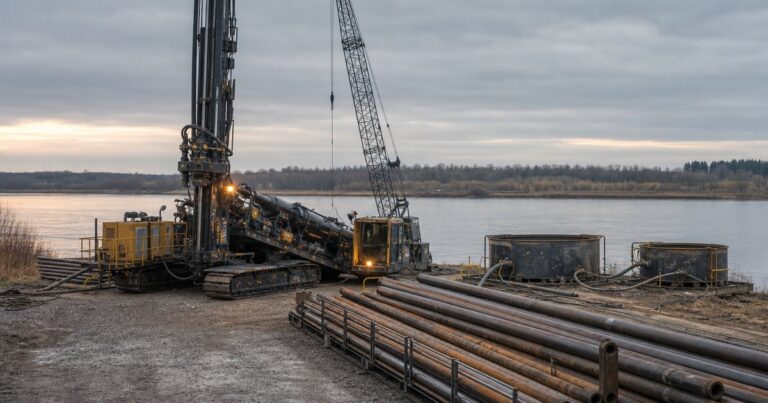
A maxi rig (the largest class of horizontal directional drilling, HDD, machine) is worth buying only when a documented pipeline of large-diameter, long or rock crossings can keep the machine working for most of the year. On this class, the purchase price is the smallest part of what the machine costs to own.
This guide covers where the class boundary sits, the project profile that justifies the machine, and the total cost stack beyond the sticker price. It then sets out the utilisation and break-even logic that decides the answer, and the due diligence and commercial terms to settle before signing. Scope: this framework applies where a forward pipeline of large crossings exists; for a single crossing, the leasing route is the relevant comparison.
What Counts as a Maxi Rig in Practice?
A machine of this class tops a three-class ladder. Industry association practice classifies directional drills as mini, midi and maxi by machine capability, and published machinery ranges for the market span roughly 3.6 t to 617 t of pullback force. The common convention puts the maxi boundary above about 100 t of pullback capacity.
Boundaries differ between organisations, which matters when a client, lender or insurer uses another definition. A UK consent submission describes midi rigs at roughly 15-40 t of pullback and 15-30 kN·m of torque. The UK gas industry standards body describes the maxi class as the largest type of directional drill, used only on major works where very high torque and pullback may be required.
| Practical class | Pullback band (published) | Typical work |
|---|---|---|
| Mini / utility | Up to about 30,000 lb (13 t); range starts near 3.6 t | Fiber, cable, small services |
| Midi / mid-size | Roughly 15-40 t (33,000-88,000 lb); 15-30 kN·m torque | Municipal mains, mixed ground |
| Maxi | Above about 100 t (220,000 lb); up to about 617 t at the top | Large-diameter pipelines, river approaches, rock |
Weight matters as much as rated force. One current track-mounted, self-contained machine weighs under 95,000 lb (about 43 t) with the vise removed, and still delivers class-level torque and pullback force according to World Pipelines reporting in 2024. The XCMG XZ6600 has a self-weight of about 58 t, and that figure excludes the vise, so a road-limit check has to add it separately. Published ratings span the same range, up to the American Augers DD1100RS at 1,100,000 lb.
Which Project Profile Justifies the Maxi Class?
A machine of this class earns its keep on crossings a midi rig cannot complete reliably: long, large-diameter, heavy or hard.
- Large-diameter, long crossings: calculated pull load climbs with diameter, wall thickness and installed length.
- Rock and mixed ground: reaming torque, not pullback, drives the machine choice.
- River, estuary and shore approaches: long set-backs and deep cover a smaller machine cannot hold.
- Congested corridors: one long bore that avoids multiple pits or road occupations.
- Heavy auxiliary demand: large fluid volumes for cuttings transport, plus recycling and cranes.
The profile that does not justify it is clear: utility distribution, fiber and cable, short urban bores, and mid-length crossings a midi machine already covers.
A machine of this class is one option among several. On some river and landfall crossings, a comparison against microtunneling construction or other trenchless technologies can produce a cheaper, lower-risk answer than one long bore.
Equipment and tooling choices are inputs to project-specific design and must be confirmed by a competent engineer for the actual crossing. A rated maximum pullback is a machine specification, not a design limit. Pull load calculations are commonly carried with a margin of about 1.5-2.0.
What Does a Maxi-Class Machine Really Cost Beyond the Sticker Price?
Observed dealer and secondary-market ranges in 2025-2026 put a new machine from about USD 1 million upward, with used units from roughly USD 300,000 to over USD 1,200,000. Those are observed ranges, not quoted prices, and configuration moves the number a long way.
The mistake is treating the purchase price as the addressable cost. On this class the maxi rig cost that matters is a stack: the machine, the move, the permits, the fleet, the people who run it, and the money that sits idle between jobs. In our experience, buyers who budget only the machine discover the gap on first mobilisation.
| Cost element | What drives it | Why it is easy to under-budget |
|---|---|---|
| Mobilisation and transport weight | Self-weight, number of loads, distance, road restrictions | A big spread rarely moves as one load |
| Permits and escorts | Oversize and overweight rules, route surveys, escorts | Approval lead time can exceed the drilling window |
| Auxiliary fleet | Fluid pumps, mixers, recycling, rod handling, cranes, tracking | The rig alone does not drill |
| Crew size and skill | Operators, fluid technicians, surveyor, supervisors | Large crews cost more per idle day |
| Consumables and fuel | Drill pipe, reamers, cutters, fluid additives, fuel | Cost scales with torque and formation, not metres alone |
| Maintenance and downtime | Service intervals, hydraulic wear, parts lead time | Unplanned downtime is the largest hidden cost line |
| Yard, insurance and storage | Footprint, secure storage, transport between sites | A machine of this size needs a real yard |
| Financing cost | Interest rate, term, currency, security and deposit | Interest can rival a share of annual ownership cost |

Two consequences follow for the total cost stack: a machine that is cheaper to buy but heavier to move can cost more per crossing, because transport weight and permit burden recur on every mobilisation. The auxiliary fleet must also be planned with the rig, because fluid handling and recycling capacity decide whether the bore can be drilled at the planned rate. The pipe string still has to be fabricated, welded and installed, which is where servicios de instalación de tuberías enters the stack.
How Does Utilisation Decide Whether the Machine Pays?
A machine of this size earns only while it is turning. Finance payments, insurance, the yard lease and the minimum crew to keep the spread serviceable accrue whether or not the drill is working. That is why the HDD rig investment question is a utilisation question: not whether the class can do the work, but how many days a year it is billable.
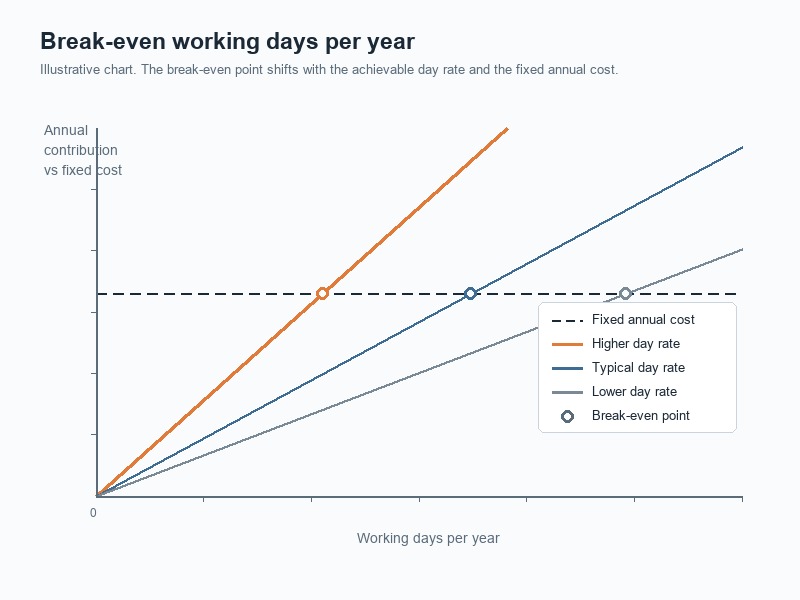
Utilisation is billable working days divided by available days in the year. Two inputs decide the answer: the achievable day rate in your market, which depends on region, competition and whether the rate covers the rig alone or the full spread, and continuity, the days the pipeline can fill.
Continuity matters because an idle machine still consumes cash. Long mobilisations, weather windows, permitting lead times and client schedule slippage all reduce the billable day count, and our field teams record mobilisation days separately. The table below is a worked illustration of the utilisation arithmetic; every value is a stated assumption, not a quotation.
| Artículo | Illustrative value | Nota |
|---|---|---|
| Financed purchase price | USD 1,000,000 | Illustration assumption only |
| Finance terms | 8 percent over 5 years | Annual capital cost about USD 250,000 |
| Other fixed annual cost | USD 200,000 | Insurance, yard, compliance, minimum staffing |
| Annual cost before the machine turns | About USD 450,000 | Capital cost plus other fixed cost |
| Contribution per billable working day | USD 7,500 | Margin left after fuel, crew and consumables |
| Break-even utilisation | About 60 working days per year | Roughly 27 percent of a 220-day working year, the availability basis assumed here, not a market norm |
Every figure in the illustrative break-even table is a stated assumption rather than a market value; its purpose is to show the arithmetic, not predict an outcome. The sensitivity runs both ways: at 30 billable days roughly USD 225,000 of fixed cost is uncovered, and at 120 days the machine contributes about USD 450,000 above fixed cost.
Should You Buy New, Buy Used or Lease?
There are three routes into the class. The HDD rig investment decision is easier once you accept that a machine billable for 200 days a year justifies a different structure from one billable for 60.
- Buy new: warranty coverage, the current control and telematics platform, factory financing and predictable parts supply. Against that, depreciation sits on the books, working capital is locked up, and lead times run to months.
- Buy used: the used maxi rig market offers machines roughly in the USD 300,000 to USD 1,200,000+ band, putting a capable unit on site sooner and at lower capital cost. The trade is condition risk. The low end of that range typically reflects an older control platform and a shorter drill string; the upper end a recent machine supplied with tooling. Condition moves a machine within that band more than age does.
- Lease, or rent with an operator: converts capital into an operating cost and suits a single crossing or an uncertain pipeline. Per-day cost is higher and availability limited.
One decision rule keeps the choice honest: a documented year-round pipeline supports owning new; a real but short pipeline with tight capital points to owning used; a single crossing is a leasing decision.
Technical Due Diligence on a Used Machine: What to Check?
Buying a used maxi rig is a condition assessment, not a paperwork exercise. meter hours tell you little on their own, because the cost of returning a tired machine to work sits in a few expensive assemblies a repaint can hide.
| Consideration | What to ask the seller | Red flag |
|---|---|---|
| Meter hours versus condition | Hour meter history and service records matched to those hours | Records stop years ago, or the meter was recently replaced |
| Drill string | Number of rods, thread form, hours per rod, rejected joints | Mixed thread forms, re-cut threads, rods stored outdoors |
| Vise and breakout | Jaw replacement date and breakout torque held under load | Jaws worn smooth, or capacity never demonstrated |
| Torque and thrust verification | A load or torque test report against the rated figures | Broker claims only, or refusal to run the machine under load |
| Hydraulic system | Oil analysis results, pump and motor hours, leak history | No oil sampling, chronic leaks, non-OEM hoses |
| Rotational and thrust gearbox | Repair or rebuild history with documentation | A recent rebuild with no paperwork, or metal in the oil |
| Control system and telematics | Whether the platform is current and spares are still supplied | An obsolete platform with no spare modules |
| Parts availability and service network | Parts held locally, lead time on high-risk components, nearest technician | A single-source parts channel, or no regional support |
We have seen machines priced on hours alone that needed a drill string and a vise rebuild before their first job, and the buyer found out after the money moved. Telematics is worth a specific request: if the platform still reports, the seller can hand over a genuine utilisation and fault history.
Which Commercial Terms Change the Real Price?
The price is one term in a package, and several of the others are worth more than a discount. Total cost of ownership is decided at contract stage, long before the first bore.
- Warranty scope and exclusions: what is covered, for how long, and which assemblies are excluded. Cover on the main gearboxes and rotary head is worth more than a long term on wear parts.
- Parts lead time: ask for lead times on the highest-risk components, then price a critical spares kit into the deal.
- Service network and response: the nearest trained technician, the response commitment, and whether remote diagnostics are included.
- Resale liquidity: how many units of the model trade in your region. A used maxi rig that rarely changes hands is hard to exit, and that illiquidity is a real balance-sheet cost.
- Currency and payment terms: the currency of the purchase and of future parts, plus milestones tied to commissioning rather than delivery.
- Delivery, commissioning and training: who pays for set-up, who signs off performance, and how the crew is trained.
Build a total cost of ownership model covering seven to ten years and the second mobilisation. In our reviews, the deals that aged badly were the ones with no answer for parts lead time, not the highest purchase price. A total cost of ownership model that stops at the invoice moves the surprise to year three.
Buying a Maxi-Class Machine: Frequently Asked Questions
How is the maxi class defined?
Pullback capacity above about 100 tonnes is the common working boundary, but the label describes capability rather than a fixed legal category. Industry association practice splits machines into mini, midi and maxi, published machinery ranges span roughly 3.6 t to 617 t of pullback force, and one UK consent submission puts midi rigs at 15-40 t. Confirm which definition a specification, a lender or an insurer uses.
How much does a maxi rig cost?
Observed 2025-2026 dealer and secondary-market ranges put a new machine from about USD 1 million upward, with used units from roughly USD 300,000 to over USD 1,200,000. Those are observed ranges rather than quoted prices, and configuration moves the figure a long way. Treat the price as the entry ticket, because transport, permits, crew and downtime keep adding to the maxi rig cost.
How many working days does the machine need to pay for itself?
There is no universal number, because it depends on financing terms, fixed annual cost and the contribution each working day produces. In the illustrative example in this guide, a fixed annual cost of about USD 450,000 and a contribution of about USD 7,500 per working day give a break-even near 60 days. Substituting your own costs will move that figure, so treat it as a method rather than a result.
Should I buy a new, used or leased machine?
Buy new when the pipeline is documented and the balance sheet can carry the depreciation; buy used when the work is real but the capital is not; lease when the work is a single crossing. Each route carries a different mix of warranty, condition risk and cash-flow profile, so follow utilisation and pipeline depth rather than the appeal of the largest machine available.
What should I check before buying a used machine?
Verify hours against service records, then inspect what costs the most to replace: the drill string, the vise, the rotational and thrust gearbox and the hydraulic system. Ask for a load or torque test against the rated figures, and confirm parts availability and the regional service network before agreeing a price.
When is a maxi rig the wrong choice?
A maxi rig is the wrong choice when the calculated pull load, torque and fluid demand are already covered by a midi machine with margin, or when the forward pipeline cannot keep such a machine working. Over-buying the class brings transport weight, permits and escorts, a larger crew and a bigger yard, none of which earn revenue while the machine waits. Equipment choice is an input to project-specific design and must be confirmed by a competent engineer for the actual crossing.
We have a 1.4 km river crossing next year and about USD 1.2 million of capex – should we buy used, buy new or lease?
Match the route to the forward pipeline, not to the capex figure: a single confirmed crossing is a leasing decision, and buying used only becomes the lower-risk route when the inspection is thorough and more work follows. The observed 2025-2026 range for used machines of this class is roughly USD 300,000 to over USD 1,200,000, and those are ranges rather than quotations, so condition risk is what the inspection has to buy down.
Puntos clave
- The maxi class is a capability band. Industry association practice uses mini, midi and maxi, the boundary sits above about 100 t of pullback, and published ranges span 3.6 t to 617 t.
- Justification comes from a repeating project profile, not a single crossing: long large-diameter bores, rock and mixed ground, and river or shore approaches a midi machine cannot hold.
- The purchase price is the smallest part of the commitment. Mobilisation, permits, the auxiliary fleet, crew, consumables, downtime and yard all recur every year.
- The machine earns only while it is working, so utilisation, day rate and pipeline continuity decide the answer, and every HDD rig investment case should be tested against a break-even calculation.
- Parts lead time, service network and resale liquidity often matter more than the discount negotiated on the day.
How JSW Supports Maxi-Class Crossing Investment
JSW executes trenchless crossings with its own crews and equipment, so we work with this utilisation arithmetic ourselves. Our scope covers HDD crossing services y automatic pipeline welding, alongside the method and design work that decides whether a crossing needs this class of machine.
We offer integrated delivery rather than a machine recommendation. Planning, pipe fabrication and welding, fluid management and restoration are engineered together, and equipment assumptions stay auditable.
- Integrated delivery: design, construction and restoration under one scope, so equipment choices are tested against the bore plan.
- Auditable process data: bore records and equipment assumptions that a client, lender or insurer can review.
- Risk-explicit pricing: ranges with the governing assumptions stated, never a rule of thumb as a design value.
- Safety and compliance: permitting, escort and site controls handled as part of the crossing scope.
Weighing a maxi-class purchase against a midi spread or a leased machine? Send your crossing parameters for a free technical review. Our engineers respond with a scoped recommendation and budget range.





































 English
  Arabic
  Russian
  Spanish
  French
  Vietnamese
  Polish
  Thai
Thai  Indonesian
  Turkish
  Portuguese