
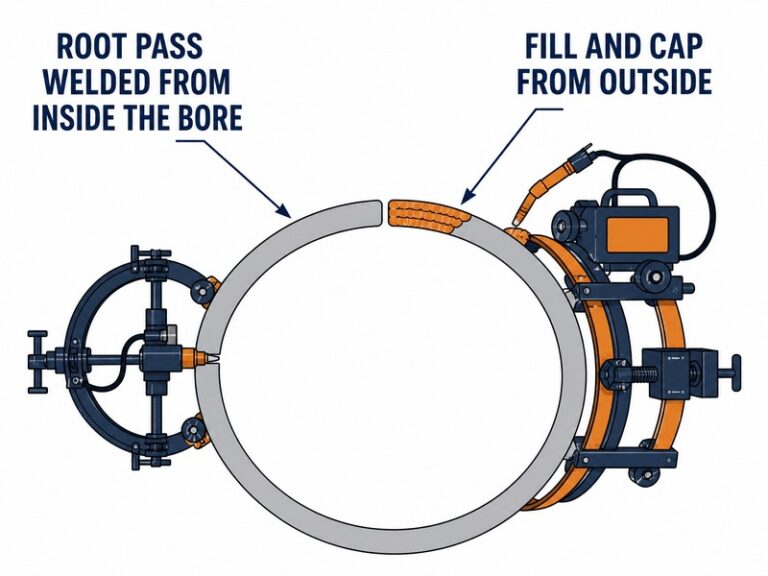
For large-diameter mainlines with high weld counts, the internal-root method cuts root defects and lifts productivity; for small diameters, tie-ins, and repair work, welding from outside is the only practical option. Internal pipe welding and the outside approach answer the same question, how to make a sound girth weld, but they work from opposite sides of the joint. Internal pipe welding completes the root pass from inside the pipe bore with a mechanized alignment clamp; the outside method then completes every pass from the pipe’s outer surface. This guide compares both welding methods across process, equipment, quality, cost, and safety, and gives you a five-question framework to choose the welding approach for your pipeline project.
Puntos clave
- Internal pipe welding suits large-diameter mainlines and double jointing yards where weld counts are high enough to justify mechanized equipment.
- External-only work fits small diameters, tie-ins, crossings, and repair work and requires far less capital.
- An internal line-up clamp welds the root pass from inside the bore, which makes root penetration consistent and repeatable on 30-inch and larger pipe.
- Diameters below roughly 16 inches are welded from outside only, because welding heads cannot fit and the equipment cost cannot be justified.
- Quality, repair access, and confined space rules differ sharply between the two approaches and must be part of your decision.
What Is Internal Pipe Welding?
Internal pipe welding is any welding performed from inside the pipe bore. In modern mainline construction, the term refers to a mechanized system in which an internal line-up clamp aligns the joint and welds the root pass from the inside, after which external units finish the fill and cap passes. The internal root is the defining feature of the method and the reason it produces such repeatable welds on large-diameter pipe.
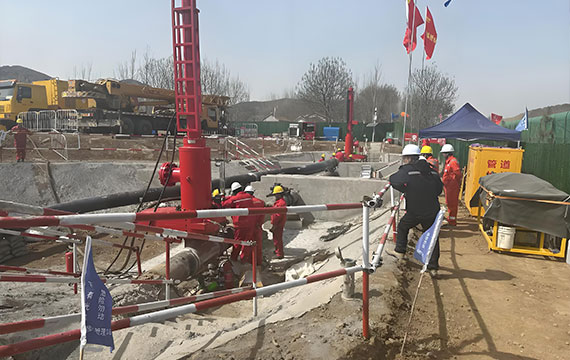
The system is not new. Internal root welding machines have been standard on cross-country mainlines since the 1970s, and they now work alongside external bug welders that deposit the remaining passes from outside. On a typical spread, the alignment clamp enters from the open pipe end, expands to grip the bore, and welds the root around the full circumference while the joint stays perfectly aligned.
The same method is also the basis of double jointing, the yard process in which two single pipe joints are welded into one double-length joint before they reach the field. Because the welding station is fixed and protected from weather, root quality stays consistently high in the yard.
What Is External Pipe Welding?
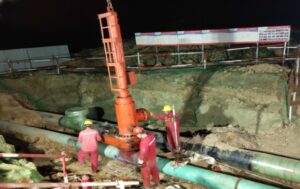
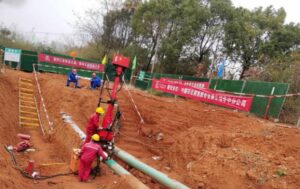
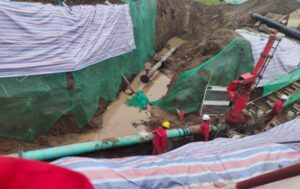
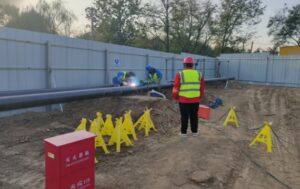
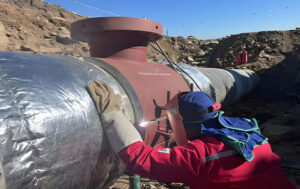
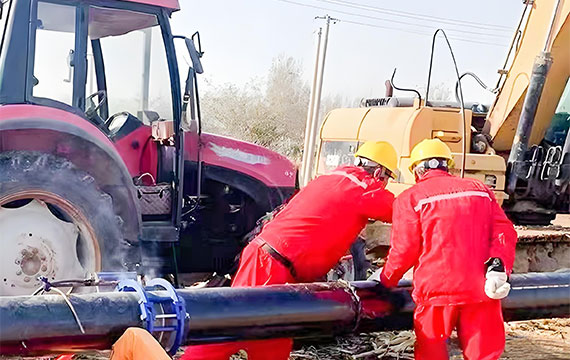
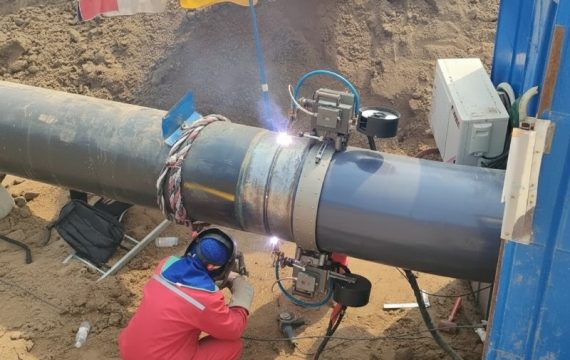
External welding is performed entirely from the outside surface of the pipe. The welder or the welding machine accesses the joint from the outer surface, starting with the root pass and finishing with fill and cap passes. This is how the majority of the world’s pipe welding is done, because it works at every diameter and requires no access to the bore.
The root pass from outside is made with a cellulosic stick electrode, STT, RMD, or pulsed GMAW, depending on the procedure and the steel grade. Fill and cap passes follow with FCAW, low-hydrogen SMAW, or external automatic welding bugs. Manual and semi-automatic work remains the standard for short spreads, tie-ins, crossings, and repair work across the pipeline industry.
The outside approach has one clear advantage beyond flexibility: the welder can see the weld pool and respond to fit-up gaps in real time. That human control matters on older pipe, repaired sections, and any joint where the internal surface is not accessible. It is also the fallback for every line too small for an alignment clamp, which covers most of the pipeline network in service today.
Internal Welding vs External Welding: Key Differences at a Glance
The fastest way to compare the two approaches is a side-by-side table. The figures below are planning ranges reported by contractors for a 36-inch, 12.7 mm (0.5 in) wall, X70 mainline, excluding right-of-way, stringing, and coating. They vary with labor rates and location, but the ratios are consistent across projects.
| Comparison point | Internal pipe welding | External pipe welding |
|---|---|---|
| Where the root pass is made | Inside the bore, by welding heads on the alignment clamp | Outside the bore, by a welder or external bug |
| Typical pipe diameter | 30 inches and larger for production mainlines; some systems operate down to about 16-20 inches | All diameters, from 2-inch gathering lines to 56-inch mainlines |
| Typical repair rate | Below 2 percent | 3-10 percent for semi-automatic work, higher on difficult wall thicknesses |
| Joints per day per spread | 50-80 | 25-40 for semi-automatic work |
| Equipment investment | Part of a $1.2-2.5 million automatic welding spread | $150,000-400,000 for a semi-automatic spread |
| Bore access required | Yes, the clamp enters and travels through the pipe | No, the outside surface is the only access needed |
| Best fit | Long mainlines, high weld counts, yard fabrication | Small diameters, tie-ins, crossings, repair, short spreads |
The table shows why the question has no single answer. Internal welding wins on repeatability and speed at large diameter, while the outside method wins on flexibility and capital cost everywhere else. The remaining sections explain the mechanics behind each line of the table and how to apply them to your project.
Conclusión: Choose the internal-root method when the line is roughly 30 inches or larger and the project has more than about 1,500 to 2,000 girth welds. Choose welding from outside for everything else: smaller diameters, tie-ins, crossings, repair, and low-volume work.
How Does Internal Pipe Welding Work?
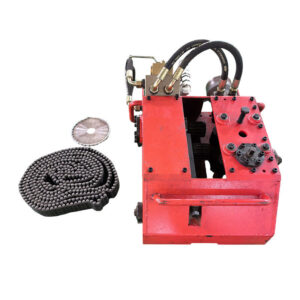
The method relies on a machine that aligns the joint and welds from inside at the same time. The internal line-up clamp carries two or more welding heads on a rotating ring, expands against the pipe bore to pull the joint halves into alignment, and then welds the root pass as the heads travel around the circumference.
The typical sequence on an automatic mainline spread is:
- Line up the pipe ends and clean the bevel with a pipeline cutting machine if re-facing is needed.
- Insert the internal line-up clamp from the open pipe end and expand it to grip both joint halves.
- Run the welding heads around the bore to deposit the root pass in one continuous bead.
- Release the clamp, pull it to the next joint, and repeat while the external crew works behind.
- Complete fill and cap passes from outside with an external bug on a band.
- Inspect the completed joint, usually with automated ultrasonic testing (A-UT).
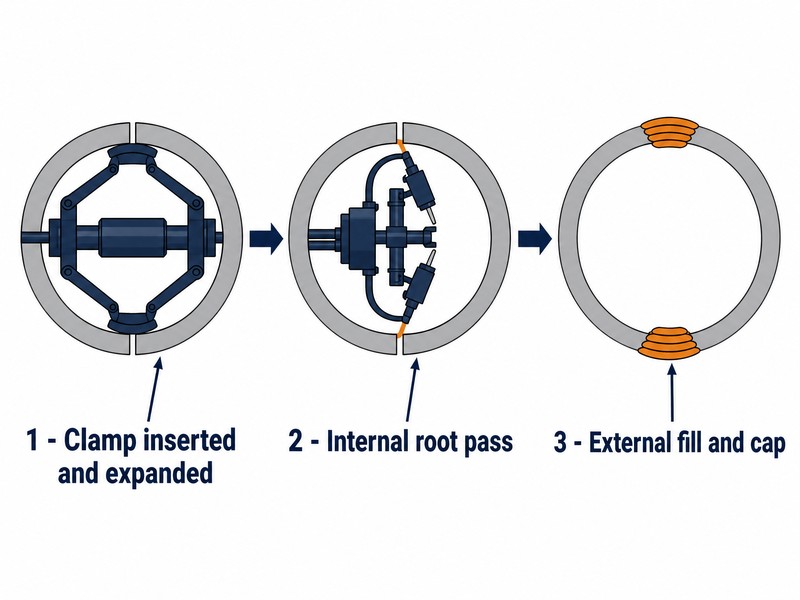
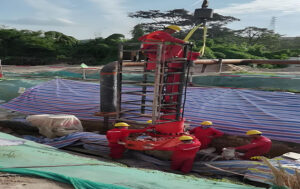
Figure 2. The alignment clamp welds the root pass from inside the bore, and external bug welders finish the fill and cap passes from outside.
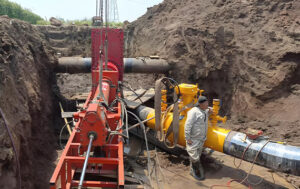
Because the clamp travels through the pipe, the method needs a clear bore and a minimum diameter. In our yard, we run double jointing stations where the internal welding machine is fixed on a carriage and the pipe joint is indexed past it, which gives the same root quality in a controlled environment. The result is a root pass that does not depend on a welder’s hand position, and that repeatability shows up directly in inspection results.
How Does External Welding Work?
The external method keeps every pass on the outside surface of the joint. This is the approach used for most pipeline welding work worldwide, because it works at every diameter and requires no access to the bore. The root pass is deposited first, either downhill with cellulosic electrodes or with a wire-fed process such as STT, RMD, or pulsed GMAW.
The sequence is shorter than the internal approach because no machine enters the pipe:
- Clean the bevel and check the fit-up gap.
- Weld the root pass from outside with the qualified procedure for the steel grade.
- Apply the hot pass to protect the root from cracking.
- Deposit fill passes and cap the weld to the required profile.
- Inspect with radiography (RT), ultrasonic testing (UT), or both, per the governing code.
Outside welding remains the default on most projects because it works on any diameter and any joint condition. In our experience, external root welding with a skilled crew still delivers sound joints on small-diameter and repaired lines, where an alignment clamp would not fit or would cost more than the whole project. Our records on such work hold repair rates at [__] percent and [__] joints per crew per day, using the same tracking we keep on internal-root spreads.
When Is Internal Pipe Welding the Right Choice?
Internal pipe welding becomes the right choice when three conditions are met: large diameter, high weld count, and a need for repeatable root quality. On a 36-inch or larger mainline with hundreds of kilometers of pipe, the alignment clamp pays for itself through speed and low repair rates.
Our crews used an internal root system on a 42-inch X70 gas mainline in 2024 in [region] and sustained more than 60 joints per day over [__] km with a repair rate below 1.5 percent. The same project would have needed roughly twice the welding stations with a semi-automatic external spread. That productivity gap is why automatic pipeline welding with an internal root is the production standard for modern large-diameter lines.
The same approach also fits double jointing yards, where a fixed welding station produces the root for every double joint before the pipe leaves the yard. This is the most economical way to use the equipment, because the welding machine never stops and weather never interrupts the root pass.
| Diámetro de la tubería | Typical approach | Por qué |
|---|---|---|
| Up to 16 inches | Welding from outside only | Welding heads cannot fit and capital cost is unjustified |
| 16-30 inches | External root, or an alignment clamp where available and volume justifies it | Internal systems exist but are chosen mainly for high-volume mainlines |
| 30 inches and larger | Internal root plus external fill and cap on long mainlines | Productivity and repair-rate gains cover the equipment cost |
There is a caveat we state on every tender. Internal welding is not a quality magic wand; it is a volume machine. If your project has fewer than roughly 1,500 to 2,000 girth welds, the mobilization cost of an alignment clamp and its supporting spread usually outweighs the per-joint savings, and welding from outside is the economically honest choice.
When Is External Pipe Welding the Right Choice?
External welding is the right choice for most projects, and the decision rules are simple. Choose it for pipe below roughly 16 inches, for tie-ins, road and river crossings, station work, repair welds, and any job where the equipment must move frequently or where the total weld count is low. For most pipeline welding work, outside access is the only access available.
Outside welding is also the standard for in-service welding, where the line stays pressurized, such as hot tapping and plugging services on an operating mainline. Procedures for live-line welding follow ASME PCC-2 guidance with controlled heat input, and the joint is welded from outside with qualified low-hydrogen techniques. On such jobs, internal access is usually impossible because the line is full of product.
The capital argument is decisive at small scale. A semi-automatic external spread costs a fraction of an automatic system, mobilizes in days, and can handle everything from 2-inch gathering lines to 36-inch tie-ins. For contractors, this is why pipe welding on short spreads remains an external-only business in most of the world.
How to Choose: A Five-Question Framework
You can compare the two pipeline welding methods with five questions. Work through them in order, and the approach that fits your project emerges without guesswork.
- What is the pipe diameter? Below 16 inches, weld from outside. From 16 to 30 inches, decide by weld count and volume. Above 30 inches on long mainlines, the internal-root approach becomes the production standard.
- How many girth welds does the project need? Above roughly 1,500 to 2,000 welds, the alignment clamp pays back. Below that, welding from outside is usually cheaper.
- Is the bore clean and accessible for the full length? The alignment clamp must travel through the pipe, so obstructions, small bends, and internal coating rule it out.
- Does the specification allow mechanized welding? API 1104 covers mechanized procedures, but the owner’s specification decides what is acceptable on your line.
- What does the repair plan look like? If joints may need rework in difficult terrain, outside welding gives easier access to the weld.
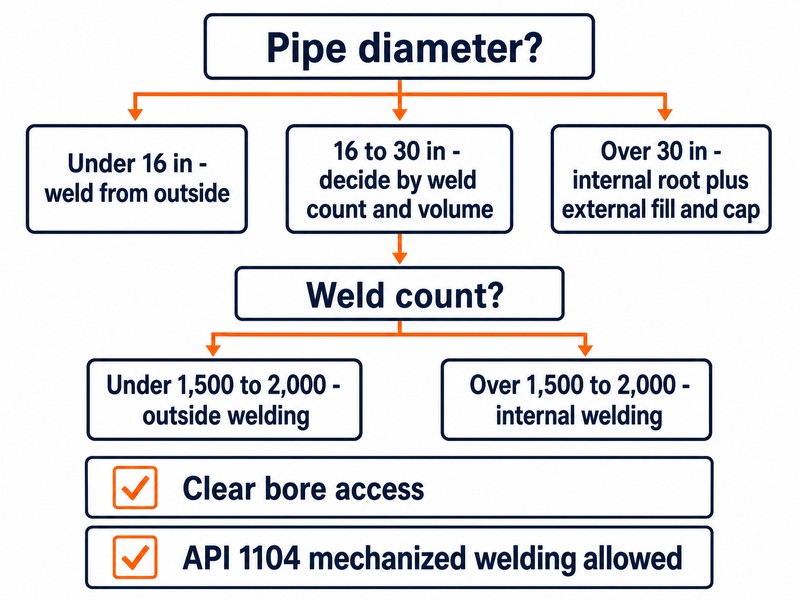
Figure 3. Diameter and weld count are the two fastest filters when choosing a welding approach.
| Project profile | Recommended approach | Primary reason |
|---|---|---|
| 100 km, 36-inch X70 gas mainline (about 4,000-8,000 girth welds depending on joint length) | Internal root plus external fill and cap | High weld count, repeatable root, low repair rate |
| Fabrication yard, 12 m to 24 m joints | Fixed yard station for the root pass | Weather-independent root quality, maximum utilization |
| 8-inch water line, 15 km | Welding from outside | Diameter below alignment clamp range |
| 30-inch tie-in on an operating line | Welding from outside | In-service conditions, bore not accessible |
| 20 km, 24-inch line, double-jointed to 24 m (about 800 field girth welds) | Welding from outside | Weld count below internal break-even volume |
When the answer is close, run a simple cost model with your own numbers: equipment mobilization, labor per joint, repair rate, and schedule. In our tendering practice, a 36-inch project crosses from external to internal at roughly 1,500 to 2,000 welds, and the gap widens as diameter grows. Whatever welding method you lean toward, your project manager should be able to reproduce that crossover with local rates in an afternoon.
Still deciding? Send us five numbers: pipe size, wall thickness, steel grade, weld count, and governing specification. Our welding engineers will confirm which approach fits your project and provide a cost estimate for your line.
Request a welding method assessment
Weld Quality, Inspection, and Repair: Internal vs External
Weld quality is where the two approaches differ most in practice. The internal root pass is deposited by a machine at a controlled speed, so penetration and bead shape are consistent joint after joint. The external root depends on the welder’s skill and on fit-up, which is why defect rates for semi-automatic external work run higher in contractor statistics.
The inspection logic is the same for both: radiography (RT) and ultrasonic testing (UT) are applied from outside, and acceptance is judged against API 1104 for cross-country lines or ASME Section IX for plant piping. In automatic pipeline welding, mechanized welds with an internal root are commonly paired with automated ultrasonic testing (A-UT), because the consistent weld geometry lets the automated system achieve repeatable results.
Repair access is the honest difference. A defective external root can be ground out and re-welded from outside in most cases. A defective internal root sits on the far side of the wall, and repair usually means cutting out the joint or sending a welder into the bore, which triggers entry-permit rules. This is the reason some owners still specify external root welding on lines where internal access would be difficult to recover.
Cost Considerations for Each Approach
The cost story of the internal-root method is capital-heavy and volume-sensitive. The alignment clamp is part of an automatic welding spread that typically costs $1.2 million to $2.5 million, against $150,000 to $400,000 for a semi-automatic external spread. That difference must be recovered through joints per day and repair rates.
Our cost records on 36-inch X70 work show the trade clearly. An internal-root spread completes 50 to 80 joints per day with repair rates below 2 percent. A semi-automatic external spread completes 25 to 40 joints per day with repair rates of 3 to 10 percent. On pipeline welding projects above the break-even volume, the internal approach saves enough labor and rework to cover its equipment cost, and the advantage grows on longer lines.
At those rates, our records put the direct cost per girth weld on a 36-inch X70 line near [$___-___] for the internal spread and [$___-___] for the semi-automatic external spread, including labor, consumables, gas, and NDT. A simple cross-check: divide the daily spread cost plus consumables by joints per day, then add NDT per joint.
Automatic pipeline welding also changes the consumables picture. The internal root uses solid wire with shielding gas, while external cellulosic stick roots consume noticeably more electrode mass per joint. When you compare welding costs, include consumables, gas, NDT, rework, and schedule, not just the hourly rate of the crew.
Safety, Confined Space, and Entry Rules: Internal vs External
Safety rules differ sharply between the two approaches. Outside welding happens in the open, where the main controls are PPE, wind protection, and fume extraction. Internal work adds bore-entry exposure whenever a person must enter the pipe, which happens during manual repair of internal roots, inspection, or work in smaller lines.
Confined space welding inside a pipe requires atmosphere testing before entry, continuous ventilation, a gas watch at the entry point, and a signed entry permit under site safety rules. Pipeline welding crews treat this as a mandatory gate: no permit, no entry. Fumes from the welding arc accumulate faster in a closed bore, and oxygen levels must be verified before any torch or welder goes inside.
In our operations, the rule is simple: the clamp-based method is a machine task that nobody enters for, while any manual work in the bore follows the full entry procedure. If your project plan includes internal repair capability, budget for the ventilation and monitoring equipment, because it is a real line item, not a paperwork formality.
Preguntas frecuentes
Is internal pipe welding better than external pipe welding?
Not universally. The internal-root method gives a more consistent root pass on large-diameter pipe, which cuts root defects and raises productivity on long mainlines. Outside welding is the only practical method for small diameters, tie-ins, crossings, and repair work, and it needs far less capital. The right choice depends on pipe size, weld count, and access.
Why is the root pass welded from inside on large-diameter lines?
Welding the root pass from inside removes the welder’s hand from the equation. The alignment clamp centers the joint and carries welding heads that deposit a uniform root bead around the full circumference, so penetration is consistent and lack of penetration is rare. External fill and cap passes are then completed from outside, and the repeatable root geometry suits automated ultrasonic testing.
Can small-diameter pipe be welded from inside?
Rarely. Alignment clamps and welding heads need a minimum bore size, usually around 16 to 20 inches, and the capital cost is hard to justify below about 24 inches. On pipe under 16 inches, the root pass is welded from outside using STT, RMD, or cellulosic electrodes, which is standard practice across most of the world’s pipe welding.
What is an internal line-up clamp?
It is a hydraulically expanded alignment tool inserted into the pipe end that centers the two joint halves and holds them in alignment while the root pass is welded. In automatic systems it also carries two or more welding heads that weld the root pass from inside the bore. After the root is complete, it releases and travels to the next joint.
What is double jointing and how does it work?
The yard process welds two single pipe joints into one double-length joint, using a fixed welding station for the root pass and an external station for fill and cap. The yard setup gives the clamp stable, repeatable working conditions, and it halves the number of field welds on the right-of-way, which is the main productivity gain.
Do you need confined space entry to weld inside a pipe?
It depends on how the weld is made. The automatic clamp-based method does not require a person to enter the pipe, because the welding heads travel inside on the clamp. Any work that puts a welder inside the bore, such as manual repair of an internal root, is an entry-permit job and requires atmosphere testing, ventilation, a gas watch, and a signed permit under site safety rules.
How much does pipe welding cost?
It depends mainly on pipe diameter, wall thickness, and weld count. On a 36-inch mainline, equipment investment runs $1.2-2.5 million for an internal-root spread against $150,000-400,000 for a semi-automatic external spread, and per-joint cost is driven by joints per day and repair rate. Send us your pipe size, wall thickness, steel grade, weld count, and governing specification for a project-specific estimate.
Conclusion: Choose by Diameter, Weld Count, and Access
Internal pipe welding and external welding are complementary production methods, not rivals. The internal-root method earns its place on large-diameter mainlines and in fabrication yards, where the alignment clamp turns the root pass into a repeatable machine operation and pays for itself through speed and low repair rates. Outside welding remains the flexible, low-capital standard for everything else, from small-diameter lines to tie-ins, crossings, and repair work on operating pipelines.
Run the five questions from this guide with your own project numbers, and the choice becomes a calculation rather than an opinion.
If you are still deciding, send your pipe size, wall thickness, steel grade, weld count, and governing specification to our engineers, and we will recommend a pipe welding method with a cost estimate for your line. JSW performs automatic pipeline welding with internal-root systems, pipeline construction services, pipeline repair services, and pipeline maintenance services under API 1104, ASME B31.4, and ASME B31.8, and we also supply hot tapping and plugging services for operating lines.
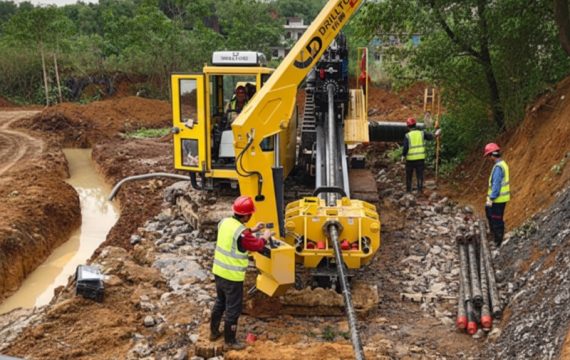
For trenchless alternatives, we support projects with horizontal directional drilling, microtunneling, and trenchless pipeline repair. Contact our team through the project inquiry form to start the assessment.










 English
  Arabic
  Russian
  Spanish
  French
  Vietnamese
  Polish
  Thai
Thai  Indonesian
  Turkish
  Portuguese