
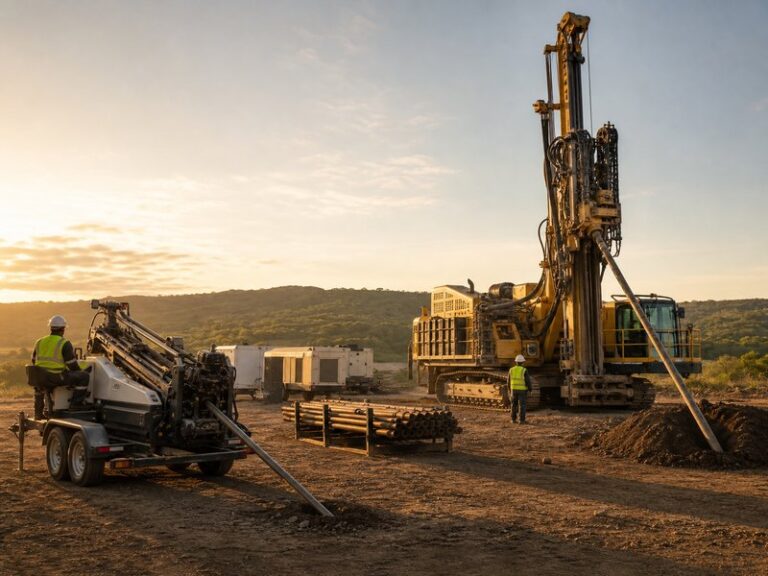
The difference between maxi-HDD and mini-HDD comes down to pullback capacity, product pipe diameter, bore length and site footprint. A mini HDD rig typically delivers up to 20,000 lb (89 kN) of pullback for 2-10 in (50-250 mm) pipe over bores of roughly 600 ft (183 m). A maxi HDD rig delivers 100,000 lb (445 kN) or more to install 24-48 in (600-1,200 mm) steel pipeline across crossings of up to 5,000 ft (1,500 m).
This guide covers the official HDD rig size classes, a side-by-side comparison of the two extremes, the applications each serves best, and the real cost difference. It ends with a practical selection method and answers to the questions we hear most often from utility owners and pipeline contractors.
What Are Mini-HDD and Maxi-HDD?
Horizontal directional drilling (HDD) is a steerable, trenchless method for installing pipe, conduit and cable along a controlled underground arc without open-cut excavation. The industry divides HDD rigs into three size classes based on typical application and technical parameters such as product pipe diameter, bore depth and bore length: mini-HDD, midi-HDD and maxi-HDD. The method was adapted from oil-field drilling in the early 1970s; the first river crossing covered 183 m (600 ft), and the technology soon progressed to installing 107-cm (42-in) pipe over 1,220-m (4,000-ft) crossings.
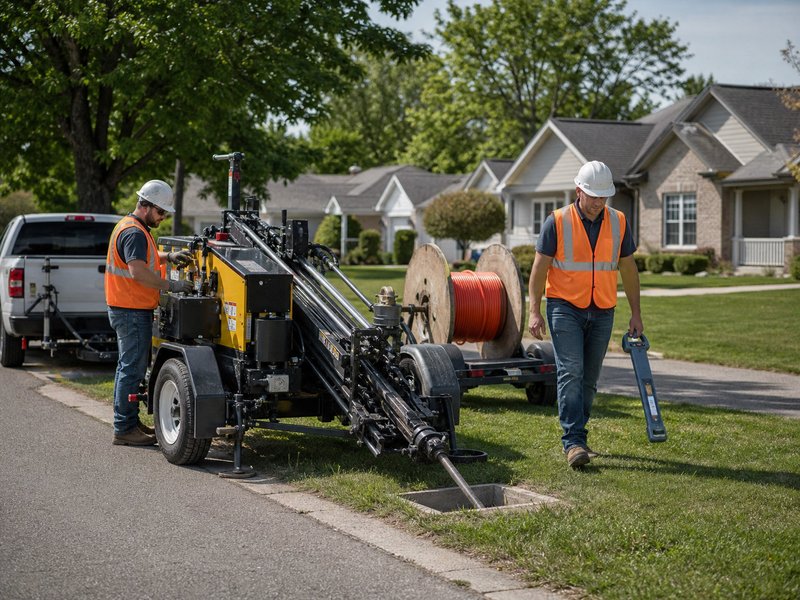
Mini-HDD is a compact, trailer-mounted machine built for small-diameter utility work. It sits at the small end of the class range, bores a pilot hole, reams it open and pulls back products such as fiber optic cable, power cable, gas service line and water service line in one continuous operation, usually from small entry and exit pits. Workhorse machines in this class include the Ditch Witch JT20, rated at 20,000 lb (89 kN) of pullback for residential and urban service work, and the Vermeer D23x30DR S3, a dual-rod rig that crews often run at the top of the mini class or the bottom of the midi class on utility and fiber projects. Ratings across this class vary by manufacturer, so always check the spec sheet against your design.
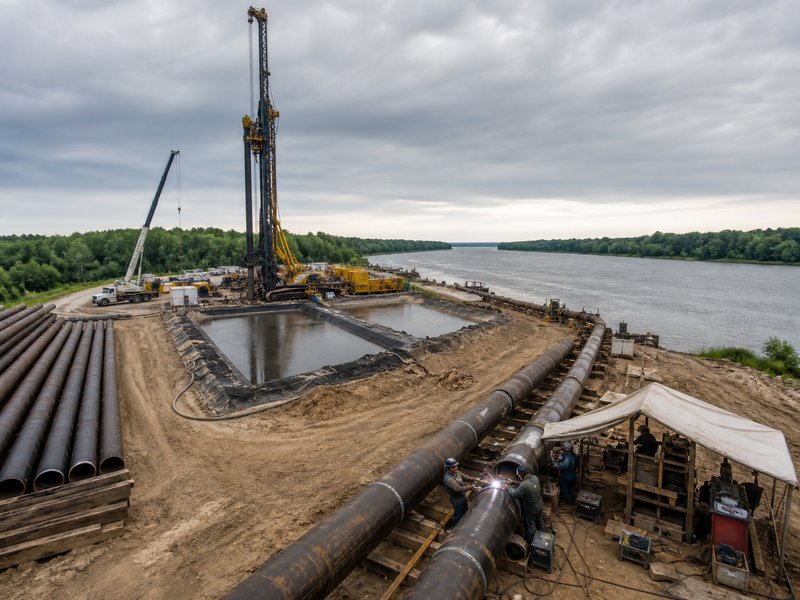
Maxi-HDD is a high-torque, high-pullback machine or machine set used for major infrastructure crossings. Maxi spreads install large-diameter steel and HDPE pipelines under rivers, highways, railways and environmentally sensitive land, often with deep cover and bores measured in kilometers.
The Official HDD Rig Size Classes: Mini, Midi and Maxi
The reference values below come from the U.S. Federal Highway Administration’s utility manual, which summarizes the HDD Consortium Good Practices Guidelines, the closest thing the industry has to a standard classification. The classes overlap at their edges, so treat the numbers as typical envelopes rather than hard cutoffs.
| Class | Product Pipe Diameter | Depth Range | Bore Length | Torque | Thrust / Pullback | Machine Weight | Aplicación típica |
|---|---|---|---|---|---|---|---|
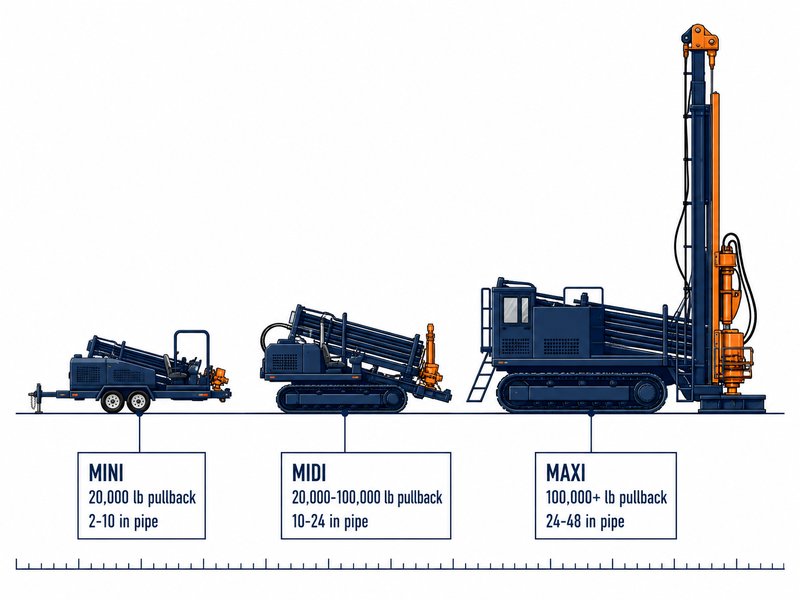
| Mini-HDD | 50-250 mm (2-10 in) | up to 4.5 m (15 ft) | up to 183 m (600 ft) | up to 1.3 kN-m (950 ft-lb) | up to 89 kN (20,000 lb) | up to 80 kN (9 short tons / 18,000 lb) | Telecom and power cables, water and gas lines |
| Midi-HDD | 250-600 mm (10-24 in) | up to 23 m (75 ft) | up to 274 m (900 ft) | 1-9.5 kN-m (900-7,000 ft-lb) | 89-445 kN (20,000-100,000 lb) | up to 160 kN (18 short tons / 36,000 lb) | Under rivers and roadways |
| Maxi-HDD | 600-1,200 mm (24-48 in) | up to 61 m (200 ft) | up to 1,500 m (5,000 ft) | up to 108.5 kN-m (80,000 ft-lb) | from 445 kN (100,000 lb) | from 267 kN (30 short tons / 60,000 lb) | River and highway crossings |
In short: mini rigs cap at 20,000 lb pullback, 10-in pipe and 600-ft bores; maxi rigs start at 100,000 lb pullback for 24-48 in pipe over 5,000-ft crossings.
Two points are worth noting. First, the mini HDD class is defined by the small end of the envelope: products up to 250 mm (10 in), shallow cover and short crossings. Second, the Federal Highway Administration figures are conservative baselines for the upper class; modern maxi machines are commonly rated from 100,000 lb up to more than 1,000,000 lb (454 t) of pullback. The Barbco B500, a maxi rig, completed a 7,000-ft (2,134-m) subsea crossing in the Gulf of Mexico in November 2023, and manufacturers such as Vermeer introduced new maxi systems to extend the class further.
Maxi-HDD vs Mini-HDD: The Key Differences
The differences between the two classes show up in six areas: machine size, reach, guidance, drilling fluids, site footprint and cost. Each is explained below.
1. Pullback Capacity and Machine Size
Pullback force is the cleanest way to tell the classes apart. Mini horizontal directional drilling rigs top out at roughly 20,000 lb (89 kN), which is enough to drag small-diameter products through short bores. Maxi rigs start at 100,000 lb (445 kN) and can exceed 1,000,000 lb (454 t) for the largest machines.
Machine size follows the same curve. A mini rig fits on a single trailer and is often moved with a pickup truck; our crews have set up and completed residential bores in as little as three to five hours. A maxi spread arrives on multiple tractor-trailers and includes a separate power unit, drill pipe trailers, a mud plant and a reclaimer.
2. Product Pipe Diameter and Bore Length
The pilot hole is reamed to roughly 1.3-1.5 times the product diameter, so diameter drives pullback demand and the number of reaming passes. Small systems install 2-10 in (50-250 mm) products over bores up to about 600 ft (183 m). Maxi systems install 24-48 in (600-1,200 mm) pipe, and larger in some cases, over crossings up to 5,000 ft (1,500 m) and beyond.
Bore length matters as much as diameter. Doubling the length roughly doubles the contact area between drill string and soil, which raises torque and pullback faster than diameter alone. That is why a 1,000-ft crossing with a 12-in pipe often still needs a midi or maxi class machine rather than a small rig.
3. Guidance and Steering Systems
Work at the small end of the range typically relies on a walkover locator: an operator walks the surface with a handheld receiver, tracks a sonde in the drill head and steers by rotating the string. The system is fast and cheap, but its range is limited to shallow depths.
Maxi crossings use non-walkover systems because the drill head is too deep for a surface receiver. Wireline steering tools and gyro survey probes inside the drill string report position and orientation continuously, which is essential for long, deep, high-accuracy crossings. In our experience, the guidance decision is made by depth and length, not by pipe size.
4. Drilling Fluid Systems
Both classes use a bentonite-water drilling fluid that carries cuttings, stabilizes the bore during reaming and can be filtered and reused. The scale is where they diverge.
A small spread runs a mixing unit and measured volumes in the hundreds of gallons per job; containment is simple and frac-out (an inadvertent return of drilling fluid to the ground surface) consequences are limited. A maxi crossing can circulate hundreds of thousands of gallons across a full mud plant with recycling and containment ponds, and fluid loss or a frac-out near a waterway becomes a major environmental and cost event. Fluid management is one of the largest line items on maxi projects, and contractors control the risk with containment ponds, drilling fluid monitoring and frac-out response plans agreed with the environmental regulator before work starts.
5. Site Footprint, Crew and Mobilization
The footprint of a compact rig fits inside a residential right-of-way: the machine, small pits at entry and exit, and a crew of two to three people. Setup takes hours, which is why this equipment is the default for fiber and utility service work in built-up areas.
A maxi spread occupies a large work area at both ends of the crossing, including entry and exit pits, mud ponds, a pipe string fabrication yard and laydown for the product pipe. Crews of ten to twenty people work across drilling, fluid, welding and restoration crews, and mobilization alone can take days or weeks.
6. Cost Profile
Cost at the small end is dominated by fixed mobilization and small per-foot rates, so short bores are inexpensive. Maxi work is dominated by engineering, fluids, crew and equipment time, so even a modest maxi crossing is a six-figure project (USD 100,000+), and major river crossings routinely reach millions.
From our bid reviews, site preparation, drilling fluids and restoration together typically account for 30-45 percent of a mid-size crossing price, while small jobs carry the same overhead items over a much shorter bore, which is why per-foot comparisons between the two classes mislead.
When to Use Mini-HDD
Mini horizontal directional drilling is the workhorse of small utility construction. Use it whenever the product fits the class envelope and the crossing is short.
- Fiber optic cable and telecom conduit, including fiber-to-the-home and broadband expansion work across North America and Europe
- Power cable and low-voltage distribution lines under roads and driveways
- Gas service lines and water service laterals connecting homes and businesses to mains
- Small drainage, irrigation and utility crossings where open cut would damage pavement, landscaping or traffic
The advantages of this class are practical: no pavement cuts, minimal restoration, short setup time and the lowest entry cost of any HDD class. The limits are equally real: depth is typically capped around 4.5 m (15 ft), diameters above 250 mm (10 in) are out of range, and hard rock requires specialty tooling that small rigs cannot always drive.
The stakes of careless utility work are quantified in Common Ground Alliance’s 2026 economic impact report, which estimates underground utility damage costs the U.S. about USD 83.2 billion per year. Correct class selection and one-call practices are the first line of defense.
On a recent fiber line installation we supported, the contractor completed three road crossings (a total of 1,800 ft of 1.25-in conduit) with a small rig in a single day, using walkover guidance and a two-man crew, with zero pavement cuts. Open cut would have required lane closures and restoration for the same three crossings. It is the kind of work JSW’s crews support weekly across fiber, gas and water service projects.
When to Use Maxi-HDD
Choose this class when the crossing is long, deep, large-diameter or environmentally sensitive. This class exists for major infrastructure, not routine service work.
- Large-diameter steel and HDPE pipelines for oil, gas, water transmission and sewer force mains
- River, highway, railway and airport crossings where open cut is impractical or prohibited
- Deep installations, up to about 61 m (200 ft) of cover, where surface settlement must be avoided
- Wetlands, floodplains and other protected land where excavation would trigger heavy permit and restoration burdens
Market research by Fortune Business Insights and Grand View Research (2025-2026) values the global horizontal directional drilling market at about USD 9.2 billion in 2025 and projects it near USD 25 billion by 2034, a compound annual growth rate of roughly 11.7 percent. Large-diameter pipeline and utility crossings are a major share of that spend.
Maxi work also carries the largest risks: frac-out near waterways, stuck pipe in difficult geology and long contingency periods. The pilot hole alone on a long crossing can consume days in fractured rock. That is why maxi crossings demand geotechnical investigation, detailed bore planning and experienced crews, and why the pipe string side of the job matters as much as the drilling side. We routinely coordinate maxi pullback with pipe string fabrication, automatic welding and cold bending so the product is ready when the hole is.
Cost Comparison: Compact Rigs vs Maxi Spreads
Directional boring cost is the question owners ask first, and the honest answer is that the two classes live in different budgeting worlds. Small service crossings are commonly quoted at single-digit to low double-digit dollars per foot in the U.S. market, with a minimum charge for mobilization; a residential fiber or water service bore often lands between a few hundred and a few thousand dollars total.
River and highway crossings typically run from several hundred thousand dollars to several million dollars, driven by mobilization, engineering, drilling fluids, reaming passes and restoration. These are typical market ranges, and actual prices vary widely with geology, depth, length, region and schedule. Mini horizontal directional drilling projects rarely exceed six figures; maxi projects rarely come in below them.
Two reference points keep the comparison honest. The International Society for Trenchless Technology has reported that the relative cost of HDD has fallen below open-cut trenching for many applications. And the Federal Highway Administration cites a typical HDD installation rate of about 100 m (328 ft) per day with a skilled crew, which puts schedule and cost in perspective for any class.
How to Choose Between Small and Large HDD Rigs
Match the rig class to the design, not the other way around. Work through this checklist with your engineer or contractor.
- Product diameter and material: 2-10 in (50-250 mm) products fit the small class envelope; 24-48 in (600-1,200 mm) steel pipe requires a maxi class machine.
- Bore length and depth: crossings beyond roughly 600 ft (183 m) or 15 ft (4.5 m) of cover push you out of small-rig range.
- Geology: rock raises torque and pullback demand; obtain a geotechnical report before choosing a class.
- Site access: can the equipment fit, and can fluids be contained? A compact rig needs little; a maxi spread needs staging area at both ends.
- Budget and schedule: compare total cost, not per-foot rates, because mobilization and restoration dominate short jobs.
- Permits and environmental limits: waterway and protected-land crossings usually force the maxi route with full engineering.
Between the two extremes sits midi HDD, rated at 20,000-100,000 lb (89-445 kN) of pullback for 10-24 in (250-600 mm) pipe over bores up to about 900 ft (274 m). Many road and small river crossings land in this middle class. If your design sits near the edge of the small-rig envelope, a midi machine is often the safer, more economical choice than stretching a compact rig.
Quick rules of thumb:
- Pipe above 24 in (600 mm) → maxi class.
- Crossing beyond 600 ft (183 m) → at least midi class.
- Cover beyond 15 ft (4.5 m) → beyond walkover range; plan for midi or maxi with wireline or gyro guidance.
- Waterway, wetland or protected land → evaluate maxi with full engineering and containment plans.
- Rock in the bore path → obtain a geotechnical report before any class decision.
Not sure which class your design falls into? Send your bore parameters to JSW’s engineering team and get a rig-class recommendation before you budget — typically within five working days.
HDD Rig Size Class FAQ
Is mini HDD cheaper than maxi HDD?
Yes, in absolute terms. Mini HDD cost is a fraction of maxi projects because mobilization, crew, fluids and equipment time are all smaller. The right question is not which is cheaper but which class can install your design; a maxi crossing attempted with a compact rig fails or ends in costly rescue work.
What is the main difference between the two rig classes?
Pullback capacity and the pipe diameter it supports. Small rigs deliver up to 20,000 lb (89 kN) for 2-10 in (50-250 mm) products over short, shallow bores; maxi rigs deliver 100,000 lb (445 kN) or more for 24-48 in (600-1,200 mm) pipe over long, deep crossings.
Can a compact HDD rig install steel pipe?
Only small-diameter steel in limited cases. Compact equipment is designed for flexible products such as HDPE, conduit and cable; large steel pipeline requires the pullback and torque of a midi or maxi class machine, along with welding and pipe handling that small rigs do not support.
How deep can mini HDD drill?
Typical depth at the small end is up to about 4.5 m (15 ft), which covers service line and shallow utility work. Beyond that, the walkover locator loses signal, and the project moves to midi or maxi machines with wireline or gyro guidance. Maxi machines can reach about 61 m (200 ft) of cover.
Do I need a maxi HDD rig for a river crossing?
Not always, but often. A small-diameter, short river crossing may fit a midi machine, while a large-diameter pipeline under a major river is a textbook maxi-class application. The deciding factors are pipe diameter, crossing length, depth and geology, not the fact that water is overhead.
What is midi HDD?
Midi HDD is the middle size class, rated at 20,000-100,000 lb (89-445 kN) of pullback for 10-24 in (250-600 mm) pipe over bores up to about 900 ft (274 m). It covers road and river crossings that are too large for a compact rig and too small to justify a maxi spread.
How much does directional boring cost?
For small utility work, directional boring typically costs single-digit to low double-digit dollars per foot in the U.S., with a mobilization minimum, so a residential fiber or water service bore often lands between a few hundred and a few thousand dollars total. Large-diameter river crossings run from several hundred thousand to several million dollars.
What are the main HDD rig sizes?
The three main HDD rig sizes are mini, midi and maxi, classified by product pipe diameter, bore depth and bore length. Mini rigs handle up to 250 mm (10 in) pipe over short, shallow bores; midi rigs cover 250-600 mm (10-24 in); maxi rigs install 600-1,200 mm (24-48 in) pipe and larger across long, deep crossings.
Have a specific crossing in mind? Contact JSW — our engineers answer design questions directly.
Cómo apoya JSW los proyectos de perforación de pozos de petróleo y de oleoductos
JSW is a pipeline engineering and construction partner supporting owners and contractors across the full lifecycle of directional drilling and trenchless work. Our services include:
- servicios de construcción de tuberías
- trenchless pipeline repair technology
- pipeline maintenance services
- tecnología de soldadura automática de tuberías
- pipeline cold bending
- Servicios de perforación y taponamiento en tuberías en servicio
- microtunneling for the largest crossings
Our teams also supply the tooling layer of the work used to prepare pipe strings on the entry spread:
- pipeline hot tapping equipment
- pipeline plugging pigs
- pipeline cutting machines
What distinguishes our support is integrated execution: bore planning that accounts for pipe string fabrication and welding, drilling fluid management that respects environmental limits, and restoration that returns the site to a defensible condition. We publish our engineering basis, document as-builts and price contingencies explicitly rather than hiding them. Whether you need a mini HDD rig for a fiber line or a maxi HDD spread for a major crossing, request a technical review today: send your design parameters (pipe diameter, length, depth, geotechnical report and crossing type) to our engineering team, and receive a scoped proposal within five working days — no obligation.





































 English
  Arabic
  Russian
  Spanish
  French
  Vietnamese
  Polish
  Thai
Thai  Indonesian
  Turkish
  Portuguese