
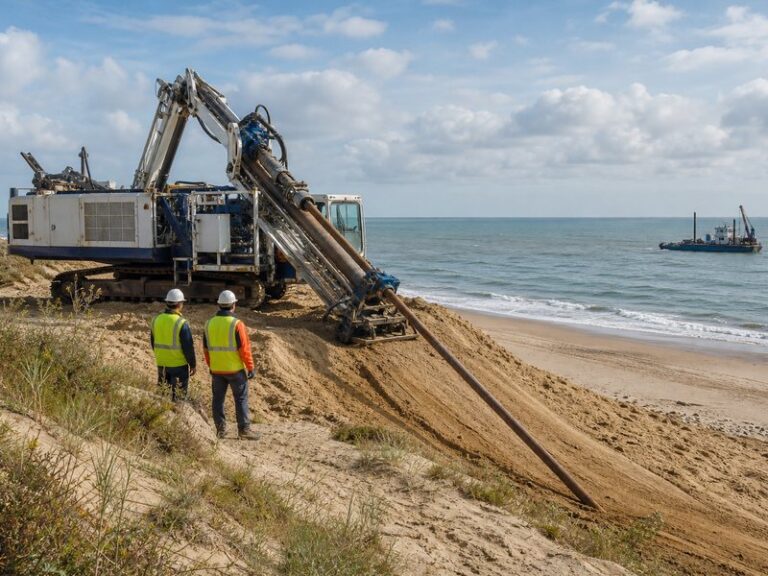
An HDD shore approach installs a pipeline from offshore to onshore by drilling from land and exiting on the seabed beyond the surf zone. The beach, dunes and nearshore seabed are never excavated: the bore connects the offshore line to the onshore facility entirely below the surface.
This guide explains how a shore approach works step by step, why owners and contractors choose HDD for pipeline landfalls instead of open-cut trenching, what lengths and burial depths are practical, what the marine spread adds to cost, and which risks decide whether the crossing succeeds. It is based on our field experience supporting pipeline construction, trenchless pipeline repair technology and coastal landfall projects across multiple continents.
At a glance—typical shore approach parameters:
- Crossing length: 300 to 1,500 m from entry to seabed exit; export-scale landfalls beyond 2,000 m
- Burial cover below the seabed: 3 to 10 m
- Entry and exit angles: 8 to 16 degrees on land, 4 to 8 degrees at the seabed
- Site time: two to six weeks for drilling and pullback, before weather contingency
What Is an HDD Shore Approach?
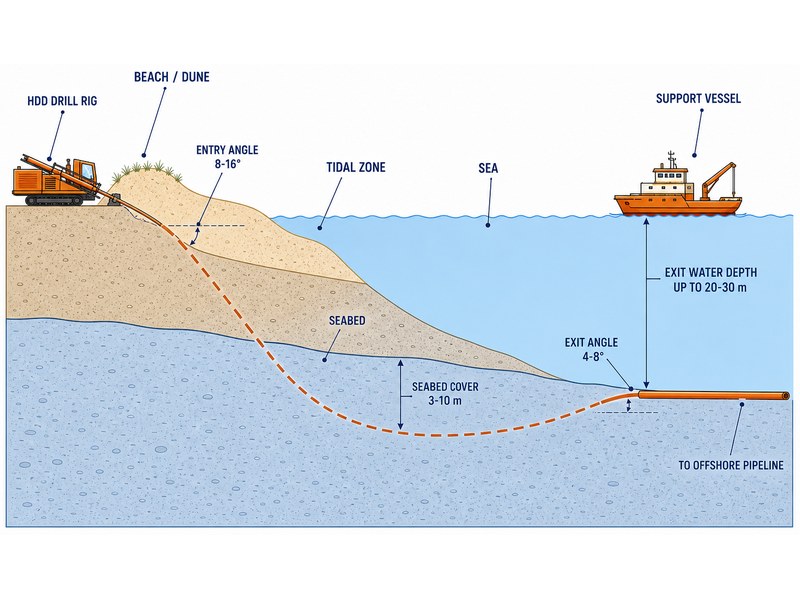
A shore approach, also called a pipeline landfall or coastal shore crossing, is the critical transition zone where a subsea pipeline or export cable comes ashore and connects to onshore facilities. Horizontal directional drilling (HDD) installs this transition trenchlessly: the drilling rig is set up on land behind the high-water line, the pilot bore descends beneath the beach and dune system, runs under the nearshore seabed, and rises to an exit point on the sea floor. The product pipe is then pulled through the open bore, and the completed crossing is tied into the subsea pipeline at the seabed end and into the onshore pipeline at the entry end.
Shore approach crossings are the standard solution whenever a coastal site is environmentally sensitive, heavily used, or protected by regulation. Offshore oil and gas export lines, gas interconnectors, water intakes and outfalls, and offshore wind farm export cables all depend on reliable landfalls. The scale of the market explains the demand: the global horizontal directional drilling market was valued at roughly USD 9.2 billion in 2025 and is projected to approach USD 25 billion by 2034, a compound annual growth rate of about 11.7 percent, according to market research published by Fortune Business Insights and Grand View Research in 2025 and 2026. A large share of that growth comes from coastal work, because most new offshore wind projects and cross-border energy links must bring their lines ashore through exactly this kind of crossing.
How Does an HDD Shore Approach Crossing Work?
An HDD shore approach follows the same sequence as any horizontal directional drilling crossing—pilot hole drilling, prereaming and pipe pullback—but it is executed across a shoreline instead of between two land pits. Three things make it different: the exit point is under water, a marine vessel spread replaces the land exit pit, and much of the offshore work is scheduled around tides, currents and weather windows.
| Phase | What Happens | Key Control |
|---|---|---|
| 1. Survey and permits | Bathymetric, geotechnical and utility surveys; land and marine permits, environmental approval | Design accuracy and regulatory approval |
| 2. Site preparation | Entry pit, drill rig and fluid plant set up behind the beach; pipe string fabricated onshore | String readiness and containment planning |
| 3. Pilot hole drilling | A steerable pilot bore is drilled seaward and exits on the seabed at the designed point | Gyro steering accuracy below the water |
| 4. Prereaming | Enlarging passes open the hole to 1.2 to 1.5 times the product pipe outside diameter | Marine assist and fluid circulation |
| 5. Pipe pullback | The pipe string is pulled from the offshore side toward land through the open bore | Pull load control and buoyancy |
| 6. Tie-in and testing | The line is connected on both ends, cleaned, gauged and pressure-tested | Tie-in quality and verification |
Drilling from Land and Exiting on the Seabed
The drilling rig is positioned on land, usually with the entry point behind the beach or dune crest, and the bore is designed so that the pipe reaches its required protection depth before it passes under the surf zone. Entry angles on shore approach crossings are typically 8 to 16 degrees, and the exit angle at the seabed is kept shallow, commonly 4 to 8 degrees, so the reamer and the pipe string transition smoothly out of the hole. The bore profile must also clear the depth of tidal scour and seasonal beach movement, which is why the deepest point of the crossing is normally placed well under the dune system rather than under shallow water.
The Marine Spread and Pipe Pullback
Once the pilot bore reaches its planned exit, the offshore work begins. A shallow-draft barge or anchored vessel positions over the exit point and provides the platform for the marine spread: the reamer is attached to the drill string at the vessel and pulled back toward land to enlarge the hole, and on large crossings the reaming tools and swivel are handled from the vessel rather than from a land exit pit.
The final pullback of an HDD shore approach is usually executed from the offshore side toward land. The product pipe string is made up at the vessel or floated on the water with buoyancy modules, connected to the drill string through a swivel, and pulled into the bore as the rig on land rotates and retracts. Buoyancy control is essential: it reduces the submerged weight of the string, lowers drag, and prevents the pipe from buckling or grounding on the seabed during the pull. On the steel export lines we support, the string is fabricated on the entry spread with pipeline automatic welding technology and pipeline cold bending before pullback begins, so the offshore pull proceeds without interruption.
Guidance and Survey Below the Seabed
Steering a marine shore crossing is more demanding than steering a land crossing because conventional walkover locators cannot be used over open water and lose reliability beyond roughly 9 to 12 m (30 to 40 ft) of depth. Magnetic interference from the sea, steel casing and nearby marine structures also distorts surface readings. Shore approach crossings therefore rely on gyro steering systems or wireline guidance, which track the downhole tool without a surface signal. Position is verified with RTK GPS and total station surveys from shore or from the vessel, and multibeam bathymetry is run before and after the crossing to confirm the exit location and check for seabed disturbance or drilling fluid breakout.
Why Use HDD for Pipeline Landfalls?
Owners select a shore approach crossing when the beach, the marine environment or the construction schedule makes open-cut trenching unattractive. The method protects the coastline itself, because the crossing is drilled below the surface features instead of through them.
- Deep seabed burial: the pipe is placed 3 to 10 m or more below the seabed, which protects it from anchors, trawl gear, scour and coastal erosion far better than most trenched installations.
- No beach or dune excavation: dunes, vegetation, archaeological layers and recreational beaches remain untouched, which shortens environmental permitting and avoids restoration disputes.
- Continuous operation: the drill works through tides and swells from the land side, so the schedule does not stop every time the tide covers the work site.
- Reduced nearshore dredging: no open trench or temporary cofferdam is needed in the surf zone, cutting marine dredging volumes and turbidity.
- Weather resilience: only the pullback and marine assist depend on vessel windows; the pilot hole and reaming continue regardless of sea state.
| Factor | HDD | Open-Cut Trenching | Microtunneling |
|---|---|---|---|
| Beach and dune impact | None; drilled below the surface | Full-width excavation and restoration | Small launch and reception pits |
| Seabed disturbance | Minimal; single exit point | Long open trench through the surf zone | Minimal; small exit pit on the seabed or shore |
| Burial depth below seabed | Deep and controlled (3 to 10 m typical) | Shallow, set by dredging and backfill | Shallow to moderate, fixed line |
| Marine traffic and tides | Mostly tide-independent | Stops during tides and high sea states | Mostly tide-independent |
| Typical application | Long, deep, steerable landfalls | Short crossings with low environmental constraints | Short, shallow, fixed-grade crossings |
| Cost profile | High setup; competitive at depth and length | Low unit cost on simple sites | High setup; competitive on short large-diameter bores |
The comparison is a trade-off between surface disruption and cost. Open-cut trenching wins on short, simple, low-sensitivity sites where dredging and beach restoration are cheap; HDD wins wherever burial depth, environmental constraints or coastal protection make trenching expensive. Microtunneling is a related trenchless option for short, shallow, large-diameter landfalls with a fixed grade, but it cannot follow the deep curved profiles that HDD achieves, which is why most export-scale shore approaches are installed by drilling rather than by microtunneling.
What Are the Main Risks and Challenges of an HDD Shore Approach?
Shore approach drilling concentrates the risk profile of coastal construction into a single underground operation. The failure modes are the same families seen on land crossings, but the marine setting raises the cost of each one. The risks we manage on every coastal project are:
- Frac-out in shallow marine sediments: drilling fluid can escape to the seabed or into the water column where cover is thin or the soil is weak. Pressure and returns are monitored continuously, and mud weight is kept conservative through the shallow sections.
- Loss of returns in sands and gravels: nearshore geology is often permeable, and fluid can disappear into the formation. Lost circulation materials and a prepared contingency keep the hole stable until the pipe is in place.
- Hole instability in unconsolidated ground: loose sands, cobbles and boulder layers can collapse or over-ream, which delays pullback and can trap the string.
- Beach and dune settlement: heave or subsidence above the bore can damage the coastline that the project is meant to protect; the bore profile and fluid pressures are designed to keep surface movement within permit limits.
- Weather and tide windows: the vessel spread can only work in defined sea states, so the pullback window is planned conservatively and the string is always ready before the window opens.
- Environmental compliance: marine discharge permits, biodegradable fluid additives, spill response plans and protected habitat or archaeology procedures are agreed with the regulator before drilling starts, not after a release.
In our experience, most failures on an HDD shore approach trace back to planning decisions rather than to the drilling itself: an undersized geotechnical investigation, an exit point placed in mobile sediment, or a pullback scheduled without a weather contingency. Across the coastal landfall designs our engineering team reviews, these planning gaps account for the majority of avoidable cost and delay, and none of them is a limitation of the method; the drilling itself is routine for an experienced maxi rig crew, and the coastal environment is what makes the crossing difficult.
What Length and Depth Can an HDD Shore Approach Achieve?
Most HDD landfall crossings (also called shore approaches) fall in the 300 to 1,500 m range, measured from the onshore entry to the seabed exit. Export-scale landfalls drilled with maxi rigs have exceeded 2,000 m, and the same rig classes that complete very long river crossings can be applied to coastal profiles when the seabed slope and the exit depth allow it. The practical limit is set by pullback force, gyro steering accuracy and drilling fluid circulation, not by the pipe itself.
| Design Parameter | Typical Shore Approach Range | Main Driver |
|---|---|---|
| Crossing length | 300 to 1,500 m; export projects beyond 2,000 m | Seabed slope, exit depth, rig class |
| Cover below seabed | 3 to 10 m, more where anchors or scour require it | Anchor loads, trawl gear, regulation |
| Product pipe diameter | Up to about 48 in on large crossings; 12 to 42 in common | Flow rate and pullback capacity |
| Entry angle | 8 to 16 degrees | Rig setup and bore geometry |
| Exit angle | 4 to 8 degrees | Smooth seabed transition |
| Water depth at exit | Typically up to 20 to 30 m | Vessel access and tie-in method |
Burial depth below the seabed is usually the design driver, because the shore approach protects the pipe where a subsea pipeline is most exposed: shallow water, anchorages, trawl lanes and mobile sand. Where local regulation sets a minimum cover, the horizontal directional drilling shore crossing profile is simply designed to exceed it, a routine requirement in the coastal landfall construction projects we support and one of the clearest advantages of the method over open-cut burial.
How Much Does a Shore Approach Cost?
A shore approach crossing costs more per meter than an equivalent horizontal directional drilling crossing on land because of the marine spread, and the gap grows with water depth and distance offshore. The main cost drivers are listed below.
| Cost Driver | Why It Matters |
|---|---|
| Crossing length and depth | Sets rig class, drilling hours, fluid volume and pullback force |
| Geology | Rock and boulder zones multiply reamer wear, fluid demand and schedule |
| Marine spread days | Vessel, crew, survey and support barge are charged per day and depend on weather windows |
| Pipe string scope | Welding, cold bending, coating and buoyancy modules for the pullback |
| Permits and environmental measures | Marine discharge approval, spill response, archaeology and habitat procedures |
| Contingency | Frac-out response, lost circulation and weather standby are priced explicitly |
In our bid reviews, the marine spread commonly accounts for 25 to 45 percent of the total shore approach price on mid-size crossings in the 500 to 1,500 m range, and site time typically runs two to six weeks before weather contingency is added. Owners who compare HDD against open-cut trenching should include the full coastal restoration, dredging and marine construction scope on the trenching side; on sensitive or deep-burial landfalls, the HDD shore approach is usually the lower total-cost option even when its unit rate is higher.
As a planning figure only, not a quotation or budget commitment, mid-size crossings in the 500 to 1,500 m range have recently been tendered from roughly USD 1 million to over USD 5 million depending on geology and marine spread days; short crossings can fall below this band and export-scale landfalls above it. Quotation-level pricing must be confirmed by our sales team against the geotechnical and marine data for your specific site.
If you are comparing HDD against trenching for a specific landfall, our engineers will review your crossing data and outline the cost trade-offs—start with a technical review.
Key Takeaways
- An HDD shore approach drills the landfall crossing from land and exits on the seabed, installing the pipeline from offshore to onshore without beach excavation.
- The method protects dunes, beaches and shallow-water habitats, and buries the pipe 3 to 10 m below the seabed where anchors, trawl gear and scour cannot reach it.
- Shore approach bores typically run 300 to 1,500 m; export-scale landfalls exceed 2,000 m, and gyro steering is required because walkover locators cannot work over water.
- The marine spread and weather windows, not the drilling itself, drive most of the extra cost and schedule risk of a coastal crossing.
- Open-cut trenching remains cheaper on short, simple, low-sensitivity landfalls; HDD earns its cost wherever burial depth or coastal protection decides the project.
HDD Shore Approach FAQ
What is a pipeline landfall in subsea construction?
A pipeline landfall is the coastal zone where a subsea pipeline or export cable comes ashore and connects to onshore facilities. In an HDD shore approach, the landfall crossing is drilled from land and exits on the seabed, so the beach, dunes and surf zone are not excavated and the pipeline reaches protection depth below the seabed.
How far offshore can a shore approach exit?
Most shore approach exits are located 300 to 1,500 m (about 1,000 to 5,000 ft) from the shoreline. Export-scale landfalls drilled with maxi rigs have exceeded 2,000 m (6,600 ft), and the practical limit is set by rig pullback capacity, gyro steering accuracy and drilling fluid circulation rather than by the method itself.
Can HDD install offshore wind export cables at landfall?
Yes. HDD is one of the two standard landfall methods for offshore wind export cables, alongside open-cut trenching. The bore exits on the seabed and the cable is either pulled through an installed duct or pulled directly through the hole from the vessel to the shore, which protects the cable from scour, anchors and beach erosion.
How deep is the pipeline buried below the seabed in a shore approach?
Shore approach bores are normally designed with 3 to 10 m (10 to 33 ft) of cover below the seabed, and more where anchor loads, trawl gear or scour depth require it. This is deeper than most open-cut burial, which is one of the main reasons owners select HDD at sensitive landfalls.
What happens to drilling mud in a marine shore approach?
Drilling fluid is mixed and recycled on the onshore spread, and marine-grade additives are used where discharge limits apply. The main risk is frac-out, where fluid escapes to the seabed or the water column, so pressure and returns are monitored continuously and contingency plans are agreed with the environmental regulator before drilling starts.
How long does a shore approach crossing take to install?
A mid-size shore approach typically takes two to six weeks of site time for the drilling and pullback, with additional weeks for permits, marine mobilization and onshore pipe string preparation. Weather and tide windows for the vessel spread are usually the largest schedule risk on the marine side.
How JSW Supports HDD Shore Approach Projects
JSW is a pipeline engineering and construction partner supporting owners, EPC firms and contractors on coastal landfalls and trenchless crossings worldwide. We provide pipeline construction services, pipeline maintenance services and pipeline repair services, together with the capabilities a shore approach depends on: pipe string fabrication with automatic welding and cold bending for entry-spread geometry, and pipeline hot tapping and plugging services for safe tie-ins where the new line connects into live onshore systems.
Our tooling layer for coastal and marine work includes pipeline hot tapping equipment, pipeline plugging pigs and pipeline cutting machines used to prepare and join pipe strings on the entry spread, and we coordinate with drilling contractors so the string, welding and marine pullback schedules fit together instead of drifting apart.
- Integrated delivery: one accountable team from bore design review, string fabrication and welding through pullback, tie-in and testing, reducing interface risk between the drilling and marine scopes.
- Auditable process data: daily drilling records, fluid management logs, pull load charts and as-built survey data delivered with every crossing.
- Transparent, risk-explicit pricing: itemized marine spread, fluid, contingency and restoration costs, with no hidden changes after award.
- Coastal compliance experience: marine discharge permitting, spill response planning and protected habitat procedures executed to regulatory standards.
If you are planning a pipeline landfall or evaluating an HDD shore approach for your coastal project, contact our engineering team via the contact page or sales hotline and send the following details:
- Crossing length
- Pipe diameter
- Geotechnical report
- Marine site data
We will provide a technical review and a scoped proposal within five working days.





































 English
  Arabic
  Russian
  Spanish
  French
  Vietnamese
  Polish
  Thai
Thai  Indonesian
  Turkish
  Portuguese