
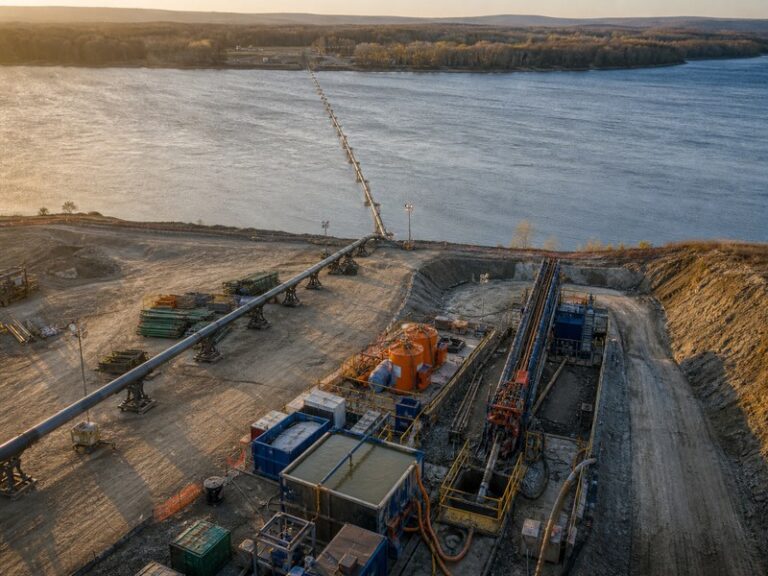
The longest HDD crossing on record is the twin 17,060-ft (5.2-km) aviation fuel pipeline installation beneath Hong Kong Harbour, completed in December 2017 and March 2018. The longest HDD crossing for a 26-in. pipeline now stands at 13,314 ft (4,058 m) after the Brahmaputra River pullback in India finished in January 2026. Record HDD crossings have grown from a 500-ft gas line under California’s Pajaro River in 1971 to these two milestones.
These records are not milestones for their own sake: they change how owners route pipelines, how engineers select methods, how contractors fabricate and pull pipe strings, and where the industry places the boundary between trenchless and open-cut work. This guide explains the verified record crossings that define the current envelope, the five technologies that unlocked them, the way record lengths alter route and design decisions, the honest economics and risk at the far end of the envelope, and what the next generation of long crossings will require.
Length and depth figures come from documented project records published by owners, contractors and industry bodies, and the technical discussion follows the framework of the NASTT HDD Good Practices Guidelines and DCA industry practice. If you are scoping a long crossing now, contact our engineering team before you commit to a method or a rig class.
| Fact | Value |
|---|---|
| Longest HDD installation on record | 17,060 ft (5.2 km) per pipe, twin aviation fuel bores, Hong Kong Harbour, 2017-2018 |
| Longest 26-in. pipeline crossing | 13,314 ft (4,058 m), Brahmaputra River, India, January 2026 |
| First HDD river crossing | About 500 ft, Pajaro River, California, 1971 |
| When intersect method is standard | Crossings beyond 7,000 ft (2,130 m) |
What Are the Longest HDD Crossings on Record?
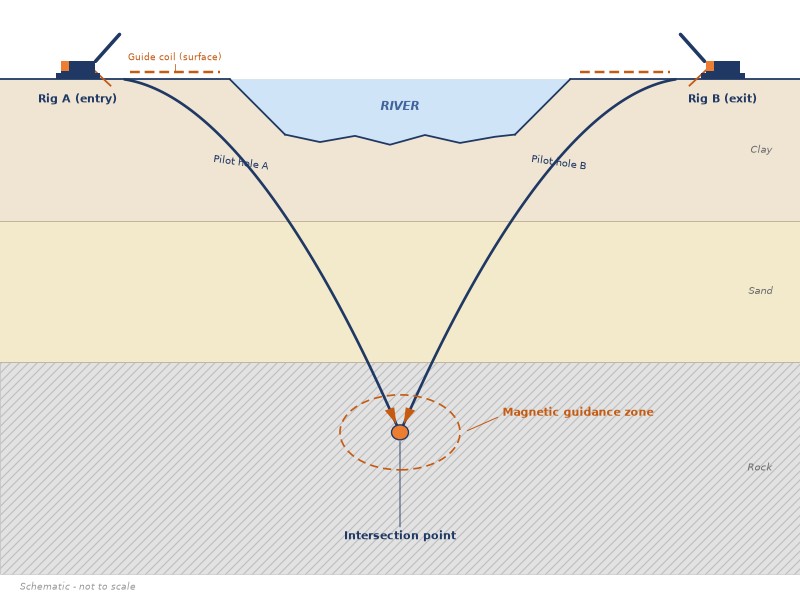
As of September 2026, the longest HDD crossing on record is the twin 17,060-ft (5.2-km) aviation fuel installation beneath Hong Kong Harbour, and the longest HDD crossing for a 26-in. pipeline is the 13,314-ft (4,058-m) Brahmaputra River bore in India, completed in January 2026. Both projects used the intersect method, which drills two pilot holes from opposite sides of the crossing and joins them deep underground, and both were driven by national-scale infrastructure needs rather than by a desire to set a number.
In everyday language, the longest horizontal directional drilling crossing usually means the longest single installed drive on record, which is the Hong Kong installation. For pipeline engineering, the more useful figure is the longest horizontal directional drilling crossing in the pipe’s own diameter class, because length and diameter compete for the same rig capacity and pullback force.
The Hong Kong project replaced two aviation fuel pipelines for the airport’s three-runway expansion. Each 20-in. (500-mm) steel line runs 17,060 ft (5.2 km) between the airport island and Sha Chau island, laid roughly 330 ft (100 m) below the seabed in rock; twin 12,140-ft (3.7-km) pilot holes drilled from the airport side intersected twin 4,920-ft (1.5-km) holes drilled from Sha Chau. The first pipe was installed on December 27, 2017, the second on March 9, 2018, and the work earned an ISTT award in 2018. Because the method required no dredging, marine ecology was undisturbed, and works paused every April to July while egrets bred on Sha Chau.
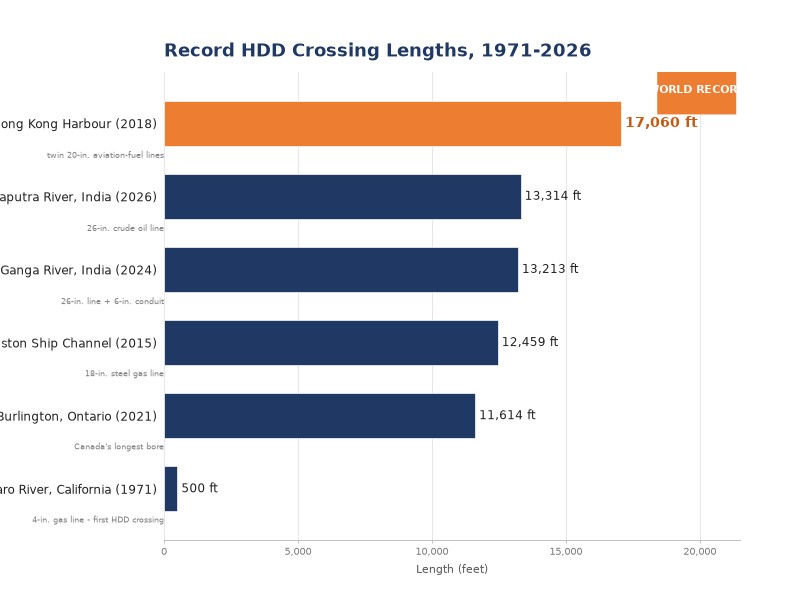
The table below separates the record crossings by class, because an absolute length record and a large-diameter record are different engineering problems.
| Project | Year | Length | Product pipe | Record class |
|---|---|---|---|---|
| Hong Kong Harbour, twin aviation fuel lines | 2017-2018 | 17,060 ft (5.2 km) each | 500-mm (20-in.) steel | Longest HDD installation on record |
| Brahmaputra River, India (PNCPL) | 2026 | 13,314 ft (4,058 m) | 26-in. crude oil line | World record for a 26-in. pipe |
| Ganga River, India (PNCPL) | 2024 | 13,213 ft (4,027 m) | 26-in. line plus 6-in. conduit | Previous world record for a 26-in. pipe |
| Houston Ship Channel, USA | 2015 | 12,459 ft (3,798 m) | 18-in. steel gas line | Tip-to-tip intersect at more than 12,000 ft |
| Burlington, Ontario, Canada | 2021 | 11,614 ft (3,540 m) | Steel pipeline | Canada’s longest HDD bore |
| James River, Virginia, USA | 2024 | 5,700 ft (1,737 m) | 42-in. HDPE force main | Longest HDPE pullback in its class |
Two patterns stand out across these records. First, every crossing beyond roughly 7,000 ft used the intersect method, because a single rig pushing drill pipe for miles accumulates steering error, torque and drag that a two-ended approach avoids. Second, consecutive records increasingly come from the same corridor: the Paradip-Numaligarh Crude Oil Pipeline (PNCPL) in India crossed the Subansiri, Ganga and Brahmaputra rivers with HDD bores of 11,516 ft (3,510 m), 13,213 ft (4,027 m) and 13,314 ft (4,058 m). The Ganga bore set the 26-in. class record in April 2024, and the Brahmaputra bore reset it in January 2026. For the length and diameter envelope behind these corridor records, see our companion guide on maximum HDD length and diameter limits.
| River crossing | Length | Completed | Execution note |
|---|---|---|---|
| Subansiri River | 11,516 ft (3,510 m) | Before mid-2024 | Two 500-tonne-class rigs; site flooded most of the year, with a 4-5 month working window |
| Ganga River | 13,213 ft (4,027 m) | April 2024 | Two American Augers DD1100 rigs; 76 days from first pilot hole to pullback |
| Brahmaputra River | 13,314 ft (4,058 m) | January 2026 | Pullback completed by EIL under the same corridor program |
The practical lesson is that the envelope does not move in random leaps; it moves when one owner needs several very long crossings on a single route and funds the engineering to deliver them in sequence. That is also why the figures in this guide are time-stamped. Record lists go stale within months, and any feasibility decision should be checked against the crossing record valid on the day the bore is designed.
Why Do Record HDD Crossings Matter to Pipeline Construction?
Record-length crossings matter because they quietly rewrite what owners, regulators and engineers treat as feasible. A length that was dismissed as impossible in one decade becomes a standard design option in the next, and every project after that benefits from the expanded choice.
Why should a contractor building a routine 2,000-ft road crossing care about the longest HDD crossing on the other side of the world? Because the same equipment, guidance systems and bore-planning discipline that set records filter down to everyday work within a few years.
- Route freedom: When a 12,000-ft crossing becomes credible, pipelines stop bending around obstacles. The Houston Ship Channel project used a 12,459-ft crossing to connect a terminal directly across the channel, avoiding a costly re-route to a location where a shorter HDD was possible. The route decision, not the drilling, was the real economic win.
- Corridor scale: A national pipeline can now cross every major river on its path without open-cut river works. The 1,635-km PNCPL crude line in India crossed the Subansiri, Ganga and Brahmaputra rivers by HDD, with the longest bores reserved for the widest channels, and the same approach appears on gas, water and power corridors worldwide.
- Environmental and social license: Deep HDD crossings avoid dredging, in-stream excavation and surface disruption. The Hong Kong harbour bores were laid about 330 ft (100 m) below the seabed with no dredging, and the Burlington crossing in Canada was drilled beneath a golf course in use, with the surface untouched for the full 11,614 ft (3,540 m).
- Method credibility: Each verified record gives owners evidence that a long horizontal directional drilling crossing can be permitted, insured and delivered on a schedule, which shortens the approval conversation for the next project.
The same records also set expectations that must be managed honestly. A 13,000-ft bore is not a scaled-up 2,000-ft bore; it is a different class of project with different planning horizons, and treating it as routine is the fastest route to failure. The sections below explain what actually changed in the field, and what did not.
What Technology Unlocked These Record HDD Crossings?
Five technologies, in combination, carry the credit for every record horizontal directional drilling crossing in this guide. Each one removes a specific ceiling, and record projects are simply the projects where all five were executed at once.
1. Intersect Drilling from Both Banks
Intersect drilling splits the bore into two pilot holes drilled toward each other, so no single rig has to push drill pipe for the full distance. This removes the practical single-rig ceiling that friction, torque and steering error imposed at roughly 7,000 ft, which is why the method is now standard practice beyond that length.
The execution details matter as much as the concept. On the Ganga River project, the two rigs were planned to intersect at 6,660 ft of measured distance and 160 ft of depth, and the connection was made on the first attempt. On the Houston Ship Channel project in 2015, the two pilot holes met tip-to-tip without any corrective steering pass, an outcome the contractor described as rare in intersect practice. Getting two bits to meet in rock or clay at depth is an achievement in guidance, not in brute force.
2. Magnetic Guidance and Gyro Steering
Guidance systems are what make the intersect method reliable. AC magnetic tracking generates a signal that can be detected at depth, letting engineers steer both pilot holes to a common point without surface access over the crossing, which is essential under rivers, harbours and shipping channels.
On the Ganga project, surface-laid guide coils limited positional uncertainty at the intersection depth to under 3 ft, and the same tracking held two parallel bores at their planned spacing for the full length of the drive. On the Houston project, gyroscopic tools with annular pressure monitoring steered the hole about 240 ft below sea level through swelling clays, where surface-based walkover locating was not possible at all. Guidance accuracy, not rig power, is the reason record crossings can now be planned with confidence.
3. Rig Power with Torque Control
The record crossings were drilled by maxi rigs in a class of their own. The Ganga project used two American Augers DD1100 machines rated above 1,000,000 lb of push-pull, and the Houston project used two 1.2-million-lb Hercules rigs. Raw capacity is only half the story: the Ganga team deliberately held torque below 60,000 ft-lb to protect the drill string over nearly 2.5 miles, and the Houston crew ran 24/7 pilot-hole operations while drilling through swelling clay.
On maxi-rig projects, a practical guardrail used in feasibility work is to treat 80% of rated pullback capacity as the planning ceiling. Once the computed pullback demand for a bore approaches that level, the options are a larger rig, an intersect setup, or a smaller product pipe. Record projects rarely run at full rated load; they run well inside it, with monitoring that lets the crew react before the string reaches a limit.
4. Drilling Fluid and Staged Reaming
Drilling fluid carries cuttings out of the bore, supports the hole wall and lubricates the pipe, and its delivery capacity is a hard constraint on length. The Ganga project combined two 600-GPM mud pumps to achieve roughly 800 GPM of effective flow during reaming, and the Houston project held full circulation close to 100% of the time through both pilot and reaming phases, a figure the contractor cited as critical in swelling clay.
Reaming is staged to protect the bore and the drill string. The Ganga pilot hole was opened in three passes from 12.5 in. to 20 in., 30 in. and finally 38 in.; the Hong Kong project reamed in two stages from 311 mm to 510 mm and then to 710 mm. Dual-sided pumping, in which fluid is delivered from both ends of the bore, keeps cuttings moving over distances where a single mud return path would stall. Undersized pumps or single-pass reaming are the most common reasons a long bore stops short of its planned length.
5. Pipe String Fabrication and Handling at Scale
A record pullback is only as strong as the pipe string behind it, and the logistics of fabricating and handling that string now shape project outcomes as much as the drilling does. The Houston pipe string weighed more than 1.16 million lb, with the pipe itself at 93.5 lb per foot, and it was pulled in sections with tie-in welds made during pullback pauses; the final execution plan cut the string joints from nine planned welds to four.
Sectional pullback changed industry practice: contractors no longer insist on one continuous string for long crossings, and automatic welding and cold bending make field joints faster and more consistent. Roller stands, cradles and entry protection manage the string through curves, and every weld in the pulled section is treated as a full-pressure joint because it will never be accessible again after installation. The disciplines of string layout, weld quality and pullback-force monitoring, not the rig alone, decide whether a record-length pull ends in completion or in a stuck pipe.
How Do Record Lengths Change Route and Design Decisions?
Record lengths change route and design decisions because they move the question from “can we cross here?” to “which crossing length is cheapest and safest for this route?” Owners now screen corridors earlier, comparing one long HDD against multiple shorter crossings, open-cut river works or microtunneling, before the alignment is fixed. The Houston project shows the value: the direct 12,459-ft crossing kept the pipeline route intact, and the two-year design and permitting effort was still cheaper than the alternative re-route.
Design practice has shifted in five observable ways, summarized below.
| Design assumption | Early 2000s practice | Practice after 2020s records |
|---|---|---|
| Practical crossing ceiling | About 6,000-8,000 ft for most owners | Up to 17,060 ft demonstrated; 26-in. pipe proven at 13,314 ft |
| Method beyond 7,000 ft | Single-rig push, high risk | Intersect method is the default |
| Guidance at depth | Walkover locating near surface | AC magnetic tracking and gyro steering at any depth |
| Pipe string strategy | Continuous single string preferred | Sectional strings with tie-in welds accepted and monitored |
| Design and permitting horizon | Months for a river crossing | Years for record-scale crossings; feasibility review first |
Four design rules follow from the record data:
- Set the crossing depth from the ground and the obstacle, not from habit. Record bores have been drilled about 330 ft (100 m) below a seabed and 240 ft below a shipping channel to find stable ground and avoid buried infrastructure.
- Design curvature for the pipe, not for the driller. A steel string that must bend through entry and exit curves sets the minimum bend radius for the whole bore.
- Size the fluid system for peak reaming demand, not average flow. Circulation loss is the most common killer of long bores.
- Plan the pullback as a logistics exercise. String layout area, tie-in weld stations, roller support and pullback-force monitoring deserve as much engineering as the drilling fluid program.
These rules are why feasibility review now happens before route lock-in rather than after it. Our pipeline construction services team reviews bore parameters, pipe material, expected pullback force and rig class on every long crossing it supports, and we recommend the same discipline to owners who are still choosing between crossing options. Still deciding between crossing options? Send your pipe size, crossing length and geotechnical report to our engineering team, and we will confirm whether the numbers are realistic before the route is locked. Contact JSW engineering.
Do Record HDD Crossings Cost More or Raise More Risk?
Yes on both counts, and honesty about that trade-off is exactly why records stay rare. A record-scale crossing carries higher cost per foot, longer planning horizons and sharper failure modes than routine work, and it earns its keep only when the route-level savings justify it. The PNCPL corridor is the clearest example: three record-class river crossings on one pipeline were expensive individually, but they allowed a 1,635-km corridor to cross every major river without open-cut works.
The risks that scale with crossing length are specific and measurable:
- Pullback force escalation: friction grows with length and pipe weight, and the Houston string at 1.16 million lb showed how quickly load builds. Crews monitor pull force continuously and stop before the pipe or rig reaches a limit.
- Stuck pipe and lost circulation: in swelling clay, fractured rock or gravel beds, the bore can tighten around the string or fluid can escape into the formation. The Hong Kong team grouted a weak zone to stop mud loss; the Ganga team designed dual-sided pumping to keep returns flowing.
- Schedule exposure: record crossings are seasonal. The Ganga work ran in the dry season from January to May in a flood-prone corridor, the Subansiri site had a 4-5 month working window, and Hong Kong paused April to July for egret breeding. A missed window can cost a full year.
- Remote logistics: the Ganga rig side and pipe side were about 125 miles apart by poor roads, with single trips taking up to 16 hours. String fabrication and crew rotation become project-critical logistics.
- Frac-out at shallow cover: fluid can escape to the surface where cover is thin or ground is weak, which is why record crossings are buried deep and monitored for annular pressure.
None of these risks is a reason to avoid record-scale work; all of them are reasons to plan it like a project, not like a drilling job. Mitigations are proven: staged reaming, dual-sided pumping, torque and annular-pressure monitoring, 24/7 operations at critical phases, sectional pullback with tie-in welds, and a geotechnical report that drives the bore plan.
Records also do not remove the other microtunneling and open-cut options. When a design demands very large finished diameter, exact line and grade for a gravity sewer, or continuous ground support in soft soils, microtunneling remains the stronger method, and short urban crossings are often still cheapest open-cut. The table below summarizes where each method sits at the edge of the envelope.
| Design situation | Method that usually wins | Reason |
|---|---|---|
| Curved crossing, steel or HDPE, up to about 48-in. product pipe | HDD, intersect beyond 7,000 ft | Proven length and diameter envelope |
| Very large product pipe beyond about 48 in. | Microtunneling | HDD product-pipe diameter ceiling |
| Exact line and grade gravity sewer | Microtunneling | Millimetre-grade control and shielded support |
| Short crossing in open ground with low disruption cost | Open-cut | Lower cost and faster permitting |
| Crossing that only a single very long bore can serve | HDD intersect | Route freedom outweighs unit cost |
What Is the Next Limit for Record HDD Crossings?
The honest answer is that the limit keeps moving, and the next record will probably be set by an intersect project on a national corridor, not by a single rig. The twin 17,060-ft (5.2-km) Hong Kong bores and the 13,314-ft (4,058-m) Brahmaputra crossing were both delivered with rigs and guidance systems already on the market, which means the technology ceiling sits well above the current records.
The binding constraint is demand, not capability: a record is set when one owner needs a crossing longer than anyone has built and funds the engineering to prove it. Twin smaller-diameter lines have already passed lengths that looked remote a decade ago, and every new long corridor is a candidate to move the envelope again.
Expect the envelope to grow unevenly, class by class. Small-diameter lines below 12 in. have the least friction per foot and may push farthest in the next decade. The 26-in. class, which the PNCPL program advanced from 13,213 ft (4,027 m) to 13,314 ft (4,058 m) in under two years, is likely to move again on the next long oil or gas corridor.
HDPE is a growing frontier, with the 2024 James River force main proving 5,700 ft of 42-in. HDPE. The large-diameter ceiling for steel product pipe, about 48 in. with a roughly 60-in. reamed hole, has moved more slowly and is governed by reaming economics rather than by rig power.
Depth, by contrast, is rarely the binding constraint: record bores have been placed about 330 ft (100 m) below a seabed, and the practical limits at depth are steering accuracy, mud return and borehole stability, not the machine.
Automation will extend the envelope further, through real-time torque and annular-pressure monitoring, closed-loop steering corrections and better pullback-force prediction during design.
For owners, the practical consequence is simple: verify your crossing against the record valid today, because the answer you were given five years ago is already outdated. If you are planning a crossing that could rank among the longest in its class, engage the feasibility engineering before the route is locked.
Record HDD Crossings FAQ
What is the longest HDD crossing in the world?
The longest HDD crossing in the world is the twin 17,060-ft (5.2-km) aviation fuel pipeline installation beneath Hong Kong Harbour, drilled between the airport island and Sha Chau island and completed in December 2017 and March 2018. The two 20-in. (500-mm) pipelines were installed about 330 ft (100 m) below the seabed with the intersect method, and no dredging was required.
What is the longest HDD crossing for a large-diameter pipeline?
The record for a 26-in. pipeline is the 13,314-ft (4,058-m) Brahmaputra River crossing in India, whose pullback was completed in January 2026 and announced as a world record for its diameter class on the Paradip-Numaligarh Crude Oil Pipeline. It surpassed the Ganga River crossing of 13,213 ft (4,027 m) on the same corridor, completed in April 2024, which is why the two records are so close together.
How long can horizontal directional drilling go?
In practice, HDD crossings range from under 1,000 ft for utility lines to about 17,000 ft for the longest installations on record. Single-rig bores normally stay below 7,000 ft, and longer crossings use the intersect method, in which two rigs drill pilot holes from opposite banks and meet underground.
How do two HDD rigs meet underground?
Two rigs drill pilot holes toward each other from opposite banks, and a magnetic guidance system steers the bits to a planned intersection point. On the Ganga River project, AC magnetic tracking limited positional uncertainty at the intersection depth to under 3 ft, and on the Houston Ship Channel project the two pilot holes connected tip-to-tip on the first attempt without a corrective pass.
When was the first HDD river crossing completed?
The first HDD river crossing was completed in 1971 across the Pajaro River in California, when Martin Cherrington and Titan Contractors drilled about 500 ft of a 4-in. gas line for Pacific Gas and Electric. Cherrington also completed the first frac-resistant river crossing in 1978, and industry accounts report that the number of HDD units in use grew more than a hundred-fold between 1984 and 1994 as the method moved from rivers to roads and utilities.
Do record HDD crossings make pipeline projects cheaper?
Not per foot, but sometimes at project level. Record-scale HDD work carries higher unit cost and higher risk than routine crossings, yet it can remove a costly route change or replace many open-cut crossings. The Houston Ship Channel project used a 12,459-ft crossing to keep a direct pipeline route, and the Paradip-Numaligarh corridor crossed every major river on its 1,635-km route with a single HDD per river.
Can record-length HDD replace microtunneling?
No. Record-length HDD expands the curved, steel and HDPE envelope, but microtunneling still wins where the design demands very large finished diameters, exact line and grade for gravity sewers, or continuous ground support in soft soils. HDD has not removed the other trenchless methods; it has changed where their boundary sits.
Have a different question about a long crossing? Our engineering team reviews HDD feasibility questions daily. Send us your crossing details and we will review your specific bore, then reply with a technical assessment within five working days.
How JSW Supports Record-Scale HDD and Pipeline Projects
JSW is a pipeline engineering and construction partner supporting owners and contractors across the full lifecycle of long-directional-drilling and trenchless work, including:
- Construction and repair: pipeline construction services, trenchless pipeline repair technology and pipeline maintenance services.
- Welding and fabrication: pipeline automatic welding technology, pipeline cold bending and pipeline hot tapping and plugging services.
- Equipment and tooling: pipeline hot tapping equipment, pipeline plugging pigs and pipeline cutting machines for the entry spread.
What distinguishes our support is feasibility engineering at the start, before the route is locked or a single joint is welded. We review the bore parameters against the record-class data in this guide, checking pipe material and wall thickness, expected pullback force, reaming schedule and rig class, and we state plainly when a design is pushing beyond proven practice and which alternative method should be evaluated. We also support microtunneling projects with the same engineering discipline, because method neutrality is part of the advice. There is no single limit for horizontal directional drilling, only the limit your equipment, geology and bore plan allow, and we help you find that limit before you mobilize. Get a technical feasibility review of your crossing: send our engineering team your bore plan, pipe size, geotechnical report and crossing type, and we will confirm whether your length and diameter are realistic, with a scoped proposal within five working days. Start your feasibility review.
Related reading: Maximum HDD length and diameter limits · How HDD crossings are engineered · Pipeline cutting machines for the pullback spread





































 English
  Arabic
  Russian
  Spanish
  French
  Vietnamese
  Polish
  Thai
Thai  Indonesian
  Turkish
  Portuguese