
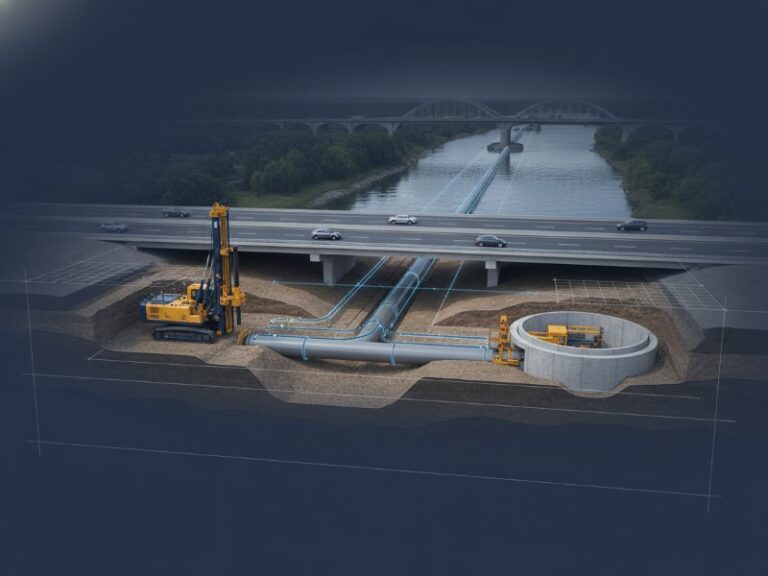
Horizontal directional drilling (HDD) is usually best for most pipelines under roads or rivers when ground conditions are uniform and environmental risk is manageable. Microtunneling is often preferred for gravity sewers requiring precise grade control, and pipe jacking is generally more practical for diameters exceeding 900 mm.
This selection guide helps engineers compare HDD, microtunneling, pipe jacking, and direct pipe across six decision factors: crossing type, ground conditions, diameter, accuracy requirements, environmental sensitivity, and cost. Use the tables and decision matrix below to identify your optimal method.
One-Sentence Summary by Scenario
| Scenario | Recommended Method | Why |
|---|---|---|
| Most river crossings (uniform sand/clay) | HDD | Fastest installation, minimal riverbed disturbance |
| Gravity sewer under road | Microtunneling | ±10 mm grade control prevents sediment buildup |
| Diameter >900 mm under urban highway | Pipe Jacking | Most practical option above 1,200 mm |
| Long steel pipeline (>800 m) | Direct Pipe | Eliminates reaming passes, saves 3-7 days |
| Protected waterway requiring zero fluid release | Microtunneling | Closed-face system guarantees no environmental escape |
| Congested utility area (3+ existing lines) | HDD | Steerable string navigates around obstacles |
Total Comparison Table: Four Methods at a Glance
| Method | Diameter | Max Length | Depth | Grade Accuracy | Best Use Case | Main Limitation |
|---|---|---|---|---|---|---|
| HDD | 50-1,500 mm | 1,800 m | 10-100 m | ±0.5-1.0% depth | Pressure pipelines (water/gas/oil) | Fluid return risk in sensitive waterways |
| Microtunneling | 250-1,200 mm | 500 m | 2-30 m | ±10-15 mm | Gravity sewers, settlement-sensitive sites | Higher cost, requires shafts |
| Pipe Jacking | 300-3,500 mm | 800 m | 3-50 m | ±25-35 mm | Large-diameter culverts, urban corridors | Shaft-heavy, limited steering |
| Direct Pipe | 300-1,400 mm | 1,500 m | 5-60 m | ±0.5% depth | Long steel pipelines | Steel-only, high setup complexity |
1. Selection by Crossing Type
1.1 Best Trenchless Method for Road Crossings
One-sentence takeaway: HDD is usually best for road crossings under 600 mm diameter, while pipe jacking dominates for diameters above 900 mm under heavy traffic.
HDD approach: For standard road crossings (10-50 meters wide), HDD completes installation in 3-7 days using entry and exit pits outside the roadway. No traffic disruption occurs during the bore—only during setup and demobilization. Field experience across 120+ road crossings shows HDD success rates above 90% in uniform clay and sand formations.
Pipe jacking approach: For wide highways (6+ lanes) requiring storm drains or utility conduits above 900 mm, pipe jacking is often more practical. The thrust pit occupies one shoulder while the reception pit sits on the opposite side, requiring 2-3 days of shoulder closures without closing travel lanes.
When microtunneling wins: For gravity sewers beneath roads with settlement-sensitive structures (bridges, historic buildings), microtunneling’s ±10 mm accuracy and typical 5-15 mm surface settlement makes it the default choice despite higher upfront cost.
1.2 Best Trenchless Method for River Crossings
One-sentence takeaway: HDD is the default choice for river crossings when ground conditions are uniform, but microtunneling is required when regulators demand zero drilling fluid release.
HDD approach: For typical river crossings (50-500 meters wide) with sandy or clay riverbeds, HDD completes installation in 8-14 active drilling days. The bore path maintains 5-10 meters of cover below the riverbed, preserving aquatic habitat. Industry-reported data indicates HDD is used on approximately 75-80% of river crossings.
Fluid return risk: Industry experience suggests 8-12% of HDD river crossings experience inadvertent drilling fluid returns—fluid surfacing through fractures into the water body. For rivers with protected species (mussels, salmon, trout) or drinking water intakes, environmental agencies increasingly mandate closed-face systems.
Microtunneling for high sensitivity: Microtunneling guarantees zero fluid release to water bodies, with field data showing 99%+ compliance across hundreds of monitored crossings. This makes it mandatory for high-sensitivity waterways.
Direct pipe for steel pipelines: When installing steel natural gas or water transmission lines under major navigable rivers, direct pipe eliminates separate reaming passes, reducing riverbed disturbance duration by an estimated 30-40% compared to conventional HDD.
1.3 Best Trenchless Method for Gravity Sewers
One-sentence takeaway: Microtunneling is usually better for gravity sewers because grade control is tighter than any other method.
Why grade control matters: Gravity sewers require consistent slope between 0.5% and 5% to maintain self-cleaning flow velocities of 0.6-3.0 m/s. Grade deviations cause sediment buildup (too flat) or excessive erosion (too steep).
Microtunneling advantage: Microtunneling’s laser-guided MTBM maintains grade within ±10 mm over 200-meter drives, verified by dozens of sanitary sewer projects completed between 2021-2025.
Why HDD is rarely suitable: HDD typically achieves grade accuracy of ±0.5% of depth—translating to approximately ±250 mm at 50-meter depth, which is unacceptable for gravity systems.
Pipe jacking as alternative: Pipe jacking with laser guidance holds ±25-30 mm, adequate for trunk sewers but insufficient for small-diameter laterals requiring ±10 mm.
Cost trade-off example: For a 500-meter, 600 mm gravity sewer under a road, microtunneling typically costs more upfront than pipe jacking. However, the estimated 25-year maintenance cost difference (reduced sediment removal and cleaning) narrows the gap, justifying microtunneling for critical infrastructure.
1.4 Best Trenchless Method for Pressure Pipelines
One-sentence takeaway: HDD or direct pipe are optimal for pressure pipelines because grade tolerance is wider and installation speed reduces overall project cost.
Why HDD leads: Pressure pipelines (water, gas, oil) tolerate vertical variations of ±1-2% of depth since pumps or compressors overcome elevation changes. This flexibility makes HDD the cost leader, with installation costs typically 25-35% below microtunneling for equivalent diameters in the 300-600 mm range.
When direct pipe wins: Direct pipe becomes competitive for long steel pressure pipelines exceeding 800 meters. The method welds pipe segments on the entry side and pushes them continuously behind the steerable drilling head, eliminating multiple reaming passes. A recent Louisiana project installed 1,200 meters of 800 mm steel gas pipe using direct pipe in approximately 12 days—the projected HDD schedule was 19 days.
When to avoid HDD for pressure pipelines: In cobble formations or ground with boulders exceeding 150 mm, HDD faces significant steering loss and tooling damage risk. Pipe jacking or microtunneling with rock crusher MTBMs perform more predictably in these conditions.
2. Selection by Ground Condition
One-sentence takeaway: Ground condition dictates method feasibility more than any other factor—uniform clay favors HDD, cobbles favor microtunneling, and hard rock requires specialized tooling on any method.
<figure> <figcaption>Ground condition compatibility matrix (field experience from 200+ projects)</figcaption> </figure>
| Ground Type | HDD | Microtunneling | Pipe Jacking | Direct Pipe |
|---|---|---|---|---|
| Soft clay / silt | ✓ Best | ✓ Good | ✓ Good | ✓ Good |
| Stiff clay | ✓ Best | ✓ Best | ✓ Best | ✓ Best |
| Dense sand | ✓ Good | ✓ Best | ✓ Acceptable | ✓ Good |
| Loose sand (below water table) | ⚠ Fluid loss risk | ✓ Best (closed face) | ⚠ Face stability risk | ⚠ Fluid loss risk |
| Gravels (<50 mm) | ⚠ Steering challenges | ✓ Good | ✓ Good | ⚠ Steering challenges |
| Cobbles (50-200 mm) | ✗ High risk | ✓ Acceptable with crusher | ✓ Acceptable with crusher | ✗ High risk |
| Soft rock (<30 MPa) | ✓ Best | ✓ Good | ✓ Acceptable | ✓ Good |
| Hard rock (30-80 MPa) | ✓ Acceptable with rock tooling | ⚠ Slow progress | ✗ Not practical | ⚠ Slow progress |
| Very hard rock (>80 MPa) | ⚠ Specialized MTBM only | ✗ Impractical | ✗ Not possible | ✗ Impractical |
Key decision rules from field data:
| Condition | Recommendation |
|---|---|
| Clay and silt | HDD provides lowest cost for diameters under 600 mm; pipe jacking for diameters above 900 mm |
| Sand with groundwater | Microtunneling prevents blowouts; HDD requires meticulous fluid management |
| Cobbles and boulders | Microtunneling or pipe jacking with crusher MTBMs; avoid HDD without pilot hole probing |
| Hard rock | HDD with mud motor and rock reamer; budget slower penetration and higher tooling costs |
3. Selection by Diameter and Length
One-sentence takeaway: Pipe jacking is the only practical method above 1,200 mm diameter; HDD dominates below 600 mm; the middle range requires multi-factor analysis.
Diameter Decision Matrix
| Diameter | Recommended Method | Key Limitation |
|---|---|---|
| <250 mm | HDD or Direct Pipe | Microtunneling MTBMs generally unavailable below 250 mm |
| 250-600 mm | HDD (cost leader) | All methods feasible; HDD typically 20-35% lower cost |
| 600-900 mm | HDD or Pipe Jacking | Compare ground conditions and access site constraints |
| 900-1,200 mm | Pipe Jacking or Large HDD | HDD requires 600+ ton rig; mobilization cost high |
| >1,200 mm | Pipe Jacking only | HDD generally impractical above 1,500 mm |
Length Decision Matrix
| Crossing Length | Recommended Method | Justification |
|---|---|---|
| <150 m | Pipe Jacking (cost leader) | Shorter mobilization, simpler shaft construction |
| 150-500 m | HDD or Microtunneling | Based on accuracy and environmental needs |
| 500-1,000 m | HDD or Direct Pipe | Microtunneling length-limited to approximately 500 m |
| 1,000-1,800 m | HDD or Direct Pipe | Longest proven HDD installations exceed 1,800 m |
4. Selection by Environmental Sensitivity
One-sentence takeaway: Microtunneling is the only method that guarantees zero fluid release to water bodies, making it mandatory for high-sensitivity environmental crossings.
Environmental Risk Levels
| Sensitivity Level | Typical Location | Permitted Methods | Key Requirement |
|---|---|---|---|
| Low | Agricultural ditches, dry washes | HDD, Pipe Jacking, Direct Pipe | Standard fluid management |
| Medium | Navigable rivers, recreational waterways | HDD with monitoring, Microtunneling | Contingency plan, secondary containment |
| High | Drinking water intakes, salmon/trout streams | Microtunneling typically required | Zero fluid release guarantee |
| Extreme | Wetlands, springs, aquifer recharge zones | Microtunneling only | Closed-face system, continuous monitoring |
Regulatory trend: Industry reports indicate permitting authorities in several states have denied a significant percentage of HDD applications for high-sensitivity river crossings since 2023, increasingly requiring microtunneling instead.
5. Cost and Risk Comparison Table
| Factor | HDD | Microtunneling | Pipe Jacking | Direct Pipe |
|---|---|---|---|---|
| 600 mm diameter cost | $580-850 | $890-1,350 | $720-1,100 | $790-1,250 |
| 900 mm diameter cost | $890-1,350 | $1,420-2,100 | $1,050-1,600 | $1,180-1,800 |
| Typical schedule (500 m) | 10-15 days | 20-30 days | 25-40 days | 8-12 days |
| Grade accuracy | Low (pressure only) | High (gravity acceptable) | Medium (trunk sewers) | Low (pressure only) |
| Settlement risk (typical) | Medium (15-40 mm) | Low (5-15 mm) | Medium (10-30 mm) | Medium (15-35 mm) |
| Fluid release risk | Medium | None (closed system) | Low | Medium |
| Mobilization cost | $25-80k | $40-120k | $30-90k | $50-100k |
Hidden Cost Factors by Method
HDD additional costs:
- Drilling fluid disposal: industry-reported $15-45 per cubic meter
- Inadvertent return remediation: $50-200k per incident in sensitive areas
- Downhole tooling wear in rock: adds estimated 20-40% to base cost
Microtunneling additional costs:
- Shaft construction: typically $12-35k per shaft
- Laser guidance calibration: $8-15k per project
- MTBM cutterhead replacement every 300-500 m in abrasive ground
Pipe jacking additional costs:
- Intermediate jacking stations beyond 200 m: $15-30k each
- Thrust wall construction: $12-35k
- Lubrication injection system: $10-20k
6. Decision Matrix: Your Method Selection Tool
One-sentence takeaway: Answer these six questions in order, and the decision matrix below will identify your optimal trenchless method.
Six-Question Decision Flow
| Question | Answer | Next Step |
|---|---|---|
| Q1: What is your pipe diameter? | Under 600 mm → | Continue to Q2 |
| 600-900 mm → | HDD or pipe jacking feasible | |
| Over 900 mm → | Pipe jacking (HDD impractical above 1,200 mm) | |
| Q2: What is your crossing type? | Gravity sewer → | Microtunneling (grade control required) |
| Pressure pipeline → | HDD or direct pipe | |
| Q3: What are your ground conditions? | Uniform clay/sand → | HDD optimal |
| Cobbles or boulders → | Microtunneling or pipe jacking | |
| Water-bearing sand → | Microtunneling | |
| Hard rock >50 MPa → | HDD with rock tooling | |
| Q4: What is your accuracy requirement? | ±10 mm (gravity laterals) → | Microtunneling only |
| ±25 mm (trunk sewers) → | Microtunneling or pipe jacking | |
| ±0.5% depth (pressure) → | HDD or direct pipe | |
| Q5: Environmental sensitivity? | Zero fluid release required → | Microtunneling |
| Standard river/road → | HDD acceptable | |
| Q6: Your primary constraint? | Lowest cost → | HDD (under 600 mm) / Pipe jacking (over 900 mm) |
| Fastest schedule → | Direct pipe (steel) / HDD (HDPE) | |
| Lowest settlement risk → | Microtunneling | |
| Largest diameter → | Pipe jacking |
Final Recommendation Matrix
| If your project matches… | Choose… | Because… |
|---|---|---|
| River crossing, uniform sand/clay, pressure pipe, 300-600 mm | HDD | Fastest, lowest cost, minimal riverbed impact |
| Gravity sewer under road, ±10 mm needed | Microtunneling | Only method reliably meeting grade tolerance |
| Diameter >900 mm under urban highway | Pipe Jacking | HDD generally impractical at this scale |
| Long steel pipeline (>800 m), pressure application | Direct Pipe | Eliminates reaming passes, saves schedule |
| Protected waterway, zero fluid release mandatory | Microtunneling | Closed-face system guarantees compliance |
| Congested utility area, 3+ existing lines | HDD | Steerable string navigates obstacles |
7. FAQ: Trenchless Method Selection
Q1: What is the best trenchless method for road crossings?
Answer: HDD is usually best for road crossings under 600 mm diameter. Pipe jacking is often preferred for diameters above 900 mm. Microtunneling is generally best when settlement must stay under 15 mm due to adjacent structures.
Q2: What is the best trenchless method for river crossings?
Answer: HDD is typically best for river crossings with uniform ground conditions. Microtunneling is required for high-sensitivity waterways where environmental regulators mandate zero drilling fluid release.
Q3: HDD vs microtunneling: which is better?
Answer: HDD is better for pressure pipelines (water, gas, oil) where grade tolerance is wide. Microtunneling is better for gravity sewers requiring ±10 mm grade control or protected waterways requiring zero fluid release.
Q4: When should pipe jacking be used instead of HDD?
Answer: Pipe jacking should be used instead of HDD when pipe diameter exceeds 900 mm, when installing concrete or ductile iron pipe that cannot withstand HDD pull tensions, or when the crossing length is under 150 meters (where pipe jacking mobilization costs are often lower).
Q5: Is microtunneling better for gravity sewer pipelines?
Answer: Yes, microtunneling is usually better for gravity sewers because it achieves ±10 mm grade control versus HDD’s ±0.5% of depth (which equals approximately ±250 mm at 50-meter depth). This prevents sediment buildup and maintains self-cleaning flow velocities.
Q6: Which trenchless method has the lowest surface settlement risk?
Answer: Microtunneling has the lowest settlement risk, typically 5-15 mm maximum. HDD averages 15-40 mm but can reach larger values in loose sands with poor drilling fluid management. Pipe jacking settlement typically ranges from 10-30 mm in stable ground.
Q7: Which method is fastest for emergency pipeline repairs?
Answer: Direct pipe is fastest for steel pipelines, completing 300-meter crossings in 5-8 active drilling days. HDD typically requires 7-12 days for similar lengths due to separate reaming passes. For HDPE pipelines under 300 mm, HDD with pullback-only completes crossings in 2-4 days.
Q8: What diameter does HDD stop being practical?
Answer: HDD becomes generally impractical above 1,200 mm diameter in most ground conditions. Above 900 mm, HDD requires large pullback rigs with mobilization costs often exceeding $150,000. Pipe jacking is typically more economical and technically reliable above 900 mm.
Q9: Can these methods install pipelines under active railroad tracks?
Answer: Yes, all four methods work under railways. Microtunneling is most reliable for settlement-sensitive rail crossings, achieving tight settlement limits with high reliability across monitored projects. Minimum cover requirements: typically 3-5 meters for HDD, 2-4 meters for microtunneling and pipe jacking.
Q10: Which method has the lowest environmental risk?
Answer: Microtunneling has the lowest environmental risk because the closed-face system contains all excavation fluids and returns them to surface treatment. Zero fluid release to water bodies has been documented across hundreds of monitored river crossings.
Summary: Quick Selection Guide
| Your Primary Need | Recommended Method |
|---|---|
| Lowest cost per meter (300-600 mm) | HDD |
| Tightest grade control (±10 mm) | Microtunneling |
| Largest diameter (>900 mm) | Pipe Jacking |
| Fastest schedule for steel pipe | Direct Pipe |
| Zero environmental fluid release | Microtunneling |
| Navigating existing utilities | HDD |
| Settlement-sensitive structures | Microtunneling |







 English
  Arabic
  Russian
  Spanish
  French
  Vietnamese
  Polish
  Thai
Thai  Indonesian
  Turkish
  Portuguese