
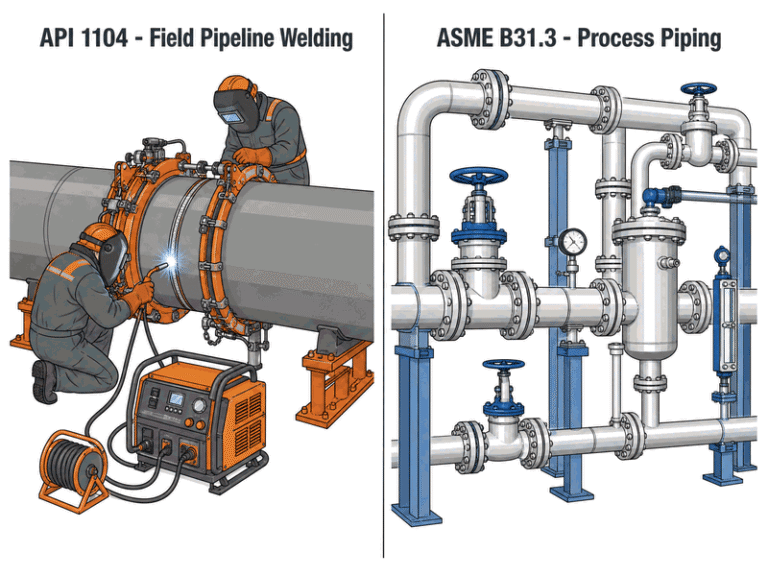
Deciding between API 1104 vs ASME B31.3 comes down to one question: where does your pipe sit? ASME B31.3 applies to process piping inside facilities such as refineries, chemical plants, and power stations, while API 1104 governs the field welding of cross-country pipelines built to ASME B31.4 or ASME B31.8; when a project combines both, each standard controls its own portion. This guide compares the scope, welding qualification, NDT acceptance criteria, heat treatment, and pressure testing of API 1104 vs ASME B31.3, the two pipeline welding standards most often confused, then gives you a step-by-step method to decide which standard applies to your pipeline project. You will also learn how B31.4 and B31.8 delegate their welding rules to API 1104, why welder qualification does not transfer between the two systems, and what to do when both standards meet on one site.
Key Takeaways
- Location decides the standard: ASME B31.3 governs process piping inside facility limits; API 1104 governs field welding of cross-country pipelines under ASME B31.4 or ASME B31.8.
- Qualifications do not transfer: Welding procedure and welder qualifications earned under API 1104 are not valid for B31.3 work, and Section IX qualifications are not valid for API 1104 pipeline work.
- Testing rules differ: B31.3 requires post-weld heat treatment per Table 331.1.1 and hydrostatic testing per Chapter 345; API 1104 does not cover system pressure testing.
- Both can apply on one site: Stations and terminals routinely weld mainline tie-ins to API 1104 and station piping to B31.3, with the boundary defined in the project specification.
- Verify before the first bead: Check the governing code, the qualification cards, and the acceptance criteria against the exact scope of work before welding starts.
What Is API 1104?
API Std 1104, Welding of Pipelines and Related Facilities, is the American Petroleum Institute (API) standard for field welding of pipelines. The current edition is the 22nd Edition, published in 2023 with Errata 1. Contractors use it for girth welds, branch connections, and repair welds on cross-country pipelines carrying crude oil, natural gas, refined products, and other hydrocarbons.
The standard is self-contained. Chapter 4 covers welding procedure qualification, Chapter 6 covers welder qualification, and the standard body defines acceptance criteria for radiography (RT), ultrasonic testing (UT), magnetic particle testing (MT), and penetrant testing (PT). API 1104 also covers repair welding of pipelines in service, which makes it the reference standard for hot tapping and in-service welding work.
API 1104 is a welding and fabrication standard, not a design code. It does not size pipe walls, calculate stresses, or require system pressure tests. Those duties belong to the pipeline design codes that call API 1104 into their scope, mainly ASME B31.4 for liquids and ASME B31.8 for gas.
What Is ASME B31.3?
ASME B31.3, Process Piping, is the piping code of the American Society of Mechanical Engineers (ASME) for piping inside facility boundaries. The current edition is B31.3-2024.
It applies to piping in petroleum refineries, chemical plants, pharmaceutical plants, hydrogen production facilities, pulp and paper mills, power generation plants, semiconductor fabs, and cryogenic plants.
Unlike API 1104, the ASME B31.3 process piping rules form a complete design and construction code. The code specifies materials and components, provides pressure design rules in Chapter 300, requires flexibility analysis of piping systems, and covers fabrication, assembly, erection, examination, and testing of every system it governs.
Its fluid scope covers chemicals, petroleum products, gas, steam, air, water, refrigerants, cryogenic fluids, and fluidized solids.
For welding, B31.3 does not write its own qualification rules. It requires all welds to be made to procedures and by welders qualified in accordance with ASME Section IX, and it sets its own examination and acceptance requirements in Chapter 341 and Appendix A.
API 1104 vs ASME B31.3: The Key Differences
The quickest way to understand the API 1104 vs ASME B31.3 comparison is to put the two standards side by side. They answer different questions. API 1104 answers “how should this pipeline weld be made and accepted?”, while ASME B31.3 answers “how should this facility piping system be designed, built, and tested?”
| Aspect | API Std 1104 | ASME B31.3 |
|---|---|---|
| Primary role | Field welding of pipelines and related facilities | Design, fabrication, and testing of process piping |
| Typical application | Cross-country oil and gas transmission lines | In-plant piping in refineries, chemical plants, power stations |
| Design content | None; welding and acceptance only | Full pressure design, stress analysis, material selection |
| Welding procedure qualification | Chapter 4, self-contained | Per ASME Section IX (para. 328.2) |
| Welder qualification | Chapter 6, self-contained | Per ASME Section IX |
| NDT acceptance criteria | Defined in the standard body | Appendix A; examination scope per Chapter 341 |
| Post-weld heat treatment | Not a general requirement for new construction | Required for carbon steel per Table 331.1.1 in defined thickness and service ranges |
| System pressure testing | Not covered | Required by Chapter 345 before service |
| Current edition | 22nd Edition, 2023 | B31.3-2024 |
How Do the Scopes Compare in Practice? (B31.4 vs B31.8 vs B31.3)
In practice, the API 1104 vs ASME B31.3 question is decided by where the pipe is located. Piping inside a facility battery limit is process piping and falls under ASME B31.3. Piping that transports a product between facilities is a pipeline system and falls under ASME B31.4 or ASME B31.8, whose welding rules point to API 1104.
The table below maps common project scenarios to their governing design code and welding standard. Use it as a first pass before you open either document.
| Piping or system | Governing design code | Welding standard |
|---|---|---|
| Cross-country liquids pipeline (crude, products, ammonia, slurry) | ASME B31.4 | API 1104 |
| Gas transmission or distribution line | ASME B31.8 | API 1104 |
| Refinery, chemical, or power plant process piping | ASME B31.3 | ASME Section IX |
| Hydrogen piping inside a facility | ASME B31.3 (B31.12 for dedicated hydrogen pipelines) | ASME Section IX |
| Pump, compressor, or meter station piping | ASME B31.4 or B31.8 | API 1104 for mainline tie-ins; B31.3 for defined process systems per owner specification |
| Interconnecting piping within facility limits | ASME B31.3 | ASME Section IX |
What About ASME B31.4 and ASME B31.8?
ASME B31.4 covers pipeline transportation systems for liquids and slurries, and ASME B31.8 covers gas transmission and distribution piping. These are the design codes for cross-country pipeline systems, and neither of them rewrites welding rules. Both adopt API 1104 as the welding standard within their scope.
| Aspect | ASME B31.4 | ASME B31.8 |
|---|---|---|
| System covered | Liquid and slurry pipeline transportation | Gas transmission and distribution piping |
| Typical regulation | 49 CFR Part 195 | 49 CFR Part 192 |
| Welding standard | API 1104 | API 1104 |
This means a mainline girth weld on a liquids line is designed under B31.4, welded to API 1104, and system-tested to B31.4 requirements. The same logic applies to gas lines under B31.8. When people compare pipeline welding standards, the real question is whether their line is governed by B31.4, B31.8, or B31.3.
How Do Welding Qualification Requirements Differ?
Welding qualification is where the two systems differ most for contractors. API 1104 handles welding procedure qualification and welder qualification inside its own document, while ASME B31.3 delegates both to ASME Section IX. A qualification earned under one system is not automatically valid under the other.
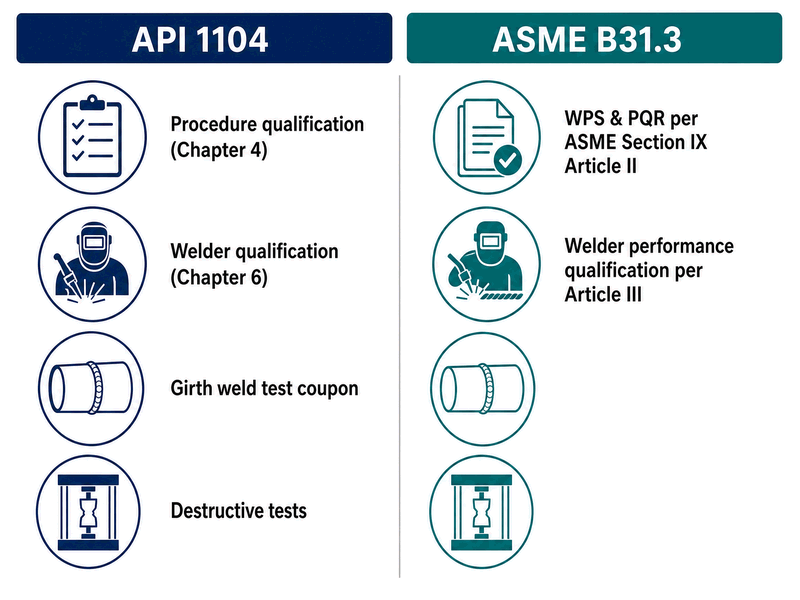
Figure 1 . API 1104 qualifies procedures and welders within the standard itself, while ASME B31.3 references ASME Section IX for both.1
| Qualification element | API 1104 | ASME B31.3 |
|---|---|---|
| Procedure document | WPS qualified per Chapter 4 | WPS and PQR qualified per ASME Section IX |
| Essential variables | Process, electrode class, thickness range, position, and more | Defined by ASME Section IX, Article II |
| Welder test | Girth weld test per Chapter 6 | Performance qualification per ASME Section IX, Article III |
| Validity | Applies to API 1104 pipeline work only | Applies to B31.3 process piping work only |
| Transfer between systems | Not accepted for B31.3 unless the owner accepts it | Not accepted for API 1104 pipeline work |
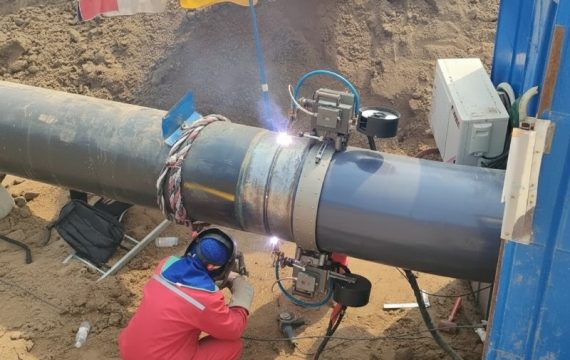
This difference is the core of the API 1104 vs ASME B31.3 comparison for welding contractors. In our welding department we keep two separate qualification matrices: one for API 1104 pipeline welding crews, and one for plant piping welders qualified to ASME Section IX. The two sets of essential variables never fully overlap, and sending the wrong welder to the wrong scope is a common cause of failed inspections. The same logic applies to automatic pipeline welding: the automatic process and its essential variables must be qualified within the governing system before production welding starts.
How Do NDT Requirements and Acceptance Criteria Differ?
Both standards rely on the same NDT methods, but they set NDT acceptance criteria in different places and scope the examination differently. Understanding this prevents rework at final inspection.
API 1104 defines acceptable limits for porosity, slag inclusions, incomplete fusion, and other imperfections directly in the standard body, with additional rules in its appendixes for automated UT. The extent of examination, whether partial or 100 percent, is set by the governing pipeline code and the operator’s specification, not by API 1104 itself.
ASME B31.3 bases examination scope on fluid service category. Chapter 341 defines how much examination each category requires, ASME Section V governs the NDT methods, and Appendix A provides the acceptance criteria. NDT personnel on B31.3 work must be qualified per ASME Section V and SNT-TC-1A requirements.
| NDT requirement | API 1104 | ASME B31.3 |
|---|---|---|
| Methods | RT, UT, MT, PT with criteria in the standard | RT, UT, MT, PT per ASME Section V |
| Examination extent | Set by governing code and operator specification | Based on fluid service category in Chapter 341 |
| Acceptance basis | Standard body and appendixes | Appendix A |
| Personnel qualification | Per governing code or owner specification | Per ASME Section V / SNT-TC-1A |
How Do PWHT and Hydrostatic Testing Compare?
The two standards also differ in post-weld heat treatment (PWHT) and system testing. These requirements drive cost and schedule, so they matter when you budget a project.
ASME B31.3 requires PWHT for carbon steel piping above defined thicknesses and for certain services, per Table 331.1.1, and it requires impact testing of the base material where the code specifies. API 1104 does not generally require PWHT for new construction field welds on cross-country lines, because heat treatment of long field runs is impractical; the governing pipeline code and the owner’s specification define any exceptions.
Pressure testing is the clearest difference. ASME B31.3 Chapter 345 requires every new process piping system to pass a hydrostatic test, or a pneumatic test where hydrostatic testing is not practical, before it goes into service. API 1104 does not cover system pressure testing at all; testing of a cross-country line is required by B31.4, B31.8, or the applicable regulation such as 49 CFR Part 192 or Part 195.
| Requirement | API 1104 | ASME B31.3 |
|---|---|---|
| Post-weld heat treatment | Not a general requirement for new construction field welds | Table 331.1.1 for carbon and alloy steels at defined thicknesses and services |
| Impact testing | Not specified in the standard | Required for defined materials and services |
| System pressure test | Not covered | Hydrostatic testing or pneumatic test per Chapter 345 before service |
Which Standard Applies to Your Pipeline Project?
To answer the API 1104 vs ASME B31.3 question for your own project, work through these five steps. They take about ten minutes and will stop you from applying the wrong code.
- Step 1: Locate the piping. If it sits inside a facility battery limit, it is process piping and ASME B31.3 governs. If it runs between facilities, it is a pipeline system governed by B31.4 or B31.8.
- Step 2: Identify the fluid. Liquids and slurries point to ASME B31.4. Gas points to ASME B31.8. Facility process fluids point to ASME B31.3.
- Step 3: Check the regulator and the owner. Regulations such as 49 CFR Part 192 and Part 195, local codes, and the project specification can add requirements and can move the boundary between codes.
- Step 4: Match the welding standard to the design code. B31.4 and B31.8 systems are welded to API 1104 pipeline welding requirements. B31.3 systems are welded to ASME Section IX qualifications.
- Step 5: Confirm the boundary on site. At stations, terminals, and tie-ins, define where each code takes over, usually at the isolation valve or the facility fence line, and record it in the project specification.
If you are still unsure after step five, send us your pipe size, fluid, and operating pressure, and our engineers will confirm the governing code for your project before you finalize the specification. Our pipeline construction services cover the full scope from code selection through final testing.
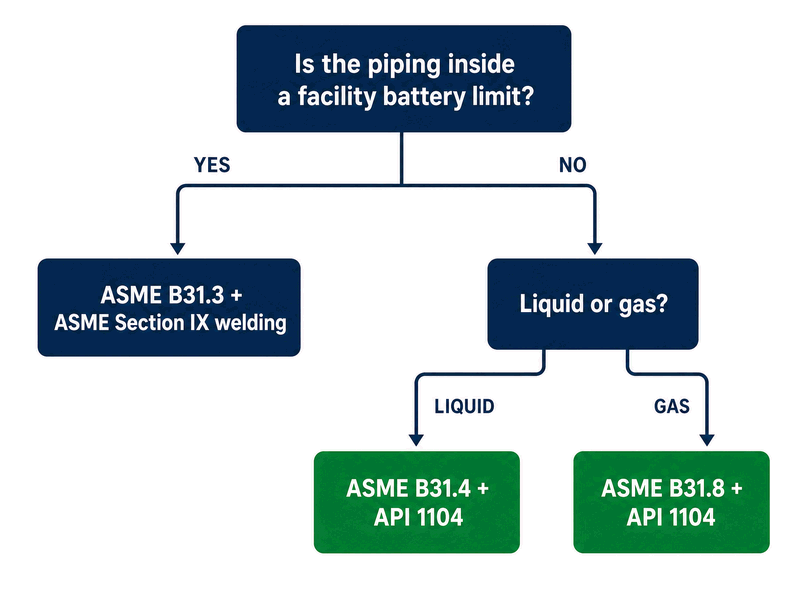
Figure 2. A five-step decision path that selects the governing design code and the welding standard for a given project scope.
Can Both Standards Apply to the Same Project?
Yes, and this is the situation that confuses most project teams. A pipeline project with a pump station, compressor station, meter station, or terminal routinely uses both standards on one site. The mainline girth welds are welded to API 1104 under B31.4 or B31.8, while the station process piping is designed and welded to ASME B31.3.
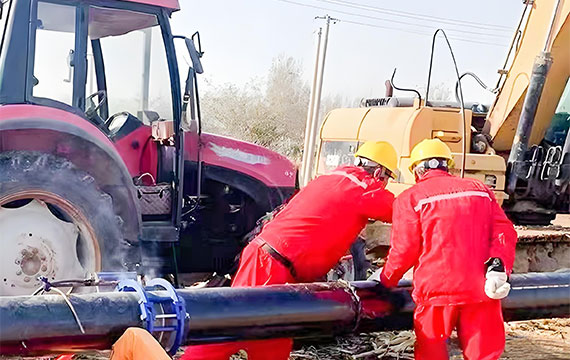
On a recent crude transfer project, our crews welded a 24-inch mainline to API 1104 while the pump station piping was fabricated and welded to ASME B31.3 with Section IX-qualified welders. The transition sat at the station block valve, exactly where the project specification defined it. The lesson: the boundary is a specification decision, not a technical judgment call made at the spool.
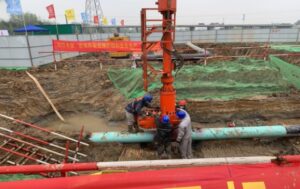
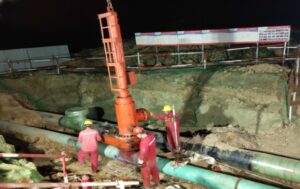
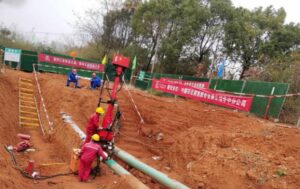
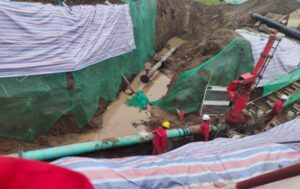
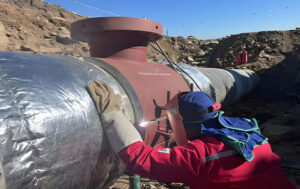
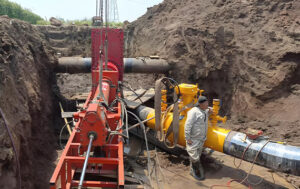
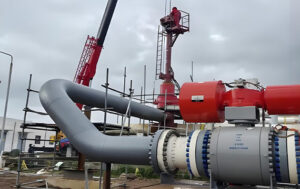
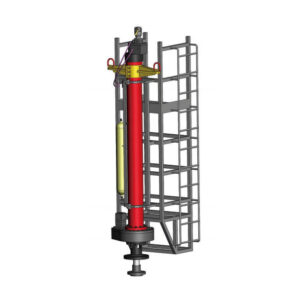
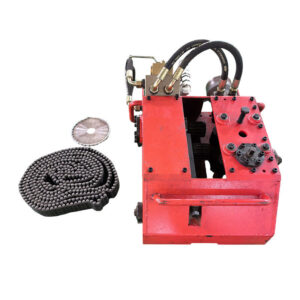
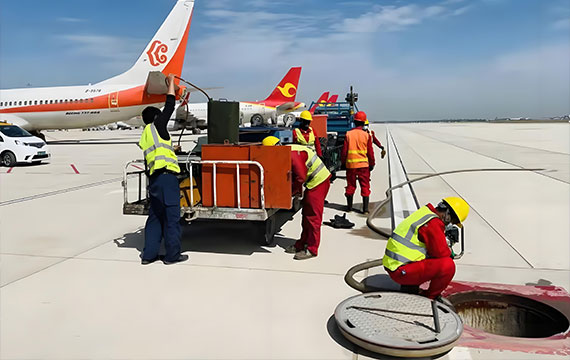
Hot tapping follows the same logic. A hot tap on an operating cross-country line is welded to API 1104 in-service welding requirements, supported by ASME PCC-2 practices. A hot tap or tie-in on B31.3 facility piping is governed by B31.3, again with PCC-2 guidance for in-service work. The same boundary logic applies when a station tie-in needs line stopping and plugging equipment, and we see both on almost every multi-discipline project we execute.
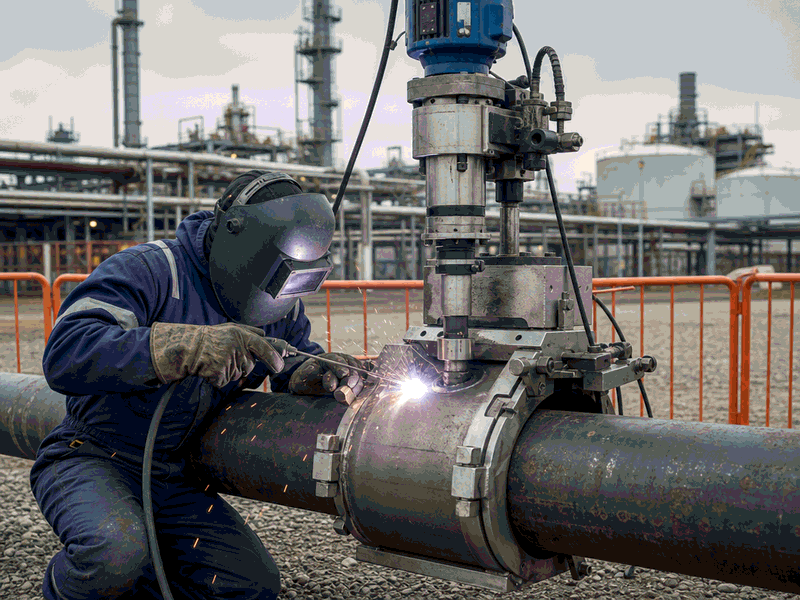
Figure 3. Hot tap welding on an operating line is an in-service welding scope executed to API 1104 when the pipeline is governed by B31.4 or B31.8.
See how JSW executes hot taps on operating lines with our hot tapping and line stopping team.
Frequently Asked Questions
What is the difference between API 1104 and ASME B31.3?
API 1104 is a welding standard for cross-country pipelines; ASME B31.3 is a design and construction code for process piping inside facilities. API 1104 covers welding procedure qualification, welder qualification, and weld acceptance criteria but no design content, while B31.3 covers full pressure design, materials, fabrication, examination, and testing, and delegates welding qualification to ASME Section IX. In short, B31.3 governs the piping system, while API 1104 governs the weld on pipeline systems built to ASME B31.4 or ASME B31.8.
Is API 1104 a design code?
No. API 1104 is a pipeline welding standard, not a design code. Design of the pipeline system comes from the governing pipeline code, ASME B31.4 for liquids or ASME B31.8 for gas, or from the applicable regulation. API 1104 covers how welds are made, qualified, and accepted, not how the pipe is sized or supported.
Does ASME B31.3 apply to cross-country pipelines?
Generally no. Cross-country transmission lines are governed by ASME B31.4 for liquids and ASME B31.8 for gas. ASME B31.3 process piping rules apply inside facility boundaries, and the owner or regulator can extend B31.3 to specific systems, such as defined station process systems, where the project specification says so.
Which standard governs hot tapping on an operating pipeline?
It depends on the system. Hot taps on operating cross-country lines follow API 1104 in-service welding requirements with ASME PCC-2 practices. Hot taps on B31.3 facility piping follow B31.3, again supported by PCC-2. The fluid service, pressure, and wall thickness determine the exact procedure either way, and the hot tapping equipment must be matched to the line size and pressure class.
Can a welder qualified to API 1104 weld to ASME B31.3?
Not automatically. API 1104 qualification is valid for API 1104 pipeline welding work, and B31.3 work requires qualification per ASME Section IX. The two systems are not interchangeable, and an owner who accepts a transfer is taking a compliance risk. Verify the welder’s qualification card against the exact scope before the first bead.
Does API 1104 require pressure testing?
No. API 1104 does not cover system pressure testing. Testing of a pipeline system is required by the governing code, ASME B31.4 or ASME B31.8, and by regulations such as 49 CFR Part 192 and Part 195. On B31.3 projects, the hydrostatic testing required by Chapter 345 is a separate milestone from weld inspection.
Which editions are currently in force?
API Std 1104 is at the 22nd Edition, 2023, with Errata 1. ASME B31.3 is at the 2024 edition, and ASME B31.4 is at the 2025 edition. Always verify the edition referenced by your contract and the local regulation, because projects often cite earlier editions that are still legally current.
Is API 1104 or ASME B31.3 more demanding?
Neither standard is universally stricter; they enforce different things. B31.3 adds requirements API 1104 does not touch: post-weld heat treatment per Table 331.1.1, impact testing, and a hydrostatic or pneumatic system test per Chapter 345 before service. API 1104, by contrast, embeds its weld acceptance criteria in the standard body, and the examination extent on a pipeline is set by B31.4, B31.8, or the operator’s specification, which can demand 100 percent radiography. For budgeting, the main cost drivers are the NDT extent, PWHT on thicker-wall station piping, and qualifying crews to two separate systems when both standards meet on one site.
For most projects, the facility boundary is the deciding factor: inside the fence, ASME B31.3 process piping rules govern design, fabrication, and testing, with welds qualified to ASME Section IX; on the cross-country line, B31.4 or B31.8 governs the system, and API 1104 governs the welding. Many projects use both, and the boundary between these pipeline welding standards must be written into the project specification, not improvised on site.
Choosing the wrong standard means compliance risk, rejected welds, failed tests, and schedule loss.
If you are planning pipeline construction, a station tie-in, or a hot tap, send our engineering team your pipe size, fluid, pressure, and governing code. We will confirm the compliant approach, supply the equipment, and execute the work to the standard that applies to your pipeline project.
For lines already in service, our pipeline repair services and hot tapping and plugging services follow the same qualification discipline for repair and tie-in work.








 English
  Arabic
  Russian
  Spanish
  French
  Vietnamese
  Polish
  Thai
Thai  Indonesian
  Turkish
  Portuguese