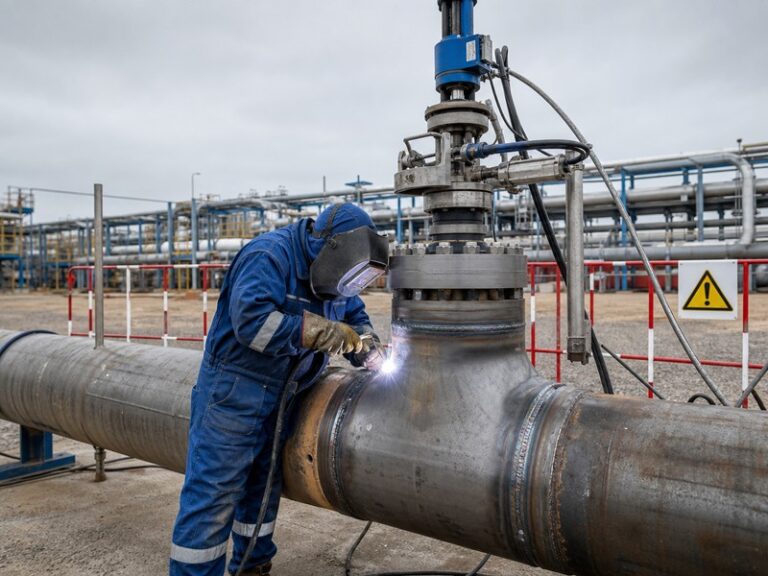
In-service pipeline welding is the controlled practice of welding onto a pressurized pipeline while it remains in operation, typically for hot tapping, line stopping, and repair connections that would otherwise force a shutdown. To weld on a live line safely, you must qualify the procedure for the actual service conditions, measure the remaining wall thickness, control heat input with stringer beads, and verify flow before the first bead. This complete guide explains when the technique is used, the two failure modes that govern it, the standards that apply (API 1104, API RP 2201, ASME PCC-2, ASME B31.4/B31.8, ISO 15156-2), the eight-step preparation procedure, welding processes and parameters, mechanical alternatives, and realistic cost drivers, followed by a practical FAQ.
In this guide:
- What Is In-Service Pipeline Welding?
- When Do You Need In-Service Welding? 6 Common Applications
- What Are the Two Main Risks of Welding on a Live Pipeline?
- Which Standards Govern In-Service Welding?
- How to Prepare for Live Line Welding: 8-Step Procedure
- What Welding Processes and Parameters Are Used?
- In-Service Welding vs. Mechanical Alternatives: How Do You Choose?
- How Much Does In-Service Pipeline Welding Cost?
- Frequently Asked Questions
- Conclusion
Key Takeaways
- In-service welding is standard industry practice for hot tapping, line stopping, and branch connections, with procedures and welders qualified per API Standard 1104 (24th ed., 2021).
- Two failure modes control the work: burn-through (the weld pool melts through the remaining wall) and hydrogen cracking (a hard, crack-prone heat-affected zone).
- Remaining wall below the conservative 6.4 mm (0.25 in) threshold requires reduced heat input, and 4 mm is the research-validated lower limit for controlled direct welding.
- Keep heat input at or below 1.0 kJ/mm on 4.0-6.4 mm walls; up to 1.5 kJ/mm is allowed only on walls of 6.4 mm or more, per a qualified WPS.
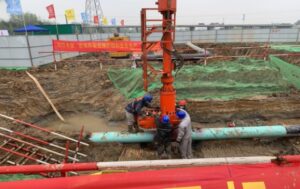
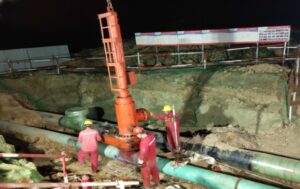
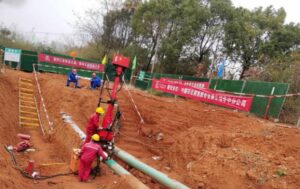
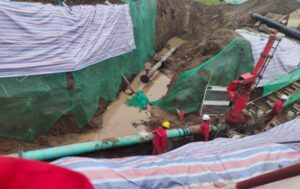
- Hot tapping is the most common in-service application: a split-tee fitting is welded onto the live line, then drilled through an attached valve to create a new branch without shutdown.
- Verify product flow before welding; dead legs are the highest-risk locations because nothing carries heat away from the inner wall.
- Cap weld and heat-affected zone hardness at 22 HRC in sour service per NACE MR0175/ISO 15156-2:2015.
What Is In-Service Pipeline Welding?
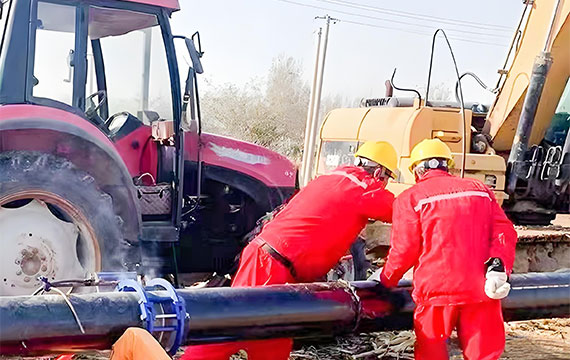
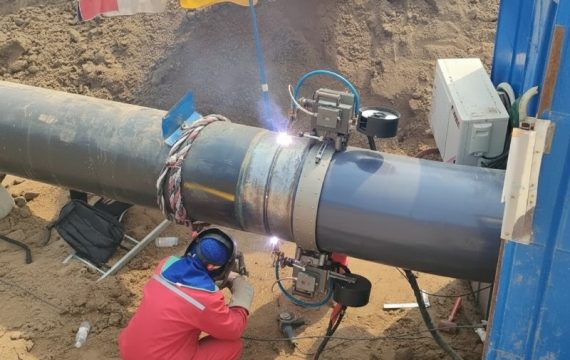
The process welds fittings onto a pipeline that is still carrying product under pressure. The line is not isolated or drained; it continues to operate while the weld is made, which is why the technique is also called live pipeline welding, and hot tap welding when a branch connection is involved.
The purpose is economic. Shutting down a transmission or process line can cost hundreds of thousands of dollars per day in lost production, so operators prefer to make connections and repairs without stopping the flow.
Two characteristics define the discipline. First, the remaining wall thickness must be sufficient to absorb welding heat without melting through. Second, the welding procedure must be qualified for the exact pressure, flow, and wall conditions on site, because a procedure qualified for a depressurized tie-in is not valid for a pressurized line.
When Do You Need In-Service Welding? 6 Common Applications
From hot tapping new offtakes to line stopping sections for repair, in-service work appears wherever a pipeline must keep running. The six applications below cover most real-world jobs.
| Application | What it does | Typical industries |
|---|---|---|
| Hot tapping (branch connections) | Welds a split-tee fitting onto a live line, then drills through the fitting to create a new offtake without shutdown | Oil, gas, water, chemicals |
| Line stopping | Installs stopper fittings and plugging equipment to isolate a section for repair while the rest of the line keeps flowing | Gas distribution, water mains, refineries |
| Repair sleeves and full encirclement saddles | Welds reinforcement over corroded or thin sections to restore strength | Cross-country pipelines, plant piping |
| Leak repair | Welds patches or fittings over pinhole and small leaks under controlled conditions | Refineries, terminals |
| Temporary by-pass connections | Creates temporary flow paths so a section can be isolated and repaired | Transmission operators |
| Instrument and small-branch attachments | Adds small connections, supports, and attachments to operating lines | All industries |
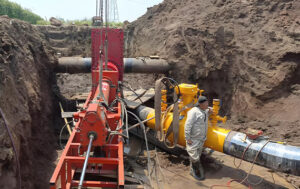
Hot tapping is the most common single use: the fitting is welded first, the new valve is bolted on, and the drilling machine cuts through the wall through the open valve. Our hot tapping and line stopping services cover the complete workflow, from procedure qualification to fitting supply and execution on site.
What Are the Two Main Risks of Welding on a Live Pipeline?
Every risk in in-service pipeline welding reduces to two failure modes, and the entire procedure is designed to control both of them.
Burn-through: the weld pool melts through the remaining wall
Burn-through is the sudden rupture that occurs when the arc melts through the remaining wall and internal pressure blows out the weakened area. Research by EWI and PRCI defines burn-through as occurring when radial deformation of the wall exceeds 0.1 times the wall thickness. TWI research cites 982 °C (1800 °F) as the critical internal wall temperature. Both criteria are managed by wall thickness measurement, low heat input, and flowing product that carries heat away.
A dead leg is a section of pipe with no flow, typically a branch closed at both ends or a stagnant line. Because nothing carries heat away from the inner wall, heat builds up locally and burn-through risk rises sharply.
For the full mechanism, the four risk factors, and eight prevention methods, see our dedicated guide on burn-through prevention in live pipeline welding.
Hydrogen cracking: a hard, brittle heat-affected zone
Hydrogen cracking (also called hydrogen-induced cracking) occurs when hydrogen in the weld diffuses into the heat-affected zone and, combined with a fast cooling rate, produces a hard, crack-prone microstructure. The controls are preheat, low-hydrogen electrodes, and controlled cooling. In sour service, NACE MR0175/ISO 15156-2:2015 requires weld and heat-affected zone hardness to be capped at 22 HRC.
| Failure mode | Mechanism | Primary controls |
|---|---|---|
| Burn-through | Weld pool melts through the remaining wall; internal pressure ruptures the molten zone. Research criteria: 0.1x wall thickness radial deformation (EWI/PRCI); 982 °C inner-wall temperature (TWI/PRCI thermal analysis) | Wall thickness survey, heat input at or below 1.0 kJ/mm on thin walls, stringer beads, verified flow |
| Hydrogen cracking | Hydrogen diffusion plus fast cooling produces a hard, crack-prone heat-affected zone | Preheat to 100 °C or more when wet or sour, low-hydrogen electrodes, hardness at or below 22 HRC |
Which Standards Govern In-Service Welding?
Five standards form the regulatory backbone of in-service pipeline welding. Which standard applies determines how pipeline welding procedures are qualified, what the welder must hold, and how the completed weld is inspected.
| Standard | Scope | Key requirement for in-service work |
|---|---|---|
| API Standard 1104 (24th ed., 2021) | Welding of pipelines and related facilities | Qualification of welding procedures and welders for in-service pipelines |
| API RP 2201 (5th ed.) | Safe hot tapping practices in petroleum and petrochemical industries | Preheat to at least 100 °C (212 °F) when the surface is wet or the product contains hydrogen sulfide; job planning and permits |
| ASME PCC-2-2022 | Repair of pressure equipment and piping | Article 201: hot tapping repair methodology |
| ASME B31.4 / ASME B31.8 | Liquid and gas transmission piping systems | Design codes that adopt API 1104 welding requirements for repairs and tie-ins on operating lines |
| NACE MR0175/ISO 15156-2:2015 | Materials for H2S-containing environments | Weld and heat-affected zone hardness at or below 22 HRC in sour service |
API 1104 is the qualification standard that matters most on cross-country work. If you are comparing it with ASME B31.3 for plant piping, our guide on API 1104 vs ASME B31.3 maps the boundary between field pipeline welding and process piping.
How to Prepare for Live Line Welding: 8-Step Procedure
The procedure below is the sequence our crews follow on hot tap and live line jobs. Each step is a gate: if a step cannot be satisfied, the job stops until it can.
- Review as-built drawings and inspection records; confirm the pipe grade, diameter, wall thickness, and coating.
- Run an ultrasonic thickness (UT) survey over the weld area and map the minimum remaining wall.
- Confirm the product, operating pressure, temperature, and flow condition; flag dead legs and stagnant sections (see the risks section for why they are dangerous).
- Select the connection method: direct fillet weld, full encirclement saddle, or hot tap split tee.
- Verify that the Welding Procedure Specification (WPS), its Procedure Qualification Record (PQR), and the welder are qualified per API 1104 for the exact wall range, pressure, and flow on site.
- Prepare the surface: remove coating, corrosion products, and moisture down to sound metal.
- Preheat to the procedure minimum (typically 100 °C) when moisture or hydrogen sulfide is present; monitor with thermocouples.
- Deposit stringer beads within the qualified heat input; cool between passes and watch for deformation; stop immediately if the wall sags.
After welding, the completed weld is inspected with visual testing (VT), magnetic particle or penetrant testing (MT/PT), UT thickness checks, and hardness testing where the service demands it. We log heat input for every bead on live line work and keep the records with the job file. That way, the answer to “how was burn-through prevented” is always documented rather than assumed. Final acceptance follows the inspection criteria of the governing standard (API 1104 for cross-country work), so the NDT results are judged against a defined acceptance level, not an opinion.
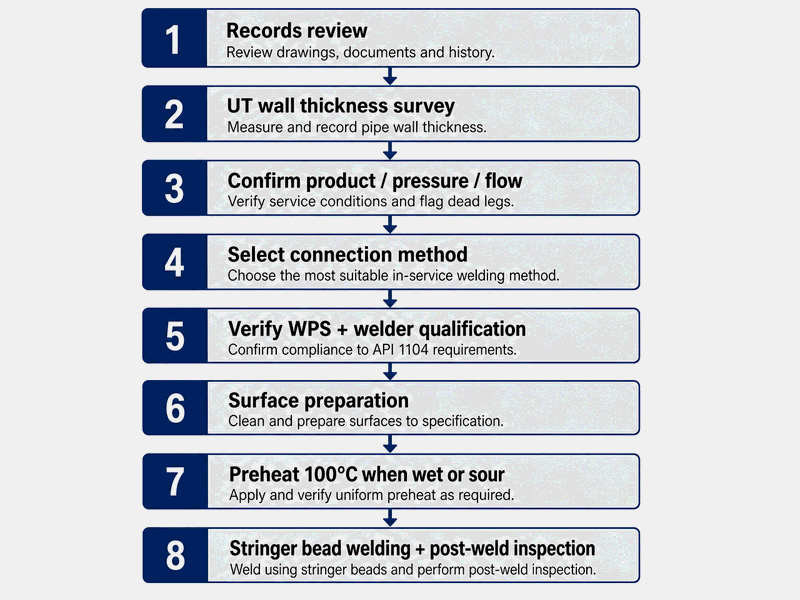
Figure 1. The eight-step preparation and execution procedure used on live line jobs.
What Welding Processes and Parameters Are Used?
Shielded metal arc welding (SMAW) with low-hydrogen electrodes is the workhorse of in-service pipeline welding because it gives the welder direct control over heat input bead by bead. Gas tungsten arc welding (GTAW) is used for small-diameter and high-integrity root passes, and automatic welding systems are increasingly used on large-diameter work because they hold parameters more consistently than manual welding.
Heat input is the variable that decides burn-through risk, and it is calculated as:
Heat input (kJ/mm) = 60 x Volts x Amps / (1000 x travel speed in mm/min)
As a working rule, keep heat input at 1.0 kJ/mm or below when the remaining wall is in the 4.0-6.4 mm range. Heat input up to 1.5 kJ/mm is acceptable only on walls of 6.4 mm or more, and only when the welding procedure is qualified for that value. EWI experiments demonstrated that a 4 mm wall can be welded with a 3.2 mm electrode at 110 A and 0.9 kJ/mm heat input.
As a worked example, 110 A at 22 V with a 150 mm/min travel speed gives 60 x 110 x 22 / (1000 x 150), about 0.97 kJ/mm, inside the 1.0 kJ/mm ceiling for 4.0-6.4 mm walls. These are example values; the actual ceiling is whatever the qualified welding procedure specifies.
| Parameter | Typical range | Reason |
|---|---|---|
| Electrode diameter | 2.4 mm or 3.2 mm (3/32 in or 1/8 in), low-hydrogen E7018 class | Smaller electrodes reduce current density and penetration |
| Welding current | 90-130 A (SMAW) | Keeps heat input within the qualified ceiling |
| Bead technique | Stringer beads only, no weaving | Weaving holds the arc on one spot and raises inner-wall temperature |
| Heat input ceiling | At or below 1.0 kJ/mm for 4.0-6.4 mm walls; up to 1.5 kJ/mm for walls of 6.4 mm or more per qualified WPS | Keeps inner-wall temperature below the 982 °C burn-through threshold |
| Interpass temperature | Cool to hand-touch between passes | Lets the flowing product carry accumulated heat away |
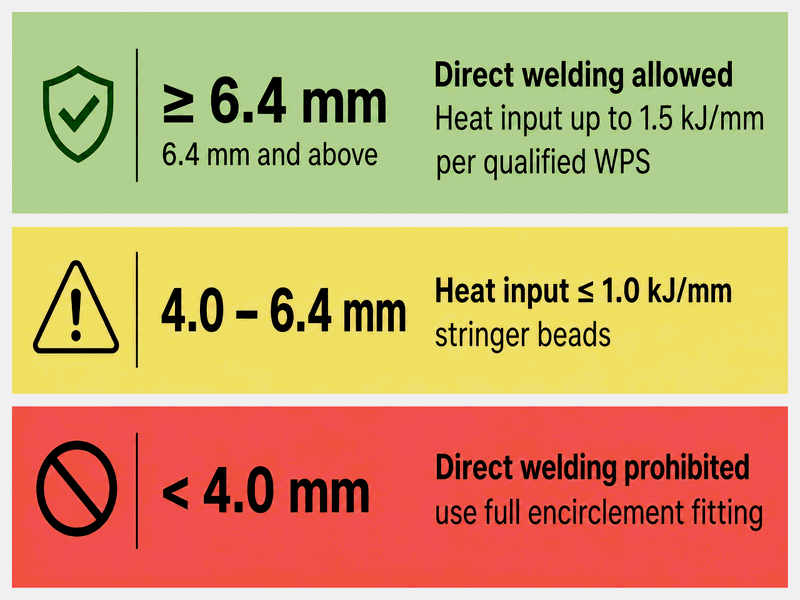
Figure 2. Wall thickness and heat input limits for direct welding, anchored to the 6.4 mm conservative threshold and the 4 mm research-validated lower limit.
For large-diameter transmission lines, automatic welding with real-time heat input monitoring is becoming standard on new construction and major repair programs. Our automatic pipeline welding technology page explains how machine control improves consistency on big-diameter girth welds.
In-Service Welding vs. Mechanical Alternatives: How Do You Choose?
Welding is not always the right answer. Bolt-on mechanical clamps and shutdown repair are the two main alternatives, and each has a clear application window.
| Method | Best for | Joint type | When to avoid |
|---|---|---|---|
| In-service welding | New branch connections, reinforcements, and repairs on sound metal with adequate wall thickness | Permanent, full-strength welded joint | Wall below 4 mm, confirmed dead legs, volatile environments where hot work is restricted |
| Bolt-on mechanical clamp | Leak repair on thin or uncertain walls and in no-hot-work zones | Temporary to long-term, depends on design and standards such as ASME PCC-2 | Permanent structural reinforcement without engineering review |
| Shutdown, drain, and weld | Any weld when the line can be taken out of service | Permanent | When lost production outweighs the repair cost |
In our experience, the decision is rarely about capability and almost always about economics and safety policy. A refinery with a strict no-hot-work policy in a unit will choose a mechanical clamp even when the wall is weldable. A gas transmission operator, by contrast, will usually prefer in-service welding for a new offtake. If the line cannot be welded and the leak is localized, bolt-on repair clamps offer a proven non-welded alternative.
How Much Does In-Service Pipeline Welding Cost?
Costs vary widely with location, diameter, and access, but the main drivers are consistent. Budgeting against the wrong driver is the most common planning error on live line projects.
- Welding procedure qualification: developing and qualifying the procedure for the specific wall, pressure, and flow conditions.
- Mobilization and access: excavation, scaffolding, and site preparation dominate remote work.
- Equipment: welding machines, hot tap drilling machines, line stopping plugs, and fittings.
- Crew and welder qualification: certified welders for live line work command a premium.
- NDT and records: MT/PT, UT, hardness testing, and the full documentation trail.
- Downtime avoided: the value of the production not lost, which usually dwarfs every other line item, and the reason operators fold in-service work into their pipeline maintenance services budgets.
Because a hot tap job is priced around the specific fitting size, pressure class, and access conditions, the reliable way to budget is to ask our engineering team for a project-specific estimate rather than relying on rule-of-thumb figures.
To get a reliable figure, send us the following:
- Pipe size and wall thickness (from the nameplate or a UT reading)
- Product and operating pressure / temperature
- Flow condition: flowing or a dead leg?
- Access: above ground, buried, or in a congested area
- Photos of the weld area
- Governing standard or code, if you know it
Frequently Asked Questions
Can you weld on a live pipeline?
Yes. Welding on live pipelines is a routine, code-controlled operation when it is performed to a qualified procedure per API 1104 with measured wall thickness, controlled heat input, and verified flow. The line stays in service, which is the purpose of the technique, so the procedure must be engineered for the actual pressure and flow.
What is the minimum wall thickness for live line welding?
The conservative engineering threshold is 6.4 mm (0.25 in) for direct welding with low-hydrogen electrodes and normal welding processes. EWI research demonstrated that a 4 mm wall can be welded with a 3.2 mm electrode at 110 A and 0.9 kJ/mm heat input. Below 4 mm, use a full encirclement fitting or take the line out of service. For a quick reference, see the wall thickness and heat input decision chart in the parameters section above.
What is the difference between hot tapping and in-service welding?
Hot tapping is a specific application of in-service welding: the fitting is welded onto the live line, then a drilling machine cuts through the wall through an attached valve to create a branch. In-service welding is the broader discipline that covers hot tapping, line stopping, repairs, and any other weld on a pressurized pipeline.
Do you need to preheat before welding on a live pipeline?
Preheat is required when the surface is wet, when moisture is present, or when the product contains hydrogen sulfide; 100 °C (212 °F) is the common minimum per API RP 2201 (5th ed.). On dry, clean carbon steel with adequate flow, preheat may be minimal because the flowing product provides the cooling.
What happens if burn-through occurs during welding?
Burn-through produces an immediate leak or blowout at the weld location. The correct response is to stop welding, remove the heat source, and isolate the section per the emergency response plan. Burn-through is why wall thickness measurement, procedure qualification, and flow verification all happen before the first bead.
What is a dead leg and why is it dangerous for in-service welding?
A dead leg is a section of pipe with no flow, such as a branch closed at both ends or a stagnant line. Because nothing carries heat away from the inner wall during welding, heat builds up locally and the burn-through risk rises sharply. Dead legs are flagged during the flow check in the preparation procedure and are usually handled with a full encirclement fitting, reduced heat input, or a controlled shutdown rather than direct welding.
Is in-service pipeline welding safe?
Any welding on a pressurized pipeline carries risk, and burn-through is the primary hazard. The risk is managed, not eliminated: wall thickness measurement, a qualified procedure, heat input control, and verified flow reduce it to a level the industry routinely accepts. An unmeasured thin wall, a confirmed dead leg, or an unqualified welder turns an acceptable risk into an unacceptable one.
What qualifications do welders need for live pipeline work?
Welders must hold current qualification per API 1104 covering in-service welding, and the welding procedure must be qualified for the exact wall range, pressure, and flow on site. A welder qualified for depressurized tie-ins is not automatically qualified for live line work. Per API 1104, a qualification stays valid only while the welder continues to weld with that process, typically under a six-month continuity rule; otherwise requalification is required.
How long does an in-service welding job take?
A typical hot tap can be completed in one to two shifts once access and permits are in place, with the weld itself taking hours depending on the fitting size. Line stopping and repair programs take longer because of the additional plugging, testing, and isolation steps. Mobilization and site access usually dominate the schedule, not the welding.
How much does hot tapping cost?
Hot tapping costs vary widely with fitting size, pipe diameter, pressure class, access, and location, so published lump sums are rarely reliable. The main cost drivers are welding procedure qualification, mobilization and access, equipment, certified crew, and NDT, with the value of avoided downtime usually the largest item. The practical approach is to request a project-specific estimate, because pricing follows the actual fitting size, pressure class, and site conditions.
Planning an in-service weld and unsure about your wall thickness or governing standard? Send us your pipe size, wall thickness, product, and pressure. Our engineers will confirm the compliant approach, usually within 24 hours.
In-service pipeline welding is the economic answer to a simple question: how do you connect, repair, or modify a pipeline without stopping it? The answer is a controlled system of wall thickness measurement, qualified procedures, disciplined heat input, verified flow, and complete inspection, all anchored to API 1104 and the supporting standards.
Done correctly, this work is routine and dependable, proven across thousands of hot taps and line stops worldwide. Done carelessly, it is a burn-through or a hydrogen crack waiting to happen. The difference is entirely in the preparation.
If the line cannot be taken out of service and welding is not permitted, pipeline repair services with bolt-on clamps are the standard fallback, and trenchless pipeline repair covers rehabilitation options for buried lines.
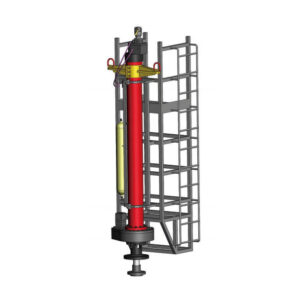
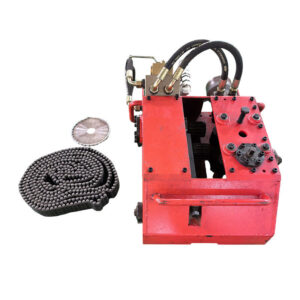
JSW is a pipeline engineering and equipment specialist with more than 1,200 completed hot tap and line stopping jobs across Asia, the Middle East, Africa, and South America. We combine field crews with our own equipment line, including hot tapping equipment, line stopping plugs, and pipeline cutting machines, so we can qualify the procedure, supply the fittings, and execute the weld under the standard that governs your line.
Our engineers will confirm the safe, code-compliant approach for your specific line before you commit to the work.
Get a Free In-Service Welding Feasibility Check







 English
  Arabic
  Russian
  Spanish
  French
  Vietnamese
  Polish
  Thai
Thai  Indonesian
  Turkish
  Portuguese