jasonsong889@gmail.com

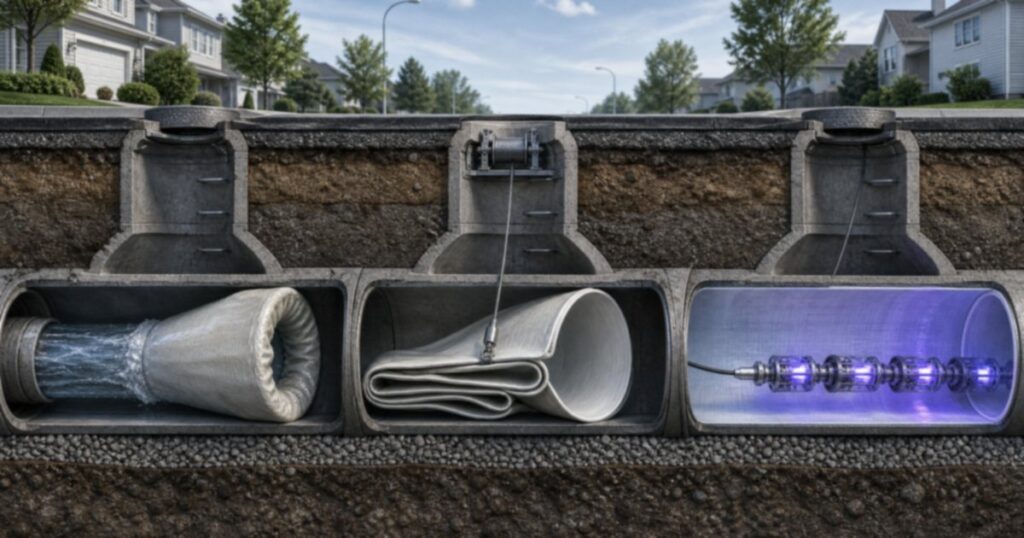
Three CIPP installation routes - an everted tube, a pulled tube and a UV light train - shown side by side from placement through to cure

Inversion vs. Pull-in-Place vs. UV: Choosing the CIPP Installation Method

Choose the route by host conditions and cure control, not by habit. The everted route suits long, tight-bore runs; the pulled route, runs needing tighter on-site thickness control; the light route, fast, low-emission schedules. All three share a typical 150-300 m single-run band, so diameter and access decide first. Choosing among CIPP installation methods is

Inversion vs. Pull-in-Place vs. UV: Choosing the CIPP Installation Method Read More »

Cross-section comparing a thin cured-in-place liner formed against a host pipe wall with a thicker sliplining pipe inserted inside the same host pipe, showing the larger gap sliplining leaves

CIPP vs. Sliplining: Diameter Loss, Cost and Structural Strength Compared

Short answer: in a CIPP vs sliplining decision, sliplining typically gives up 10%-25% of the internal diameter, while cured-in-place pipe typically loses only its own wall, a few percent. CIPP’s structural strength comes from its ASTM F1216 design, not from the host pipe. A CIPP vs sliplining decision turns on three things: how much internal

CIPP vs. Sliplining: Diameter Loss, Cost and Structural Strength Compared Read More »

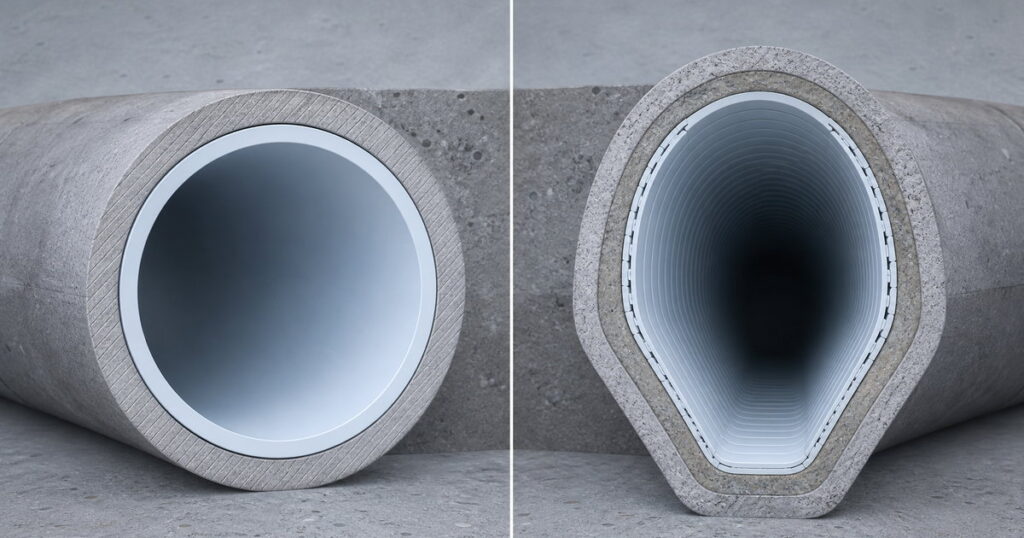
A cured-in-place tube formed as a round liner beside a spiral-wound profile coil that follows a non-circular sewer cross-section.

CIPP vs. Spiral-Wound Lining: When Wound Profiles Beat a Cured Tube

Spiral-wound lining wins on non-circular, ovoid or man-entry sections, and on pipes that cannot be taken out of service; CIPP stays the default for a true circle. The CIPP vs spiral wound lining decision therefore turns on three variables: section geometry, tolerance for working under flow, and how well a grouted liner fills the space

CIPP vs. Spiral-Wound Lining: When Wound Profiles Beat a Cured Tube Read More »

Diagram comparing a short sectional CIPP repair sleeve at one defect against a continuous full-length CIPP liner running the whole pipe length between two access points

Sectional CIPP vs. Full-Length CIPP: Choosing the Right Repair Scope

Short answer: use a sectional repair when the pipe is sound apart from a few discrete defects. Use full-length lining when defects recur along the run or the host has lost structural value between access points. In the sectional CIPP vs full-length CIPP choice, the coded CCTV and PACP survey decides. Sectional CIPP and full-length

Sectional CIPP vs. Full-Length CIPP: Choosing the Right Repair Scope Read More »

Engineer and plumber reviewing the same cast iron sewer line to compare CIPP lining against full pipe replacement

CIPP vs. Cast Iron Replacement: What Engineers and Plumbers Disagree About

Bottom line: CIPP vs. cast iron is decided by the host pipe, not by the trade. CIPP fits cast iron that is still round with enough wall for a liner; replacement fits a pipe that is collapsed, badly deformed or missing its invert. A plumber judges one lateral, an engineer judges a whole network. The

CIPP vs. Cast Iron Replacement: What Engineers and Plumbers Disagree About Read More »

CIPP structural liner beside a thin epoxy spray lining bonded to a sound host pipe

CIPP vs. Epoxy Spray Lining: Structural vs. Non-Structural Rehabilitation

Short answer: choose cured-in-place pipe (CIPP) when the pipe needs a standalone structural liner, a semi-structural design when the wall shares load, and epoxy spray lining when the pipe is sound and only needs a corrosion and infiltration barrier. The CIPP vs epoxy lining decision turns on one test – can the host pipe still

CIPP vs. Epoxy Spray Lining: Structural vs. Non-Structural Rehabilitation Read More »

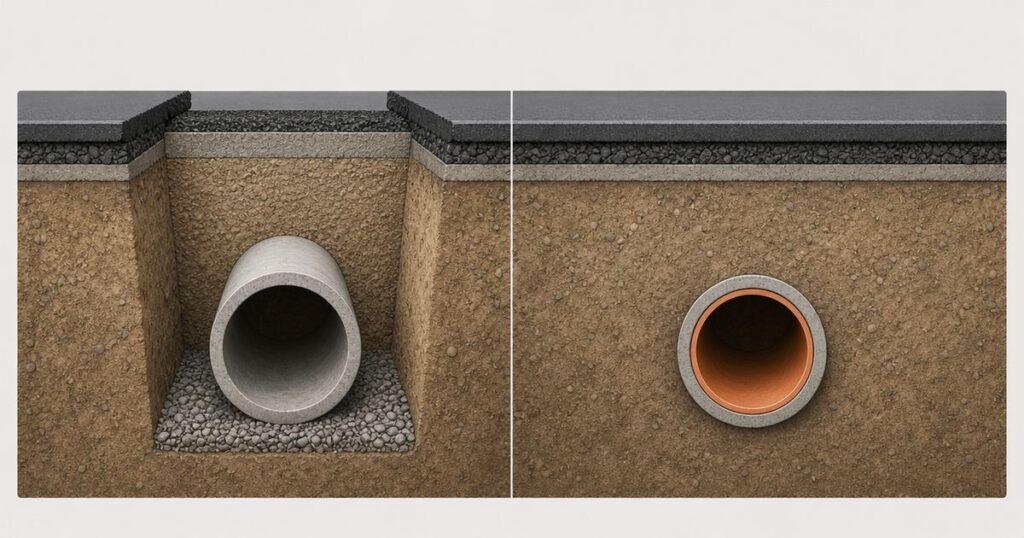
Cross-section comparing an open cut excavation trench with reinstated pavement above a replacement pipe against a CIPP liner cured inside the existing sewer reached through two manholes

CIPP vs. Open-Cut Replacement: Cost, Disruption and Carbon Compared

Short answer: In a CIPP vs open cut comparison, CIPP usually delivers the lower whole-life cost on deep, congested or heavily trafficked streets. Open cut keeps the lower direct bid on shallow, straight runs in open ground, where trench and reinstatement costs stay low. In a CIPP vs open cut decision, both methods reach one

CIPP vs. Open-Cut Replacement: Cost, Disruption and Carbon Compared Read More »

CIPP lining and pipe bursting compared along a host pipe route underground

CIPP vs. Pipe Bursting: Which Trenchless Method Fits Your Pipe?

Answer: CIPP vs pipe bursting separates a repair from a replacement. Cured-in-place pipe (CIPP) cures a liner inside the host pipe; pipe bursting fractures the pipe and pulls a new HDPE pipe through the same path. Line a pipe that holds its shape and needs no extra capacity; replace it when the cross-section has failed

CIPP vs. Pipe Bursting: Which Trenchless Method Fits Your Pipe? Read More »

Cover illustration of four CIPP saturating resin families - polyester, vinyl ester, epoxy and silicate - with a resin drum and a lined sewer pipe cross-section

CIPP Resin Systems Explained: Polyester, Vinyl Ester, Epoxy and Silicate

CIPP resin systems are the saturating resins that carry the structural load in a cured-in-place pipe (CIPP) liner, and the trenchless industry names four families for the job: polyester, vinyl ester, epoxy and silicate. The short answer: the resin is chosen from the effluent chemistry first and from the cure route the contractor can run

CIPP Resin Systems Explained: Polyester, Vinyl Ester, Epoxy and Silicate Read More »

Cured-in-place pipe liner and open-cut pipe replacement compared side by side

CIPP vs. Traditional Pipe Replacement: A Structural and Economic Comparison

CIPP vs pipe replacement is decided by the host pipe, not the price: lining wins where the pipe keeps its shape and the surface cannot be opened, while open-cut work wins where the pipe has collapsed, lost grade or run out of capacity. Cured-in-place pipe (CIPP) renewal builds a structural liner inside the existing host,

CIPP vs. Traditional Pipe Replacement: A Structural and Economic Comparison Read More »