
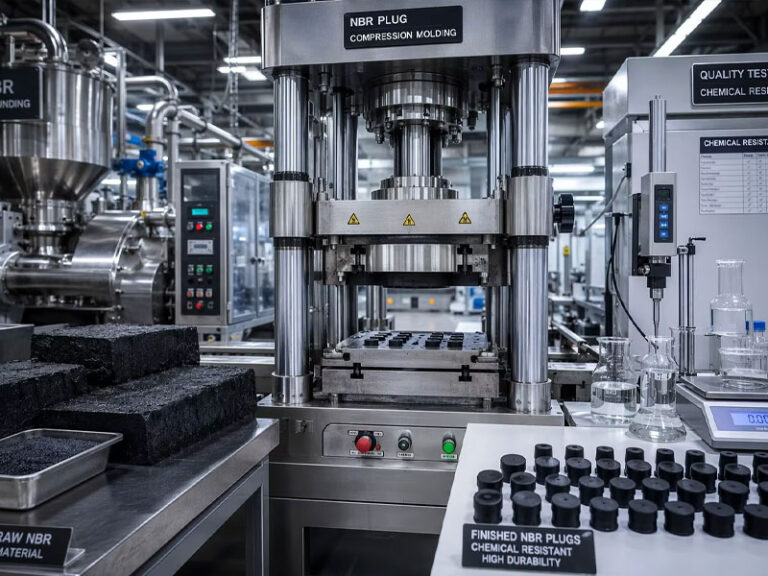
Chemical resistant nitrile rubber plugs are manufactured through five stages:
- NBR compound formulation
- Rubber mixing and compounding
- Compression or injection molding
- Vulcanization and curing
- Chemical and mechanical testing
The process creates a crosslinked NBR sealing component designed for resistance against oil, fuel, hydraulic fluid, and industrial chemicals.
1. What Materials Are Used to Manufacture Chemical-Resistant Nitrile Plugs?
The performance of an industrial nitrile plug is determined at the molecular level. For this reason, selecting the correct NBR compound is the first step in manufacturing chemical resistant rubber plugs for industrial sealing applications. The foundation is Acrylonitrile Butadiene Rubber (NBR) , a synthetic copolymer. The ratio of acrylonitrile (ACN) to butadiene dictates the balance between chemical resistance and low-temperature flexibility. A higher ACN content (34% or more) provides superior resistance to petroleum-based oils and solvents, which is critical for industrial sealing applications.
To transform the base polymer into a functional engineering material, it undergoes a precise compounding process where various additives are integrated. These additives are typically measured in phr (parts per hundred rubber) , allowing manufacturers to precisely control hardness, elasticity, chemical resistance, and processing behavior.
- Reinforcing Fillers: Carbon black is the primary filler. It not only provides the characteristic black color but significantly enhances tensile strength, tear resistance, and abrasion resistance. Different grades, such as N550 and N990, are selected based on the desired final properties.
- Plasticizers and Processing Aids: These are added to improve the compound’s flexibility, especially at low temperatures, and to facilitate the flow of material during the molding process.
- The Vulcanization Package: This is a critical blend of sulfur (the primary curing agent), accelerators (like thiurams), and activators (like zinc oxide). This package initiates the chemical crosslinking reaction during the heating phase, permanently setting the material’s shape and properties.
- Antioxidants: Added to protect the final product from degradation due to heat, oxygen, and ozone exposure over its service life.
2. Nitrile Plug Material Comparison: NBR vs EPDM vs Silicone
For engineers and procurement specialists, choosing the right elastomer is a critical design decision. While this article focuses on nitrile, it’s valuable to understand its position relative to other common materials. The table below provides a comparative overview based on standard material properties.
| Propiedad | Nitrile (NBR) | EPDM | Silicone |
|---|---|---|---|
| Resistencia química | Excelente against oils, fuels, and hydrocarbons. | Excelente against weather, ozone, and many acids. | Excelente against high heat and some chemicals. |
| Temperatura | -40°C to 120°C (depending on formulation) | -55°C to 150°C | -75°C to 230°C |
| Aplicación principal | Oil and fuel seals, hydraulic hoses, industrial plugs. | Outdoor seals, weatherstripping, automotive cooling systems. | High-heat gaskets, medical/food-grade components. |
| Ventajas clave | Superior resistance to petroleum-based fluids. | Outstanding weather and ozone resistance. | Exceptional high and low-temperature performance. |
| Limitación clave | Poor resistance to ozone, ketones, and highly polar solvents. | Poor resistance to petroleum-based oils and fuels. | Poor resistance to oils and fuels; high cost. |
| Coste relativo | Low-Medium | Low-Medium | Alta |
Note: Material selection should always be based on the specific chemical, thermal, and mechanical requirements of the application.
3. Manufacturing Challenges in Producing Chemical Resistant Nitrile Plugs
Although nitrile rubber plug manufacturing appears straightforward, achieving consistent chemical resistance requires precise control of three factors: compound formulation, molding parameters, and curing conditions.
During production, small variations in acrylonitrile content, filler dispersion, mold temperature, or vulcanization time can affect swelling resistance, hardness, and sealing performance.
Experienced manufacturers therefore maintain strict batch control, including compound traceability, rheometer testing, and finished-product inspection. This ensures each production run delivers reliable performance in demanding industrial environments.
4. Step-by-Step Manufacturing Process of Nitrile Rubber Plugs
With the compound formulated, the manufacturing process moves to converting this raw material into a finished, high-precision sealing component.
Step 1: NBR Polymerization and Formulation
The process begins at a chemical plant where butadiene and acrylonitrile are polymerized to create the base NBR. The specific ACN content is carefully controlled to meet the target chemical resistance properties. This raw polymer is then shipped to the molding facility in bales.
Step 2: The Compounding and Mixing Process
This is the single most critical step for ensuring batch-to-batch consistency.
- Internal Mixing: The NBR polymer is fed into a powerful internal mixer (like a Banbury mixer) with the carbon black fillers and plasticizers. The high shear forces generate heat to soften the polymer and disperse the ingredients uniformly.
- Two-Roll Milling: The heated compound is then transferred to a two-roll mill. Here, the temperature is carefully controlled as the vulcanizing agents (sulfur and accelerators) are added. This two-stage process prevents the compound from curing prematurely (“scorching”) due to excessive heat. The final output is a sheet of uniform, uncured compound.
Step 3: Shaping the Plug: Compression vs. Injection Molding
The choice of molding process depends on the geometry, production volume, and precision requirements of the plug.
- Compression Molding: A pre-weighed, measured amount of the uncured compound (“preform”) is placed directly into a heated mold cavity. The mold is then closed under immense hydraulic pressure, forcing the rubber to fill the cavity’s contours. The heat from the platens simultaneously begins the vulcanization process. This method is excellent for large parts and lower-volume production due to lower tooling costs.
- Injection Molding: In this automated, high-speed process, the uncured compound is fed into a heated barrel and forced (injected) under high pressure through a nozzle into a closed mold. Injection molding offers much faster cycle times, superior dimensional accuracy, and reduces material waste, making it ideal for producing complex, high-precision plugs in large volumes.
Step 4: The Vulcanization Process
Vulcanization is the irreversible chemical reaction that gives the rubber its final properties. The molding process typically occurs within a heated press, effectively combining shaping and vulcanization.
- The Chemistry: Heat (typically 155-170°C) activates the sulfur and accelerators. The sulfur atoms form crosslinks between the NBR polymer chains.
- The Effect: This crosslinking creates a three-dimensional molecular network that transforms the thermoplastic, malleable compound into a tough, thermosetting elastomer. This network is responsible for the plug’s elasticity, high tensile strength, and, crucially, its resistance to chemical penetration and swelling.
Step 5: Quality Control and Testing
A sophisticated quality assurance program is vital to verify that every batch of plugs meets the required specifications. Testing is performed on finished products and representative test specimens.
- Chemical Resistance Testing: Test specimens are immersed in specific reference fluids (e.g., ASTM #1 and #3 oils) at a defined temperature for a set duration. The changes in mass, volume, and hardness are meticulously measured. Low volume swell indicates high resistance, confirming the material’s ability to withstand the chemical environment.
- Physical Property Testing:
- Hardness (Durometer): Shore A hardness is tested to ensure the plug meets the required stiffness.
- Tensile and Elongation: Test specimens are pulled to failure to confirm the material’s strength and elasticity.
- Compression Set: This test is critical. A plug’s ability to maintain a seal depends on its capacity to return to its original thickness after being compressed. A low compression set value (e.g., under 25%) is essential for a reliable, long-lasting seal.
Quality Standards
Common testing standards used for nitrile rubber plugs include:
- ASTM D471: Standard Test Method for Rubber Property—Effect of Liquids
- ASTM D2240: Rubber Hardness Measurement (Shore A)
- ASTM D412: Tensile Properties of Vulcanized Rubber
5. Chemical Compatibility of Nitrile Rubber Plugs
Understanding the specific chemical compatibility of NBR is crucial for proper material selection. The table below provides a general guide to the resistance of standard nitrile rubber compounds against common industrial fluids. Nitrile resistance depends on ACN content, temperature, exposure time, and chemical concentration.
| Chemical | Resistance Level |
|---|---|
| Petroleum oils | Excelente |
| Diesel fuel | Excelente |
| Hydraulic fluids (mineral) | Excelente |
| Mineral oils | Excelente |
| Grease | Excelente |
| Water | Bien |
| Alcohols | Moderado |
| Ketones (e.g., Acetone) | Poor |
| Aromatic solvents (e.g., Benzene) | Poor |
Note: Resistance can vary based on the specific NBR formulation, temperature, and concentration. Always consult a material expert or conduct application-specific testing.
6. What Specifications Can Be Customized for Nitrile Plugs?
For many industrial applications, standard catalog products may not suffice. The table below outlines the key parameters that can be customized to meet specific sealing challenges.
| Parámetro | Customization Options |
|---|---|
| Material | Standard NBR, FDA-approved NBR, specialty oil/heat-resistant compounds. |
| Dureza (Shore A) | Custom formulations from 40 to 90 Shore A. |
| Geometry | Custom diameter, length, flange shape, and hole configuration. |
| Color | Black is standard; colored compounds are available for identification purposes. |
| Surface Finish | Smooth, matte, or textured surfaces depending on sealing requirements. |
| Production Method | Compression molding (low to medium volume) or Injection molding (high volume, tight tolerance). |
7. How to Evaluate a Nitrile Plug Manufacturer
Selecting a supplier is a decision that impacts product quality and operational reliability. Instead of focusing on unverifiable individual ratings, consider these key factors when evaluating a potential partner for your custom nitrile plug needs.
| Evaluation Factor | Por qué es importante |
|---|---|
| Material Certifications | Confirms the use of consistent, high-quality NBR polymer and a documented compound recipe. |
| Quality Management (e.g., ISO 9001) | Indicates a commitment to process control, traceability, and continuous improvement. |
| Molding Capability | Demonstrates the ability to handle specific part geometries and production volumes, whether compression or injection molding. |
| In-House Testing | Ensures the manufacturer can verify chemical resistance, hardness, and compression set internally without outsourcing. |
| Engineering Support | A strong technical team can assist with material selection, design optimization, and prototyping for custom applications. |
| OEM & Custom Experience | A proven track record in custom/OEM work indicates the flexibility to adapt to unique requirements. |
8. Common Manufacturing Defects in Nitrile Plugs
Understanding potential defects helps in both preventing them and diagnosing quality issues. The table below outlines common manufacturing challenges and their root causes.
| Defect | Typical Cause | Impact on Performance |
|---|---|---|
| Surface Cracking or Blistering | Incomplete vulcanization (“under-cure”) or trapped air/gas in the mold. | Poor chemical resistance and reduced structural integrity. |
| Dimensional Variation | Incorrect mold pressure, inconsistent compound weight, or tooling wear. | Leak paths due to poor fit, leading to seal failure. |
| Excessive Swelling | Using an incorrect NBR formulation (too low ACN content) for the specific chemical environment. | Rapid degradation and loss of sealing force. |
| Low Hardness/Compression Set | Incorrect compounding or an incomplete vulcanization process. | Plug fails to maintain pressure, leading to fluid bypass. |
| Flash or Tears | Poor mold design, incorrect material flow, or excessive molding pressure. | Debris in the system or premature seal failure. |
9. Frequently Asked Questions
Are nitrile plugs resistant to oil and fuel?
Yes. Nitrile rubber (NBR) is specifically designed for resistance to petroleum-based oils, fuels, hydraulic fluids, and lubricants.
Can nitrile plugs withstand gasoline?
Yes, nitrile rubber has excellent resistance to gasoline, diesel, and other petroleum-based fuels.
Can nitrile plugs be custom manufactured?
Yes. Manufacturers can customize NBR plugs by size, hardness, chemical resistance requirements, and molding method.
What hardness options are available for nitrile plugs?
Industrial **nitrile rubber plugs** are commonly available from approximately 40 to 90 Shore A hardness, depending on sealing requirements.
How are nitrile plugs tested for quality?
Testing typically includes chemical immersion, hardness measurement, tensile testing, elongation testing, and compression set testing.
What is the difference between molded and extruded nitrile plugs?
Molded plugs are formed in a cavity (compression/injection) and can have complex 3D shapes. Extruded plugs are formed by forcing material through a die and are typically used for continuous, uniform cross-section profiles.
10. Custom Nitrile Plug Manufacturing Services
JSW specializes in custom nitrile rubber plug manufacturing for industrial sealing applications. Our capabilities include NBR compound selection, custom mold development, compression and injection molding, and performance testing according to customer requirements.
From prototype development to production volumes, JSW supports OEM projects requiring reliable chemical resistance, dimensional accuracy, and consistent sealing performance.
Contact JSW today to discuss your application. Our engineering team is available to provide expert guidance on your next sealing project.










 English
  Arabic
  Russian
  Spanish
  French
  Vietnamese
  Polish
  Thai
Thai  Indonesian
  Turkish
  Portuguese