
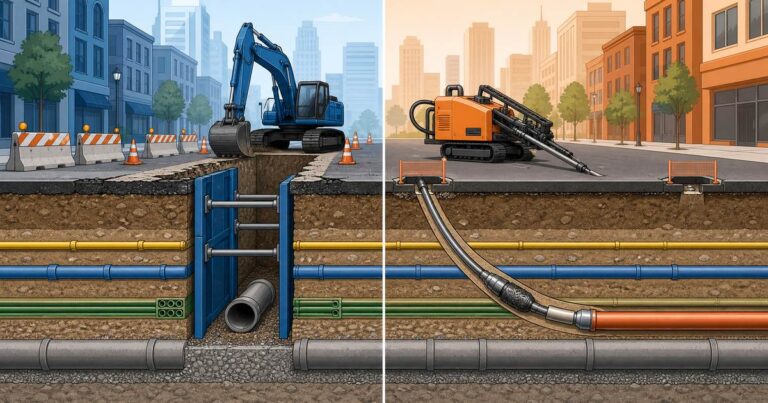
Short answer: On shallow, short runs in open ground, open cut usually wins on bid price. In the HDD vs open cut comparison on longer paved urban crossings, HDD usually wins on total installed cost once traffic control, pavement restoration, permits, utility-strike risk, and social cost are counted. On risk, open cut concentrates exposure at the surface (traffic, strikes, restoration claims), while HDD moves it underground (inadvertent returns, settlement, stuck pipe).
This guide compares two ways to install pipe on congested city streets. Open cut construction excavates a trench along the alignment; horizontal directional drilling (HDD) bores beneath the surface. It covers the HDD vs open cut cost crossover, the surface and subsurface risks of each method, and a six-step evaluation framework you can apply before requesting quotes. It is written for engineers and utility owners weighing the horizontal directional drilling vs open cut comparison on congested streets, from water mains and gas lines to sewer force mains.
Puntos clave:
- Bid price and total installed cost are different numbers; always compare the latter on urban work.
- Pavement restoration, traffic control, and permits decide the urban cost crossover.
- Open cut carries its risk at the surface; HDD carries its risk underground.
- Six site facts decide each crossing; run a structured evaluation before requesting quotes.
What Is the Difference Between HDD and Open Cut Construction?
Open cut construction, also known as open trench construction or simply trenching, is the conventional method used for most utility installation. Contractors excavate a trench along the full alignment, install bedding material, lay the pipe, backfill in compacted layers, and rebuild the road, sidewalk, or landscaping above it. Because the ground is removed from above, the pipe is placed exactly where it is designed, at virtually any diameter or depth.
Horizontal directional drilling is a steerable trenchless method that leaves the surface intact. A drilling rig on the surface drills a small pilot bore along a curved path beneath the street, reams the bore wider in successive passes, and pulls the product pipe, usually HDPE or steel, back through the finished hole. Only small entry and exit pits are excavated. Typical HDD bores run from 50 to 1,200 mm (2-48 in.) in diameter, can exceed 1,800 m in a single continuous bore, and reach depths of 15 m or more, following the ranges in ASTM F1962 design guidance.
The essential difference is therefore geometric and economic. Open cut construction exposes the entire pipe for inspection and gives perfect line and grade, but it opens the surface for the whole run. HDD hides the pipe but preserves the surface, trading surface disruption for a curved bore that suits pressure pipe rather than gravity pipe. When a gravity sewer must hold exact grade through unstable ground, microtunneling, not HDD, is the trenchless pipe installation method; see our microtunneling construction services for that method.
For most utilities, the trenchless vs open cut choice comes down to three site facts: pavement value, traffic sensitivity, and run length. Method definitions settle the vocabulary; the cost and risk sections that follow settle the decision.
Why the City Changes the HDD vs Open Cut Calculation
On open ground, open cut construction is almost always the cheapest way to install pipe, and trenchless methods struggle to compete on price. Urban streets invert that logic. In a paved corridor, the open cut method triggers cost items that have nothing to do with the pipe itself:
- Pavement restoration. Every cut weakens the road surface, so many municipalities charge a pavement-cut permit fee and require a restoration bond for each excavation, with a separate inspection for every stage of backfill and repaving.
- Traffic control. Lane closures need signing, barriers, flaggers, and often off-peak-only working windows that stretch the schedule from days into weeks.
- Buried congestion. Urban corridors pack water, gas, electric, telecom, and sewer lines into a narrow band, so excavation frequently meets an unknown or unmarked utility.
- Dewatering and disposal. Shallow groundwater must be pumped and filtered, and contaminated soil, common under older industrial streets, must be hauled away under waste regulations.
Because these items are location-driven rather than pipe-driven, the same 300 m water main can be economical as open cut construction in a greenfield subdivision and expensive as open cut in a downtown avenue. This is why engineering evaluations of urban crossings increasingly compare total installed cost, including social cost, instead of comparing excavation rates alone.
HDD vs Open Cut: Where the Cost Crossover Really Sits
On direct cost, the two methods bid very differently. Open cut mobilization is cheap: an excavator, shoring boxes, and a crew can start quickly, and the price per linear foot is low. HDD mobilization is expensive: the drilling rig, drilling fluid system, locator crew, and reamer tooling must all reach the site and be set up, which is why very short bores look disproportionately costly.
Published U.S. estimates (2023-2025) for small water and sewer lines cluster between about $50 and $250 per linear foot for the trenching or boring and pipe work alone. The real divergence appears when restoration, traffic control, and utility coordination are added: in a paved street these items can rival the excavation cost itself, and they belong almost entirely to the open cut column.
A published municipal example from Ohio illustrates the gap. In one Ohio water line project, the open-cut estimate totaled roughly $549,000, while the HDD bid priced the crossing at about $95 per linear foot plus a $30-per-foot contingency for possible road heaving or settlement. The open-cut figure included restoring the affected streets; the HDD figure barely needed it. Individual cost points like these vary by year, ground, and region, so treat them as directional rather than as a quote for your site.
The lifecycle side widens the gap further. Analyses of urban utility construction report that trenchless pipe installation can deliver 30-50 percent lower total project cost once maintenance and repeat repairs are counted, a finding that matters for utilities budgeting 50-year asset lives. Steel product strings are welded into one continuous pipe before pullback, usually with automatic pipeline welding technology, so the installed line has no field joints inside the bore. For renewal of existing lines rather than new installation, see our trenchless pipe rehabilitation guide, and plan the asset life with pipeline maintenance services in mind.
| Componente de coste | A cielo abierto | HDD |
|---|---|---|
| Mobilization and setup | Low: excavator, shoring, crew | High: rig, drilling fluid plant, tooling |
| Main construction | Trench, dewatering, bedding, pipe lay, backfill | Pilot bore, reaming passes, pullback |
| Restauración de superficies | Full-width pavement rebuild over the trench | Minor repair at entry and exit pits only |
| Traffic control | Continuous along the open trench | Localized at two pit locations |
| Utility coordination | Relocations and protection often required | Locates and potholing at bore crossings |
| Schedule exposure | Weather, traffic windows, strikes | Single continuous pullback, fluid handling |
| Contingency drivers | Utility strikes, restoration claims | Inadvertent returns, stuck pipe |
Ranges above are typical published U.S. figures (2023-2025) in USD for small-diameter mains; actual pricing depends on region, ground conditions, and depth. The pattern that holds everywhere is the shape of the bid: open cut is cheap per foot and expensive at the surface, while HDD is expensive to mobilize and cheap to finish.
As a rule of thumb from our own urban project pricing, open cut usually wins below roughly 30-45 m (100-150 ft) of paved crossing when the road can tolerate a closure. The HDD vs open cut comparison closes between roughly 45 and 90 m (150-300 ft) as restoration and traffic costs accumulate. Beyond that range, HDD usually wins once social cost and repeated repair risk enter the total. Calibrate the crossover to local restoration rates, lane-closure rules, and ground conditions.

Open Cut Risks in the City: What the Quote Does Not Show
The most expensive risk in open cut construction is the utility strike. The Common Ground Alliance (CGA) DIRT 2024 annual report logged roughly 197,000 reported utility damages (strikes) in 2024 alone. Reported events understate the full picture, which is why CGA pairs its DIRT database with a statistical model of total incidents.
That model, released in CGA’s 2026 study Between the Lines: The True Cost of Damages to America’s Buried Utilities, statistically models 668,999 damage incidents for 2025. It prices total annual underground utility damage in the United States at $83.2 billion, nearly triple the previous estimate, once repairs, outages, injuries, and third-party claims are counted. Every open trench on a busy street is a fresh opportunity to join that statistic.
Traffic is the second cost center: published urban case studies report that trenchless installation cut traffic delay costs by up to 50 percent compared with open cut. Municipal pipe replacement projects document up to 78 percent less traffic disruption and roughly 70 percent lower business losses when crews work below the street. These are social cost items, paid by road users and shopkeepers rather than by the pipe budget. That is why they disappear from open-cut quotes and reappear in community complaints and claims.
Excavation also brings safety and environmental duties that lengthen the schedule. Shoring, sloping, or shielding is mandatory in almost every jurisdiction because trench collapse is a leading cause of fatalities in excavation work. Open trenches interrupt pedestrian access, driveways, and deliveries for the full job, and dewatering can lower the local water table and settle adjacent buildings. On contaminated inner-city ground, spoil must be characterized and disposed of under waste regulations that add both cost and delay to open cut trenching.
HDD Risks Under the Street: What Can Go Wrong Below Ground
Choosing HDD does not remove risk; it moves it underground, where it is harder to see. The most common failure is the inadvertent return, sometimes called a frac-out: drilling fluid under excessive downhole pressure escapes the bore and follows the path of least resistance to the surface, a storm drain, or a waterway. Inadvertent returns occur most often near the entry and exit pits, where soil cover is thinnest.
Urban HDD crews also manage ground settlement or heave along the bore path, bore collapse in loose or water-bearing soils, and the risk of drilling into a utility that locates missed. The worst case is a stuck drill string or a product pipe that cannot be pulled back, which can force the crew to abandon the bore and re-plan the alignment. Drilling fluid must be mixed, recycled, and disposed of, so urban sites also need room for the fluid plant and a plan for cuttings handling from the start.
These HDD risks are manageable with a defined mitigation sequence, and most are predictable before the rig arrives:
- Investigate the ground. Geotechnical borings along the full bore path tell the designer where cobbles, boulders, and groundwater sit; ASTM F1962 design guidance assumes this soil data exists.
- Confirm the utilities physically. Subsurface utility engineering practice, as codified in ASCE 38, recommends potholing or hydro-excavation to verify critical conflicts instead of trusting records alone.
- Monitor the fluid. Track drilling fluid pressure and volume continuously, and reduce flow in coarse or fractured ground where escapes are likely.
- Plan the failure. Many road and waterway permits require an inadvertent-return contingency plan before drilling starts, with clean-up crews and materials staged on site.
- Use experienced crews. Most frac-outs and lost bores trace back to operator decisions about fluid and pullback speed, not to machine failure.
On the risk ledger, HDD converts a high-probability, low-consequence surface problem (a strike, a lane closure, a restoration claim) into a low-probability, high-consequence underground one. For a congested street with expensive pavement, that trade is usually favorable; for a geologically unknown greenfield site, it may not be.
HDD vs Open Cut: Side-by-Side Cost and Risk Scorecard
| Criterio | A cielo abierto | HDD |
|---|---|---|
| Alineación y nivelación | Cualquier trazado y pendiente; posibilidad de flujo por gravedad | Arco curvo; caudal típico en función de la presión |
| Diámetro de la tubería | Sin límite práctico | About 50-1,200 mm typical |
| Installation length | Unlimited, staged in sections | 1,800 m or more in one bore; short runs pay mobilization |
| Ocupación de superficie | Ancho total de la zanja a lo largo del trazado | Solo boxes de entrada y salida |
| Problemas de tráfico | Continuous for weeks or months | Localized at pits, usually days |
| Rehabilitación del pavimento | Reconstrucción a todo ancho sobre la zanja | Minor pit repairs |
| Exposición a riesgos de interrupción del suministro de servicios públicos | High, along the whole trench | Moderate, at bore crossings |
| Primary risk | Strikes, collapse, restoration claims | Inadvertent returns, settlement, stuck pipe |
| Direct cost pattern | Low mobilization, low cost per foot | High mobilization, low restoration cost |
| Social cost | Alta | Bajo |
| Best urban application | Open ground, new subdivisions, shallow gravity lines | Paved roads, deep pressure mains, obstacle crossings |
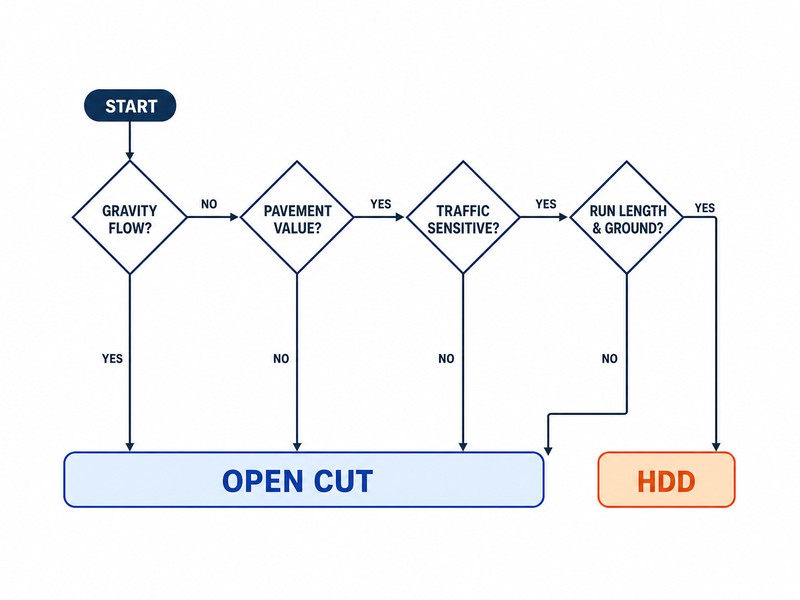
Choose open cut construction when…
Your line is shallow and runs on gravity, the diameter is large, the ground is open or unpaved, the run is short enough that HDD mobilization cannot be amortized, or the alignment is already being excavated for other work. Open trench construction also remains the straightforward choice when every joint and bedding detail must be visible for inspection and when the future maintenance strategy assumes easy access from the surface.
Choose HDD when…
You are crossing paved roads, highways, railways, rivers, or runways; the pressure main runs deep beneath congested corridors; traffic disruption or business access is politically unacceptable; the pavement is expensive or historically significant; or the density of existing utilities makes open trenching genuinely hazardous. For the pilot bore, reaming, and pullback sequence we use on these crossings, see our servicios de perforación direccional horizontal.
Not sure whether your site prices out cheaper as open cut or HDD? Send your alignment data and geotechnical report for a free method review, and our engineers will return a side-by-side cost and risk comparison for both methods on your actual street. Our engineers will tell you exactly which data to prepare: alignment length, pipe diameter and depth, plus any existing geotechnical report.
How to Evaluate Any Urban Crossing in Six Steps
At JSW we score every urban crossing against the same six steps before recommending a method, and the recommendation sometimes surprises the client because it is not the method we bid first:
- Define the pipe and alignment needs. Record the diameter, pressure or gravity service, depth, and code clearances before any cost discussion.
- Characterize the ground. Run geotechnical borings along the full alignment and flag cobbles, boulders, groundwater, and contamination that can stop a bore or flood a trench.
- Inventory the buried plant. Collect utility records, then confirm critical conflicts by potholing to quality level A, the standard of care in ASCE 38 utility designation practice.
- Price both methods on the same scope. Request line-item quotes that include restoration, traffic control, permits, and contingency for open cut construction and for trenchless pipe installation alike.
- Build a risk register. Score the likelihood and consequence of strikes, frac-outs, settlement, schedule slips, and claims for each method on your specific street.
- Decide on total cost, not bid price. Compare direct cost plus social cost plus a risk reserve, and have an engineer review the comparison before tender.
Documenting this evaluation matters for permitting and for defensible decision-making, especially for public agencies that must show ratepayers a fair method selection. It is also where the contractor choice matters most: a contractor who can price both open cut construction and HDD honestly is more useful than one who only sells a single method. Our servicios de construcción de tuberías cover both installation routes under one engineering team. Prefer to have an engineer run these six steps on your alignment? Send your alignment data for a side-by-side HDD vs open cut comparison.
Frequently Asked Questions About HDD and Open Cut in Cities
Is HDD cheaper than open cut?
Not automatically. Open cut usually bids lower per linear foot on shallow, short runs in open ground. HDD becomes cheaper on a total-cost basis in longer paved urban corridors, where open cut must pay for pavement restoration, traffic control, utility coordination, and strike risk. Ask for both quotes on the same alignment and compare total installed cost including restoration.
What does open cut mean in pipeline construction?
Open cut means excavating an open trench along the pipe alignment, installing the pipe inside it, and backfilling and restoring the surface. It is also called open trench construction and remains the standard method for shallow gravity lines, large diameters, and sites where excavation is cheap.
What are the main risks of horizontal directional drilling in cities?
The main urban HDD risks are frac-outs, when drilling fluid escapes to the surface; ground settlement or heave along the bore; bore collapse in loose soils; and striking utilities that locates missed. These are managed with geotechnical data, potholed utility crossings, fluid pressure monitoring, and a pre-drilled contingency plan.
What are the disadvantages of open cut trenching?
Open cut trenching disrupts traffic and business for the full duration of the job, requires complete pavement restoration, exposes crews to excavation hazards, and carries the highest utility strike exposure of any installation method, especially in congested corridors. The social cost is real but rarely appears in the quote.
When is open cut better than HDD?
Open cut is usually better for shallow gravity sewers and laterals, very large diameters, unpaved or open ground, and short runs where HDD mobilization cannot be amortized. HDD is generally better for paved streets, deep pressure mains, and crossings beneath roads, railways, rivers, and runways.
How much does HDD cost per foot in a city?
Mobilization and run length dominate the price. Published U.S. estimates (2023-2025) for small mains cluster between about $50 and $250 per linear foot before restoration, and paved-street restoration and traffic control belong mostly to the open cut column.
Is directional drilling safer than open cut?
It moves the risk profile rather than removing it. Open cut concentrates risk at the surface, with traffic, excavation hazards, and damaged utilities. HDD faces lower-probability, higher-consequence underground events, from frac-outs to a stuck drill string.
Final Verdict: Which Method Should Your Urban Project Use?
Neither method wins on every street. The HDD vs open cut decision is a total-cost decision: on open, shallow, or unpaved alignments, open cut construction remains the economical workhorse; on paved, congested, or deep alignments, HDD usually delivers lower total installed cost and far lower social cost, even when its bid price looks higher.
The fastest way to settle the question for your own street is to run the six-step evaluation and ask contractors to price both methods on the same scope, including restoration and contingency. The HDD vs open cut cost gap you measure on paper will narrow once traffic control and pavement work are priced realistically, and it will widen again every time the open trench has to be dug up for a repair.
Pide una segunda opinión sin coste alguno. JSW is a full-chain pipeline engineering company: our own crews execute open cut and trenchless installation. We fabricate steel line pipe with automatic welding and prepare pipe with our own pipe cutting machines. When the new line meets the live network, we complete in-service tie-ins with hot tapping and plugging services, executed with our own hot tapping machines.
Send your alignment data and ground report, and our engineers will compare HDD vs open cut cost and risk on your street, even when the recommended method is not the one we bid first.





































 English
  Arabic
  Russian
  Spanish
  French
  Vietnamese
  Polish
  Thai
Thai  Indonesian
  Turkish
  Portuguese