
Before hiring a horizontal directional drilling contractor, ask ten targeted questions and verify every answer with documents. A competent candidate is a specialist in HDD—horizontal directional drilling, also called directional boring, the steerable trenchless technique for installing pipe under roads, rivers and rail without open-cut excavation—and the ten questions below are built to verify that specialization.
This guide explains why each question matters, what a strong answer looks like, and which replies should end the conversation. It also covers how to run the interview, what a realistic HDD bid contains, and the warning signs we see repeatedly in engineering bid reviews and field audits.
Puntos clave:
- Put the questions in writing and treat verbal assurances as claims, not evidence.
- Prioritize comparable experience over years in business: geology, diameter, length and crossing type decide HDD failure modes.
- Check damage prevention, drilling-fluid management and crew identity; these are where corners get cut.
- Demand an itemized bid and explicit change-order terms so hidden scope cannot reappear as extras.
Why the Questions Matter More Than the Bid Price
The market for this work is growing quickly, which raises the stakes of contractor selection. A 2026 market forecast values the global horizontal directional drilling market at roughly USD 9.2 billion in 2025 and projects it to approach USD 25 billion by 2034, a compound annual growth rate near 11.7 percent.
Growth attracts new entrants. More crews now claim HDD capability, and the gap between genuine specialists and general excavators operating a rented rig is widening. The cost of choosing poorly is documented. The Common Ground Alliance estimated in its 2026 economic impact study that damage to buried utilities costs the United States economy about USD 83.2 billion per year, more than USD 227 million every day and nearly triple its previous estimate.
Its DIRT damage data shows that the top ten root causes account for 86 percent of reports with an identified cause, and failures to pothole, maintain clearance and follow locate marks appear consistently among them. Every one of those root causes sits inside the work scope of the contractor you are about to hire.
The ten questions below are designed as a verification system. Each one targets a different risk layer: business model, outcome record, technical experience, legal exposure, damage prevention, equipment, people, environment, documentation and money. In our audits of HDD projects, failed or disputed crossings could almost always be traced to a gap in one of these ten layers that was visible during the interview.
How to Run the Contractor Interview
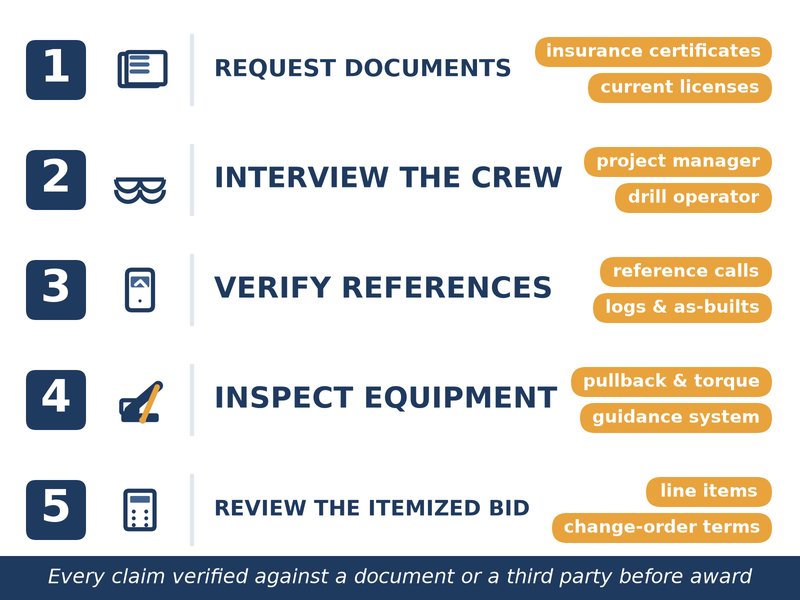
Ask the questions in writing and request written answers, because documents survive while memory does not. A disciplined horizontal directional drilling contractor will already hold most of the requested evidence: certificates of insurance, licenses, drilling logs, as-built drawings and fluid records.
- Send the list in advance. Watch which questions a contractor answers directly and which ones it sidesteps.
- Verify every claim against a document or a third party. Insurance certificates are checked with the broker, references are called, and drilling logs are reviewed page by page.
- Interview the crew that will work your site, not only the sales team; the two are often different people.
- Visit a live or completed site and inspect the reinstated entry and exit areas yourself.
The workflow in Figure 1 sequences these checks into five steps—documents first, then the crew, references, equipment and the bid. Add the completed-site visit from the list above to the workflow’s step four.
| # | Pregunta | What It Verifies | Deal-Breaker Reply |
|---|---|---|---|
| 1 | Is HDD your core business? | Specialization and equipment investment | No clear share of revenue from HDD |
| 2 | What is your completion rate? | Outcome record on crossings | No completion-rate data and no interest in tracking it |
| 3 | Have you drilled in my ground conditions? | Comparable technical experience | References that do not match your geology |
| 4 | Are you licensed and insured? | Legal floor and risk transfer | Refusal to provide certificates |
| 5 | How do you protect existing utilities? | Damage-prevention discipline | Pressure to skip locates or potholing |
| 6 | Which rig and guidance system will you use? | Equipment fit for the bore design | Capacity below the design pullback load |
| 7 | Who will run my job? | Crew qualifications and accountability | No named project manager |
| 8 | How will you manage drilling fluids? | Environmental control and frac-out readiness | No written fluid management plan |
| 9 | What records can you show me? | References, drilling logs and as-builts | Refusal to share project records |
| 10 | What exactly is in your price? | Bid completeness and change-order terms | Lump sum with hidden exclusions |
The 10 Questions to Ask a Horizontal Directional Drilling Contractor
The following sections expand each question into a full interview block. For every question we give the reason it matters, the specific checks to run, and the shape of an answer we would accept. Use the table above as a one-page scorecard during the call.
1. Is Horizontal Directional Drilling Your Core Business?
Specialization predicts equipment maintenance, crew depth and honest advice. A firm that derives most of its revenue from directional drilling owns its rigs, keeps trained operators employed and refuses jobs that its equipment cannot handle. A general excavator with a rented machine faces none of those pressures.
- Ask what share of annual revenue comes from HDD work and how many rigs the company owns outright.
- Ask how many years the company has operated dedicated HDD crews, not just how many years it has existed.
- Ask whether the firm self-performs the pilot hole, reaming and pullback or subcontracts parts of the bore.
In our experience, the contractors that quote precise completion statistics and name the operator assigned to your job are the ones treating HDD as a profession. Vague answers here usually forecast vague answers on every later question. An acceptable answer quotes a revenue share, names the rigs the firm owns and confirms it self-performs the bore. “We do a bit of everything” does none of that.
2. What Is Your Completion Rate on Crossings Like Mine?
Completion rate is the single most honest number a drilling contractor can quote. Define it before asking: the share of bores completed to design depth and alignment without a stuck pipe, lost tooling or failed pullback that required abandonment or rescue.
- Ask for the rate over the last three years, split by crossing type: road, railway, waterway and congested urban corridors.
- Ask how many crossings were abandoned or rescued, and what the contractor learned from each.
- Ask how near-misses are recorded and reviewed; a crew that cannot produce a near-miss log is not tracking the data that prevents incidents.
A credible horizontal directional drilling contractor tracks this metric and can discuss it candidly. A completion rate in the high nineties with no explanation of failures is as suspicious as a low rate with no corrective story.
3. Have You Drilled in My Ground Conditions, Diameter and Length?
Years in business matter less than documented experience with your specific bore envelope. HDD failure modes are site-specific: cobble jams steering tools, fractured rock destroys reamers, soft clays collapse holes, and long steel pulls stress every weld in the string.
- Ask for comparable projects: similar pipe diameter and material, similar bore length, and the same soil or rock types from your geotechnical report.
- Ask which product pipe the crew has installed before; steel, HDPE and ductile iron each impose different pullback and bending limits.
- Ask to review drilling logs and as-built drawings from two or three of those projects, not marketing case studies.
In one crossing we audited, a contractor with more than twenty years of history had never bored in the fractured rock of the project site. The first prereaming pass stalled, and the rescue consumed the entire contingency. Comparable experience, verified before award, would have changed the outcome. Accept “yes” only with two or three named projects in the same geology, diameter and length class—general assurances are not comparable experience.
4. Are You Licensed, Insured and Covered for Pollution Events?
Licensing and insurance are the legal floor of any drilling contractor, and they cost fifteen minutes to verify.
- Confirm that state or provincial licenses are current and match the work classification for drilling and utility construction.
- Request certificates of insurance for general liability, workers compensation and pollution liability, with your organization named as additional insured.
- Check coverage limits against project risk; USD 1 million general liability is common but can be low for crossings near waterways or high-pressure gas lines.
- Ask about membership in the Directional Drilling Contractors Association (DCA) and familiarity with the NASTT HDD Good Practices Guidelines, the industry reference for safe bore design.
Pollution coverage deserves special attention because drilling-fluid escapes and frac-outs near water can trigger cleanup obligations that general liability excludes. If a contractor cannot explain its pollution coverage, the contract will leave that risk with you. Treat the policy as verified only after your broker confirms it: additional-insured status and pollution limits are the two items most often missing on paper.
5. How Do You Protect Existing Utilities From Damage?
Damage prevention is where HDD crews most often cut corners, and the national statistics—CGA’s USD 83.2 billion annual damage figure—show the cost. Potholing failures rank among its most common root causes.
- Confirm that the crew files 811 one-call locate tickets for every bore and verifies locate marks by potholing or vacuum excavation at entry, exit and along the bore path.
- Ask what positive clearance the contractor maintains from existing utilities and how it adjusts the bore profile when clearance is tight.
- Review the contractor’s experience modification rate (EMR). A rate of 1.0 is the industry average, so a rate below 1.0 means fewer workers-compensation claims than the norm—a good sign—while a rate above 1.0 signals a worse-than-average incident history.
- Ask how the crew responds when an unknown utility is encountered mid-bore, because the answer reveals whether safety or schedule wins.
The right answer to the last question is always the same: stop, re-locate, re-plan. Any drilling contractor that offers to “push through carefully” instead is describing how utility strikes happen.
6. Which Rig and Guidance System Will You Use, and Why?
Bore success depends on matching machine capability to the pullback and torque demand of the design. Underpowered rigs cause stuck pipe; guidance systems chosen for the wrong depth and length cause alignment failures.
- Confirm that the proposed rig’s pullback and torque ratings exceed the design requirement, including the weight and stiffness of steel pipe with heavy wall thickness.
- Check the guidance method: walkover locators suit shallow bores, while wireline or gyro steering is required for long, deep or congested crossings where a surface signal cannot be relied on.
- Verify mud pump capacity and recycling equipment against the flow rates in the bore plan.
- Ask what spare parts and backup machines are available locally, because a failed pump mid-pullback is a schedule event, not a technical footnote.
Equipment planning is a systems exercise. Contractors we recommend routinely coordinate the bore with pipe string fabrication, automatic welding, cold bending and the cutting and bevelling tools used on the entry and exit spreads, so the pipe is ready the day the hole is. Accept the plan only if the rig’s pullback and torque ratings, the guidance method and the mud system match the design basis on paper—”we’ll make it work” is not an equipment fit.
7. Who Will Run My Job, and What Qualifies Them?
HDD projects fail on the surface as often as underground, and the crew is the difference.
- Ask for the names of the project manager, the superintendent and the drill operator who will be on your site, and confirm their experience with your pipe diameter and geology.
- Ask about the locator’s certification and the mud engineer’s experience; these two roles control the two biggest HDD risks, alignment and fluid loss.
- Ask how progress is reported and who has the authority to stop the bore if conditions change.
- Meet the actual crew before award if the project size justifies it; the people selling the job are frequently not the people running it.
In our field experience, a named, accountable crew with clear decision authority is the strongest predictor of a bore that ends on time and on alignment. Put the named project manager and drill operator in the contract. A contractor that refuses to commit specific people to the job is selling you the sales team instead.
8. How Will You Manage Drilling Fluids and a Frac-Out?
Drilling fluid management is an environmental permit issue as much as a technical one. In our bid reviews, fluid mixing, recycling, containment and disposal together commonly account for a double-digit share of total HDD cost, which is why low bids so often underprice it.
- Require a written fluid management plan covering mix design, recycling, containment pits, disposal manifests and waterway protection.
- Ask how the crew detects a frac-out, which is drilling fluid escaping to the surface, and what the response procedure is within the first hour.
- Ask who is responsible for cleanup and third-party notification if fluid reaches a waterway or a neighboring property.
- Check whether the bid includes fluid disposal costs or assumes they are extras.
Contractors that cannot produce a fluid plan on request are not prepared to drill responsibly. The plan should exist before the first bag of bentonite is mixed, not after a complaint arrives.
9. What Records Can You Show Me From Comparable Jobs?
References verify what documents cannot, and documents verify what references forget.
- Ask for direct contacts at three completed projects: the owner or developer, the design engineer and the utility operator where applicable.
- Ask each reference how actual schedule and cost compared with the bid, and what changed during the work.
- Ask how the contractor handled frac-outs, stuck pipe, weather delays and utility conflicts on those jobs.
- Inspect sample drilling logs and as-built drawings for completeness, timestamps and signature discipline.
A disciplined horizontal directional drilling contractor treats drilling logs, fluid volumes and as-builts as standard deliverables and can produce them within days. If records are “in storage” or “with the insurance company,” the same excuses will follow your project. Set a delivery standard before award: logs and as-builts within days. A contractor that is slow with documents during vetting will be slower after it.
10. What Exactly Is in Your Price, and What Changes It?
A lump-sum price hides how the contractor plans to deliver the job. Itemized bids expose unrealistic assumptions before they become change orders.
- Require line items for mobilization and demobilization, pilot hole, prereaming passes, pullback, drilling fluids and disposal, water supply, restoration and contingency.
- Compare unit rates for reaming passes and pipe sections so that scope growth is priced in advance.
- Define change-order triggers, especially for ground conditions that differ from the geotechnical report.
- Clarify liability for third-party utility damage, frac-out remediation and environmental cleanup, and confirm warranty terms for defects discovered after backfill.
Bids that omit drilling fluid management or restoration are hiding scope, and those costs will reappear as extras. When site preparation, fluids and restoration together fall far below the typical range we see in bid reviews, the price is not a bargain; it is a future claim.
HDD Contractor Red Flags
Some replies are decisive regardless of price or presentation. If you hear any of the following during vetting, pause the process and escalate the review.
- No verifiable insurance certificates or reluctance to name you as additional insured.
- No completion-rate data and no interest in tracking it.
- References that cannot produce a project matching your geology, diameter or length.
- Pressure to waive 811 locates, potholing or geotechnical review “to save time.”
- A rig capacity below the design pullback load and no plan to upsize.
- No named project manager or crew, and a sales team that answers every technical question.
- No written drilling-fluid plan and no frac-out response procedure.
- A lump-sum bid with hidden exclusions and no change-order mechanism.
If your vetting surfaces any of these signals, send us the bid and the contractor’s written answers, and the JSW engineering team will return a risk list within five working days.
What Should an HDD Bid Include?
Use the checklist below when comparing bids. Every line item should appear explicitly, and every assumption should match the design basis and the geotechnical report.
| Line Item | What It Covers | Common Omission |
|---|---|---|
| Mobilization and demobilization | Rig transport, setup, water supply and crew accommodation | Charged as a flat fee with no breakdown |
| Pilot hole and steering | Guided drilling with walkover, wireline or gyro system | Guidance system not specified |
| Prereaming passes | Hole enlargement to design diameter in staged passes | Number of passes not stated |
| Retroceso | Pipe string assembly and pullback to design load | No pullback load calculation shared |
| Drilling fluids and disposal | Mixing, recycling, containment and disposal manifests | Disposal treated as an extra |
| Restoration and permitting | Entry and exit reinstatement, environmental controls and crossing agreements | Restoration scope undefined |
| Contingencia | Priced risk for ground condition changes and incidents | Hidden inside the lump sum |
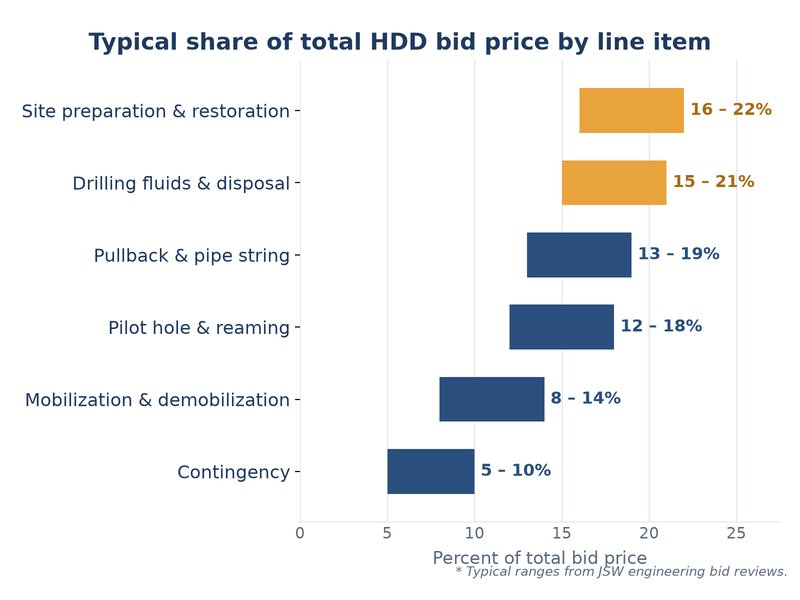
A useful benchmark from our bid reviews: when a horizontal directional drilling contractor prices a typical mid-size crossing, site preparation, drilling fluids and restoration together commonly account for 30 to 45 percent of the total price. Bids that compress these line items are usually hiding scope rather than saving money. Treat the lowest bid with suspicion if its assumptions about geology, length or fluid disposal differ from the engineering basis.
Need a benchmark for the bid on your desk? Send it to the JSW engineering team for a line-by-line review.
HDD Contractor Interview FAQ
Do I really need to ask all ten questions?
Yes, but not all at once. Send the full list in writing before the interview, then use the call to pressure-test the answers you received. The ten questions map to ten risk layers, and skipping one means accepting that risk unexamined. For small driveway or service bores, a shorter conversation is reasonable, but the five questions on licensing, damage prevention, fluids, records and bid content should never be dropped.
Should I always choose the lowest bid?
No. The lowest HDD bid is frequently the one that underprices drilling fluids, restoration and contingency, and those costs reappear as change orders or claims. Compare itemized bids line by line against the same design basis, and treat unexplained gaps as risk, not as savings.
How much does hiring a horizontal directional drilling contractor cost?
In our bid reviews, mid-size crossings commonly run from tens of thousands to several hundred thousand dollars, depending on bore length, pipe diameter, geology, fluids handling and mobilization. Only an itemized bid against a defined design can be compared reliably. Per-foot figures are even more design-dependent; check unit rates for reaming passes and pipe sections instead of relying on a single per-foot number.
How long does contractor vetting take?
A disciplined vetting process takes one to three weeks: one round of written questions, certificate and license checks, reference calls and a site visit. Contractors that cannot produce insurance certificates, drilling logs or references within that window are telling you how they will behave after award.
What documents should I collect before signing?
Collect two sets of documents: one before signing and one after the job. Before signing: certificates of insurance with you named as additional insured, current licenses, the signed scope and itemized bid, the written fluid management plan, and the change-order and warranty clauses in writing. After the job: daily drilling logs, fluid volumes, as-built drawings with the actual bore path, locate records and third-party inspection reports. These documents protect you in disputes, audits and future maintenance planning.
What is the difference between an HDD contractor and a directional boring contractor?
The terms describe the same trade. Horizontal directional drilling, directional boring and HDD all refer to the steerable trenchless process of installing pipe along a controlled underground arc—the same sequence of pilot hole, reaming and pullback. In common industry usage, “directional boring” appears more often on shorter telecom and utility bores, while “HDD” tends to be used for larger rigs, longer crossings and steel pipelines—though labels vary by market and manufacturer. What matters is not the label but whether the firm owns the equipment, the crew and the records to back it up.
Cómo apoya JSW los proyectos de perforación de pozos de petróleo y de oleoductos
JSW is a pipeline engineering and construction partner that supports owners, EPC firms and drilling contractors across the full lifecycle of directional drilling and trenchless work. Our capabilities cover three layers of an HDD project:
- Construction and repair services: pipeline construction services for new lines and crossings, with repair and maintenance programs that keep existing networks operational.
- HDD support processes: pipeline hot tapping and plugging services for tie-ins and live-line work around the bore.
- Fabrication and tooling: pipeline cutting machines used to prepare pipe on the entry spread, plus microtunneling capability for projects that need a shaft-based alternative to HDD.
What distinguishes our support is integrated execution. We review bore plans against pipe string fabrication and welding requirements, document drilling logs and as-builts as standard deliverables, and price contingencies explicitly rather than hiding them.
If you are evaluating a horizontal directional drilling contractor or planning a trenchless crossing, contact the JSW engineering team with the bid and bore plan, and we will flag the risk items and return a scoped technical review within five working days.





































 English
  Arabic
  Russian
  Spanish
  French
  Vietnamese
  Polish
  Thai
Thai  Indonesian
  Turkish
  Portuguese