
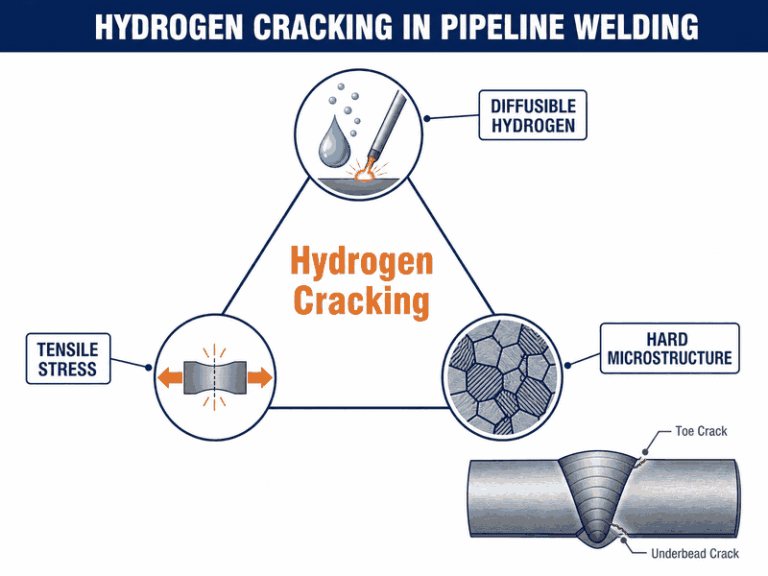
El agrietamiento por hidrógeno en la soldadura de tuberías es el fallo por agrietamiento en frío retardado que se produce cuando el hidrógeno difusible, una microestructura altamente susceptible y la tensión de tracción actúan conjuntamente en una soldadura terminada. Se previene utilizando consumibles con bajo contenido en hidrógeno, un precalentamiento adecuado, un control entre pasadas y una inspección diferida, de modo que las grietas ocultas no puedan llegar a la fase de servicio.
Esta guía explica el mecanismo de agrietamiento por hidrógeno, las tres condiciones que deben darse para que se produzca, siete medidas de prevención probadas en la práctica con sus parámetros típicos, las normas adicionales para el servicio con gas ácido y las tuberías de alta resistencia, así como los plazos de inspección que permiten detectar el agrietamiento retardado antes de que se convierta en una fuga.
Puntos clave
- La fisuración por hidrógeno requiere que se den tres condiciones a la vez: hidrógeno difusible, una microestructura dura y tensión de tracción. Si se elimina cualquiera de ellas, la fisura no puede formarse.
- La humedad es la principal fuente de hidrógeno: electrodos húmedos, biseles mojados, óxido y aire húmedo. Los consumibles con bajo contenido en hidrógeno, con 5 ml/100 g o menos de hidrógeno difusible, constituyen la referencia.
- Precalienta a una temperatura de entre 100 y 150 °C para la mayoría de las soldaduras circunferenciales de acero al carbono, y a una temperatura más alta en el caso de paredes gruesas, alto CE o alta restricción. El valor exacto viene determinado por tu WPS (Especificación del procedimiento de soldadura) homologada.
- Mantenga la temperatura entre pasadas dentro del rango homologado y aplique un recalentamiento a 200-250 °C durante 1-2 horas en uniones gruesas, con restricción o de alta resistencia.
- Realizar la inspección con un cierto retraso: las grietas por hidrógeno suelen aparecer entre 48 horas y 2 semanas después de la soldadura, por lo que hay que dejar reposar la soldadura antes de realizar el ensayo no destructivo (END) definitivo y limitar la dureza a 22 HRC en las tuberías de transporte de gas ácido.
- Consulte la Tabla 2 para ver la referencia completa de los parámetros.
¿Qué es la fisuración por hidrógeno en la soldadura de tuberías?
La fisuración por hidrógeno en las soldaduras de tuberías se manifiesta como una fisura en frío en el metal de soldadura o en la zona afectada por el calor (HAZ), a menudo horas o días después de que la soldadura se haya enfriado. También se denomina fisuración retardada, fisuración en frío o fisuración asistida por hidrógeno. Las grietas suelen ser longitudinales, discurren a lo largo del talón de la soldadura o por debajo del cordón, y son invisibles hasta que se inspecciona la soldadura mediante ensayos de partículas magnéticas o ultrasónicos.
La falla se origina en el interior del metal. El hidrógeno atómico procedente del proceso de soldadura se disuelve en el baño de fusión y queda atrapado en la soldadura solidificada. Al mismo tiempo, una velocidad de enfriamiento elevada convierte la zona afectada por el calor (HAZ) en una microestructura dura y frágil. Cuando la soldadura se contrae y se acumula tensión de tracción residual, el hidrógeno atrapado migra hacia los concentradores de tensión y provoca una grieta a través de la zona endurecida.
La fragilización por hidrógeno del metal base es un fenómeno relacionado, pero distinto, y alcanza su máxima intensidad cerca de la temperatura ambiente. Por eso, una soldadura que parece perfecta al final de un turno puede fallar dos días después, y por eso las grietas por hidrógeno en la soldadura se consideran un defecto de aparición retardada, en lugar de inmediato.
¿Qué provoca el agrietamiento por hidrógeno en la soldadura de tuberías?
Para que se produzca la fisuración por hidrógeno en las soldaduras de tuberías, deben darse tres condiciones a la vez: una fuente de hidrógeno difusible, una microestructura susceptible y una tensión de tracción. Esto suele representarse mediante un triángulo, y la regla práctica es sencilla: si se elimina cualquiera de los tres elementos, la fisura no puede formarse.
- Hidrógeno: humedad en el fundente o en el recubrimiento del electrodo, condensación en un bisel frío, óxido, aceite, pintura, humedad en el gas de protección o hidrógeno absorbido del producto que se está soldando.
- Microestructura susceptible: una zona afectada por el calor (HAZ) martensítica y dura, resultante de un enfriamiento rápido, de un acero con alto equivalente de carbono o de un grado de resistencia excesivamente alta.
- Tensión de tracción: la contracción del metal de soldadura, la restricción de la unión, la sujeción de paredes gruesas o la presión de servicio aplicada antes de que el hidrógeno se haya difundido.
| Fuente de hidrógeno | Cómo penetra en la soldadura | Control primario |
|---|---|---|
| Recubrimiento húmedo del electrodo | La humedad presente en el fundente se descompone en hidrógeno en el arco eléctrico. | Cocer los electrodos de bajo contenido en hidrógeno según las instrucciones del fabricante; mantenerlos a una temperatura de entre 120 y 150 °C; limitar la exposición a un máximo de 4 horas. |
| Bisel mojado o contaminado | La condensación, el óxido, el aceite o la pintura liberan hidrógeno durante la soldadura | Seca y limpia 25 mm a cada lado de la junta; precalienta para eliminar la condensación. |
| Entorno húmedo | La humedad ambiental es absorbida por el arco y el gas de protección | Precalentamiento, consumibles con bajo contenido en hidrógeno y menor tiempo de exposición de las latas de electrodos abiertas |
| Consumibles celulósicos o con alto consumo de hidrógeno | Los recubrimientos de celulosa contienen agua que se convierte en hidrógeno en el arco eléctrico. | Utiliza electrodos con bajo contenido en hidrógeno o ajusta el precalentamiento y el poscalentamiento en el procedimiento de soldadura (WPS). |
| Hidrógeno de producción (gas ácido, servicio de hidrógeno) | El hidrógeno procedente del H₂S o del gas hidrógeno se difunde en la soldadura durante su uso. | Control de la dureza, tratamiento térmico posterior a la soldadura (PWHT) cuando sea necesario y materiales conformes con la norma NACE |
El equivalente de carbono (CE) es la forma más rápida de evaluar el riesgo microestructural antes de soldar. La fórmula del IIW es: CE = C + Mn/6 + (Cr + Mo + V)/5 + (Ni + Cu)/15. La norma API 5L PSL2 establece un límite máximo de CE de 0,43 para los aceros X52 y X60, de 0,45 para el X65 y de 0,48 para el X70; los aceros que se acercan a estos límites máximos requieren un precalentamiento mayor que los aceros con un CE bajo.
Cómo prevenir el agrietamiento por hidrógeno: 7 métodos probados
Estas siete medidas controlan la fisuración por hidrógeno en la soldadura como un sistema, no como opciones independientes. Cada una de ellas elimina o debilita uno de los vértices del triángulo de la fisuración por hidrógeno, y omitir una de ellas multiplica el riesgo de las demás. Todos los métodos que se indican a continuación se utilizan a diario en nuestro trabajo de campo y están recogidos en nuestros procedimientos homologados.
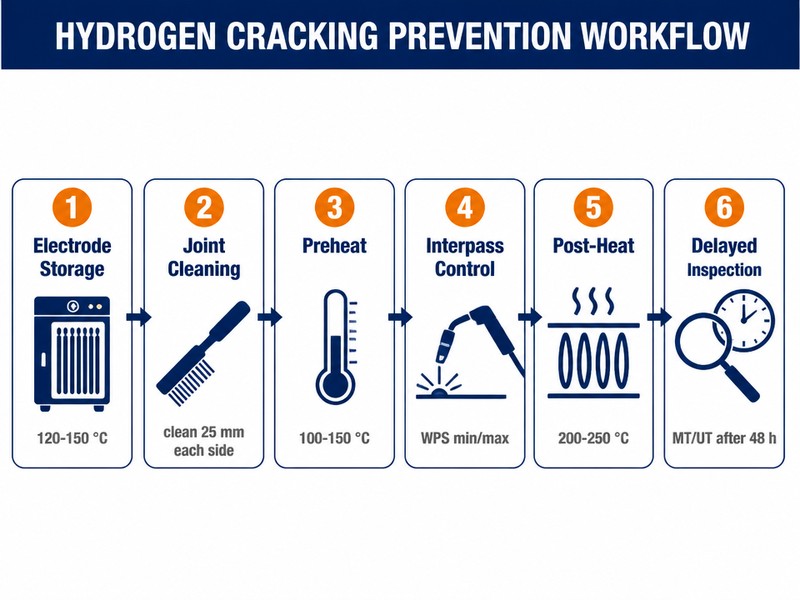
Figura 1. Un flujo de trabajo sobre el terreno de seis etapas controla la formación de grietas por hidrógeno en la soldadura, desde el almacenamiento de los electrodos hasta la inspección diferida.
1. Utiliza electrodos con bajo contenido en hidrógeno y guárdalos correctamente
Los electrodos con bajo contenido en hidrógeno, como el E7018, constituyen la referencia para la soldadura de tuberías en las que existe riesgo de agrietamiento por hidrógeno. Sus recubrimientos están formulados para mantener el hidrógeno difusible en el depósito en un nivel igual o inferior a 5 ml/100 g, lo que corresponde al nivel de clasificación H5, medido según la norma ISO 3690 o AWS A4.3.
Un electrodo solo tiene un bajo contenido en hidrógeno si se mantiene seco. Almacene los electrodos con bajo contenido en hidrógeno a una temperatura de entre 120 y 150 °C en un horno para varillas; caliéntelos a la temperatura especificada por el fabricante —normalmente entre 300 y 400 °C— antes de su uso, y vuelva a introducir las varillas sin usar en el horno tras un máximo de 4 horas de exposición al aire. En nuestro departamento de soldadura, las latas de electrodos abiertas se marcan con la hora a la que salieron del horno, y una varilla que haya estado expuesta demasiado tiempo se desecha, no se reutiliza.
2. Limpia y seca la zona de soldadura antes de realizar el primer cordón
El óxido, el aceite, la pintura, la humedad y la condensación en el bisel son fuentes de hidrógeno que ningún electrodo puede compensar. Limpia las caras de la unión y 25 mm a cada lado del bisel hasta dejar el metal al descubierto, y seca la zona con precalentamiento en los puntos donde pueda formarse condensación.
En las mañanas frías, las superficies de acero acumulan humedad visible incluso cuando el aire parece seco. Nuestra norma en la obra es sencilla: si una zona de soldadura muestra cualquier signo de humedad, el precalentamiento debe mantenerse activo hasta que la superficie esté seca y se mantenga así, y la temperatura debe medirse con un termómetro de contacto o una pistola de infrarrojos antes de cada pasada. Nuestros equipos llevan amoladoras angulares, cepillos de alambre y acetona en la franja de obra, y la junta se vuelve a comprobar visualmente antes de cada pasada de raíz.
3. Preheat to the Correct Temperature
Preheat slows the cooling rate so the HAZ transforms into a tougher microstructure instead of hard martensite, and it drives moisture off the joint before welding. The required preheat depends on carbon equivalent, wall thickness, and restraint; typical carbon steel values are 100-150 °C, rising to 150-200 °C for thick, high-CE, or highly restrained joints.
The temperature is read on the parent metal 75 mm from the weld, not on the weld itself, and it must be held through the entire welding sequence. On a recent 36-inch X70 tie-in in a coastal environment, we welded with 150 °C preheat and checked the temperature with an infrared gun before every electrode change, because humidity was driving the risk.
4. Control Interpass Temperature and Heat Input
Interpass temperature keeps the joint above the transformation window between passes, so each subsequent weld metal and HAZ cools at the controlled rate. It also prevents overheating, which widens the HAZ and burns off alloying elements.
The qualified WPS sets both a minimum and a maximum interpass temperature. Stay inside the range: too low re-creates the fast cooling that makes hard microstructure, and too high degrades toughness. Automatic welding systems with real-time parameter logging make this easier to hold than manual welding, which is one reason automatic pipeline welding is increasingly used on large-diameter work.
5. Apply Post-Heat or Hydrogen Bake-Out on High-Risk Joints
Post-heat, sometimes called hydrogen bake-out, holds the completed weld at 200-250 °C for 1-2 hours so trapped hydrogen can diffuse out of the joint while the metal is still above the danger zone for embrittlement. It is applied when preheat alone cannot be maintained, on thick-wall or highly restrained joints, and on high-strength steels.
Hydrogen embrittlement is most severe near room temperature, and steels are largely immune above roughly 150 °C. That makes post-heat a temperature race: the weld is kept hot long enough for hydrogen to escape before the metal ever passes through the cold, brittle window.
6. Use Post-Weld Heat Treatment for Thick-Wall and Sour-Service Lines
Post weld heat treatment (PWHT, also written post-weld heat treatment) at 600-650 °C for carbon steel, typically one hour per 25 mm of wall thickness, softens the HAZ and relieves residual stress. It is the strongest single defense against hydrogen cracking, and it is required by code or owner specification for thick-wall lines, high-strength grades, and sour pipelines where NACE limits apply.
PWHT is rarely applied to long field runs because heating a full pipeline section is impractical; it is used on tie-ins, fittings, and station piping where the joint count is small. When PWHT is not feasible, the combination of low-hydrogen consumables, preheat, and post-heat must carry the hydrogen control burden.
7. Cap Hardness and Inspect on a Delay
Hardness is the measurable proxy for microstructure susceptibility, and a portable survey tells you whether the procedure actually produced the microstructure you planned. In sour service the cap is 22 HRC (~248 HV) per NACE MR0175/ISO 15156-2, and many offshore codes hold non-sour welds near 350 HV.
Because hydrogen cracking is delayed, final NDT must wait. Our standard practice, and common industry practice, is a 48-hour hold before magnetic particle testing (MT) and ultrasonic testing (UT), with longer holds for high-strength steels. A weld that is accepted on the day it is finished can contain a crack that will open up two weeks later.
| Método | Key parameter | When it matters |
|---|---|---|
| Low-hydrogen electrodes | ≤5 mL/100 g (H5); store 120-150 °C; expose <4 h | All carbon steel girth welds |
| Clean & dry joint | 25 mm each side to bare metal | Cold mornings, humid sites |
| Preheat | 100-150 °C (up to 200 °C high CE/thick) | CE > 0.40, thick wall |
| Interpass control | WPS min/max range, logged | Multi-pass, automatic welding |
| Post-heat (bake-out) | 200-250 °C, 1-2 h | Thick, restrained, high-strength |
| PWHT | 600-650 °C, 1 h per 25 mm | Sour service, code requirement |
| Hardness cap + delayed NDT | ≤22 HRC (sour); 48-h hold | H2S lines, X70/X80 |
All seven parameters are fixed by your qualified WPS, and this table is what we hand to site supervisors before every girth weld campaign.
What Preheat Temperature Do You Need?
There is no single universal welding preheat temperature for hydrogen cracking prevention; the value comes from the carbon equivalent, the wall thickness, and the restraint of the joint, and the final number is fixed by your qualified WPS. The table below gives the typical starting ranges we use before qualifying a new procedure.
| Carbon equivalent (CE) | Wall thickness | Typical preheat temperature |
|---|---|---|
| CE up to 0.40 | Up to 25 mm | 50-100 °C |
| CE 0.40-0.45 | 25-50 mm | 100-150 °C |
| CE above 0.45, or high restraint | Over 50 mm | 150-200 °C |
| Sour service (NACE MR0175/ISO 15156-2) | Any | 150 °C minimum in our practice |
Three field rules keep preheat honest. Measure on the parent metal 75 mm from the joint. Maintain the temperature for the full weld, including tack welds, which are welded and kept hot like the root pass. And when ambient temperature is low or the surface is wet, add margin instead of subtracting it.
The ranges in Table 3 are starting points, not substitutes for a PQR; the final value is always confirmed in a PQR (procedure qualification record) before production welding begins.
Hydrogen Cracking in Sour Service Pipelines
Sour service duty raises the stakes because the product itself supplies hydrogen. Hydrogen sulfide in the gas or liquid dissociates at the steel surface, and atomic hydrogen diffuses into the weld in service, which is why hardness control, not just welding hygiene, becomes the governing requirement.
Welding to NACE MR0175/ISO 15156-2 means capping weld and HAZ hardness at 22 HRC, selecting consumables whose undiluted deposit meets the same limit, and frequently applying post-weld heat treatment to low-alloy steels. On sour gas projects the limits below govern the qualified procedure:
- ≤22 HRC (~248 HV) — NACE MR0175/ISO 15156-2 sour service
- ~350 HV max — many offshore codes, non-sour service
- Hardness survey across the weld, HAZ, and parent metal, recorded on the WPS so the inspector sees the proof at the joint
Repairs in sour service carry the same risk. Any weld repair adds a second thermal cycle to an already hardened HAZ, so repairs on sour lines are made with the same preheat, low-hydrogen consumables, and hardness verification as the original weld, and the area is re-surveyed after repair.
Need a sour-service WPS qualified to NACE MR0175? Send us the pipe grade and CE, and our welding engineers will confirm the hardness limits and preheat for your joint.
Hydrogen Cracking Risk in High-Strength Line Pipe
High-strength grades such as X70 and X80 are more sensitive to hydrogen cracking because their strength comes from a microstructure that is easier to over-harden, and their CE limits are near the weldability ceiling. The margin between a sound weld and a hard, cracked HAZ shrinks as the grade goes up.
The controls for high-strength pipe are the same seven measures applied more strictly: lower maximum hydrogen in the consumable, higher preheat, tighter interpass control, and longer NDT delays. Some operators require H4-class electrodes, 4 mL/100 g or less, for X80 and above, and hold final inspection for 72 hours or more.
For hydrogen service pipelines built to ASME B31.12, the same welding controls apply to the weld itself, and hydrogen effects on the base metal in service are a separate design consideration. We treat every high-strength girth weld as a hydrogen-controlled weld until the hardness survey says otherwise.
Qualification welds are made with the same consumables, positions, and ambient conditions as the production joint, so the record matches the field.
How to Inspect for Delayed Hydrogen Cracking
Delayed cracking makes inspection timing part of the prevention system. The crack needs time to grow to a detectable size, so inspecting too early gives a false sense of security, and inspecting too late means the defect is already in the ground.
The standard sequence on our projects is visual inspection immediately after welding, hardness survey where the spec requires it, and magnetic particle or ultrasonic testing after a 48-hour hold. MT catches surface toe cracks and underbead cracks at the surface; UT catches subsurface HAZ cracks that MT cannot see. Radiography is used where the contract demands it, but it is the least sensitive method for tight hydrogen cracks. Automated ultrasonic crawlers log the full scan record, so a re-review after the holding period is a matter of calling up the file rather than re-running the crew.
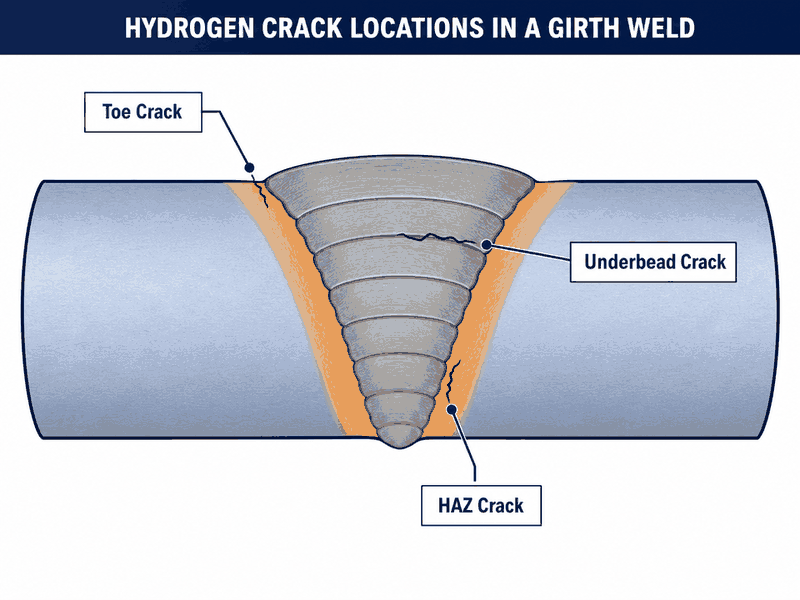
Figure 2. Hydrogen cracks in a girth weld typically form at the weld toe, under the bead, and in the hardened heat-affected zone.
When a hydrogen crack is found, the repair follows the same discipline as the original weld: grind or cut out the full crack with a pipeline cutting machine or grinder, verify removal with MT, re-weld with preheat and low-hydrogen consumables, and re-inspect after another hold. Cutting out only the visible crack leaves the hydrogen-charged zone in place, and the crack returns.
Hydrogen Cracking vs. Hydrogen-Induced Cracking (HIC): What Is the Difference?
Hydrogen cracking and hydrogen induced cracking (HIC) are often confused because the names overlap, but they describe different failure mechanisms. Hydrogen cracking is the cold, delayed crack in a weld caused by hydrogen absorbed during welding. HIC is the blistering and stepwise cracking of the base metal caused by hydrogen absorbed from wet H2S service over years of operation.
Hydrogen cracking in welding forms in hours to weeks, sits in the weld metal or HAZ, and is prevented by welding controls. HIC forms over the life of the pipeline, sits in the parent metal, and is prevented by material selection and hardness limits at the mill. Hydrogen embrittlement is the umbrella term for ductility loss from absorbed hydrogen, and both mechanisms are expressions of it.
In practice, a sour gas pipeline needs defense against both: welding controls to prevent hydrogen cracking in the girth welds, and HIC-resistant line pipe to prevent hydrogen induced cracking in the body of the pipe. Hydrogen induced cracking prevention starts at the steel mill with HIC-tested plate, while hydrogen cracking prevention starts at the weld with electrodes and preheat. Confusing hydrogen cracking with hydrogen induced cracking leads to the wrong prevention program and the wrong inspection schedule.
Preguntas frecuentes
What is hydrogen cracking in pipeline welding?
Hydrogen cracking in pipeline welding is a delayed cold crack in the weld metal or heat-affected zone that forms when diffusible hydrogen, a hard microstructure, and tensile stress are present together. It appears hours to weeks after welding and is usually longitudinal, running along the weld toe or under the bead.
What causes cold cracking in welds?
Cold cracking needs three simultaneous conditions: hydrogen in the weld, a hard susceptible microstructure from fast cooling, and tensile stress. Moisture from damp electrodes or wet bevels supplies the hydrogen, high cooling rate creates the hard HAZ, and weld contraction provides the stress. Remove any one condition and the crack cannot form.
How long after welding does hydrogen cracking occur?
Hydrogen cracks usually appear 48 hours to 2 weeks after welding, which is why the failure is called delayed cracking. The crack needs time for hydrogen to diffuse to a stress concentrator and for the crack to grow to a detectable size, and high-strength steels can crack over longer windows. This is the reason final NDT is held for 48 hours or more.
What preheat temperature prevents hydrogen cracking?
Typical carbon steel preheat is 100-150 °C, rising to 150-200 °C for thick wall, high CE, or highly restrained joints. The exact value comes from your qualified WPS and depends on carbon equivalent, thickness, and restraint. Measure the temperature on the parent metal 75 mm from the weld and hold it for the full weld, including tacks.
Do low-hydrogen electrodes alone prevent hydrogen cracking?
No. Low-hydrogen electrodes are necessary but not sufficient. They must be kept dry, the joint must be clean, and preheat, interpass control, and inspection timing must all be right. An E7018 rod that has absorbed moisture for six hours can deliver more hydrogen than a dry cellulosic rod.
Is post-weld heat treatment required to prevent hydrogen cracking?
Not for every weld. Post-weld heat treatment at 600-650 °C is required for thick-wall, high-strength, or sour-service applications where code limits apply. For ordinary carbon steel girth welds, the combination of low-hydrogen consumables, correct preheat, and post-heat at 200-250 °C is sufficient. Your WPS and the governing code decide.
Hydrogen cracking vs. hydrogen embrittlement: what is the difference?
Hydrogen embrittlement is the general loss of ductility in a metal caused by absorbed atomic hydrogen. Hydrogen cracking is the specific delayed cold crack in a weld caused by hydrogen absorbed during welding. All hydrogen cracking is a form of hydrogen embrittlement, which also includes HIC, blistering, and stress corrosion effects in base metal that no welding control can fix.
Can a hydrogen crack be repaired?
Yes, with the same discipline as the original weld. Grind or cut out the complete crack, verify full removal with magnetic particle testing, re-weld with preheat and low-hydrogen consumables, and re-inspect after another hold. Repairing only the visible crack leaves hydrogen-charged hard material in place and the crack returns, often worse. For field repairs on live pipelines, see our pipeline repair services.
Before you send your inquiry, have these three numbers ready: pipe grade (e.g. X65), wall thickness, and carbon equivalent. Send them to our welding engineers, and we will review the hydrogen cracking risk and confirm the procedure within 24 hours.
Hydrogen cracking in pipeline welding is preventable, but only as a system: dry consumables, clean joints, correct preheat and interpass control, post-heat and post-weld heat treatment where the risk demands it, and inspection on a delay. The three conditions of the hydrogen cracking triangle, hydrogen, hard microstructure, and stress, are all under the welder’s control before the first bead.
Hydrogen cracking prevention is not a code paragraph to look up; it is a field discipline that has to survive cold mornings, humid coastal air, and pressure from the schedule. In our pipeline construction and maintenance work, the joints that fail are almost always the ones where a control was skipped, a damp rod was used, or an inspection was rushed.
If you are planning pipeline construction, repair, hot tapping, or line stopping on carbon steel or high-strength line pipe, work with a team that treats hydrogen control as routine. JSW has completed more than 1,200 hot tap and line stopping jobs, including sour-service tie-in programs, and hundreds of pipeline girth weld programs across Asia, the Middle East, Africa, and South America, with welder and procedure qualifications to API 1104 and ASME B31.4/B31.8. Our pipeline maintenance services and line stopping and plugging equipment cover the repair and maintenance scope for live lines.
Send us your pipe grade, wall thickness, and carbon equivalent — you will get a hydrogen cracking risk review and a quotation within 24 hours.
Get a Free Hydrogen Cracking Risk Review





































 English
  Arabic
  Russian
  Spanish
  French
  Vietnamese
  Polish
  Thai
Thai  Indonesian
  Turkish
  Portuguese