
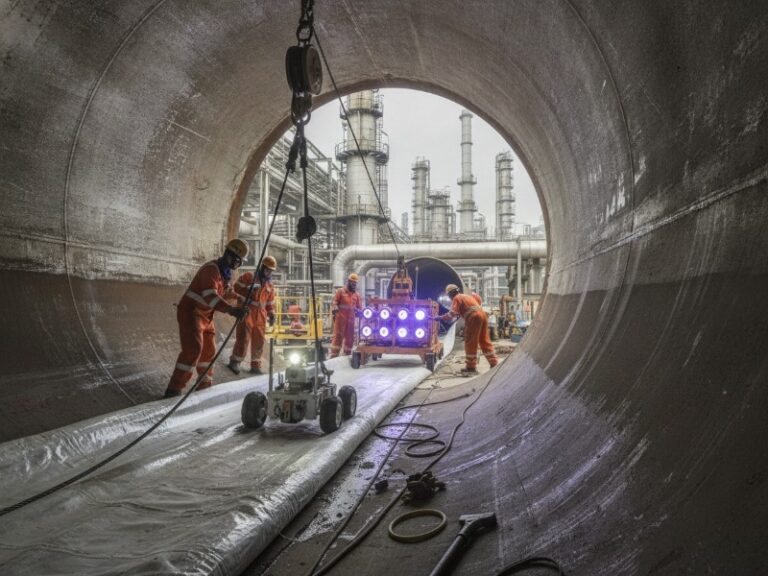
Average CIPP Pipe Lining Cost at a Glance
| Artículo | Average Cost |
|---|---|
| CIPP Cost Per Linear Foot | $80 – $250 |
| Typical 50-Foot Residential Project | $5,000 – $12,000 |
| Typical 100-Foot Sewer Line | $10,000 – $20,000 |
| Commercial / Industrial Projects | $10,000 – $40,000+ |
| Esperanza de vida | 50+ Years |
| Savings vs. Open-Cut Excavation | 30% – 50% |
CIPP pipe lining costs between $80 and $250 per linear foot in 2026, with most homeowners paying $5,000 to $12,000 for a standard 50-foot sewer lateral. For larger-diameter industrial or municipal pipes, costs scale with diameter and site complexity. This complete guide covers cost by pipe size, material, state, comparisons with pipe bursting and epoxy lining, and a step-by-step cost calculator to help you budget accurately.
CIPP Cost Calculator: Estimate Your Project in 3 Steps
Use this simple formula and reference table to estimate your total CIPP lining project cost.
Estimated Cost Formula
Total CIPP Cost = (Pipe Length × Cost Per Foot) + Cleaning & Inspection + Access & Permits + Optional Repairs
Quick Cost Lookup Table
| Pipe Length | Estimated Cost Range (4″–6″ Pipe) |
|---|---|
| 25 ft | $2,500 – $6,250 |
| 50 ft | $5,000 – $12,500 |
| 75 ft | $7,500 – $18,750 |
| 100 ft | $10,000 – $25,000 |
| 150 ft | $15,000 – $37,500 |
Example Calculation: For a 60-foot, 6-inch sewer line in good access conditions:
- Base lining cost: 60 ft × $180/ft = $10,800
- Cleaning & inspection: $800
- Access & permits: $500
- Estimated total: $12,100
This formula provides a baseline—actual quotes may vary based on your specific pipe condition, depth, and local labor rates.
What Is CIPP Pipe Lining and How Does It Work?
Cured-in-place pipe (CIPP) lining is a trenchless rehabilitation technology that restores damaged pipes from the inside without excavation. A flexible felt or fiberglass liner saturated with thermosetting resin is inserted into the existing pipe, then inflated and cured using hot water, steam, or UV light to form a new structural pipe within the old one.
This method works for sanitary sewers, storm drains, building stacks, industrial process lines, and potable water mains. Unlike traditional pipe replacement, CIPP requires only small access points—typically one at each end—preserving landscaping, driveways, industrial flooring, and interior finishes.
Why CIPP matters for cost: Because you avoid digging trenches across your property or facility, you eliminate major restoration expenses—often the largest line item in a traditional pipe repair project. According to the National Association of Sewer Service Companies (NASSCO) , CIPP is one of the most widely adopted trenchless rehabilitation technologies for aging infrastructure, with documented performance spanning decades of field service.
CIPP Pipe Lining Cost by Pipe Diameter
Pipe diameter is one of the strongest predictors of CIPP pricing. Larger pipes require more liner material, more resin, and larger curing equipment. Here are the typical per-foot ranges by diameter:
| Diámetro de la tubería | Aplicación típica | Cost Per Linear Foot |
|---|---|---|
| 3″ – 4″ | Small residential laterals, downspouts | $80 – $180 |
| 4″ – 6″ | Standard residential & light commercial | $100 – $250 |
| 6″ – 8″ | Commercial properties, multi-unit buildings | $100 – $300+ |
| 8″ – 10″ | Municipal mains, industrial process lines | $150 – $400+ |
| 10″ – 12″+ | Storm drains, large-diameter industrial pipes | $200 – $500+ |
Engineering reference: For water mains, an industry formula estimates CIPP cost at approximately **$31.23 per inch of diameter per linear foot**. For example, a 6-inch line would be approximately $187 per foot using this benchmark, which aligns with the ranges above.
CIPP Cost by Existing Pipe Material
The material of your existing pipe significantly affects cleaning effort, liner adhesion, and overall cost. Different materials present unique challenges:
| Existing Pipe Material | Typical Cost Per Linear Foot | Key Considerations |
|---|---|---|
| Cast Iron | $100 – $250 | Often requires descaling to remove tuberculation; rough interior may need extra resin |
| Clay Tile (VCP) | $90 – $220 | Roots commonly intrude at joints; may need hydro-jetting or mechanical cleaning |
| PVC | $80 – $200 | Smoothest surface; lowest cleaning effort; limited root intrusion |
| Concrete | $120 – $300 | May have cracks or spalling requiring structural preparation; larger diameters common |
| Orangeburg (Bituminous Fiber) | $120 – $300 | Fragile material; often partially collapsed; may require spot repairs before lining |
| Steel | $110 – $280 | Corrosion scaling; may need sandblasting or high-pressure cleaning for proper adhesion |
Pro tip: Cast iron and Orangeburg pipes often have the highest preparation costs. Factor an additional $5–$15 per foot for heavy cleaning or descaling when budgeting for these materials.
CIPP Cost vs. All Sewer Repair Methods
Choosing the right method depends on pipe condition, budget, and long-term goals. Here is a comprehensive comparison of all major options:
| Método | Cost Per Linear Foot | Esperanza de vida | Se requiere excavación | Mejor aplicación |
|---|---|---|---|---|
| Revestimiento CIPP | $80 – $250 | Más de 50 años | No | Structurally sound pipes with cracks, leaks, or root intrusion |
| Rotura de tuberías | $100 – $300 | Más de 50 años | Minimal (entry/exit pits) | Severely damaged or collapsed pipes needing full replacement |
| Revestimiento epoxi | $30 – $120 | 20 – 50 years | No | Small-diameter pipes, potable water, mild to moderate corrosion |
| Spot / Point Repair | $500 – $2,000 per repair | 5 – 15 years | Mínimo | Isolated holes or joint defects; not for extensive damage |
| Sustitución de corte abierto | $100 – $250 + restoration | Más de 50 años | Full excavation | Shallow lines, low restoration cost areas, or when other methods are infeasible |
| Pipe Ramming | $150 – $400 | Más de 50 años | Entry/exit pits | Large-diameter steel casing installation under roads or railroads |
Key insight: CIPP offers the best balance of cost, longevity, and minimal disruption for most rehabilitation projects. Open-cut replacement only becomes cost-competitive when restoration costs are minimal (e.g., new construction or bare yard sites).
CIPP Cost vs. Pipe Bursting Cost
Pipe bursting is another trenchless method that replaces the existing pipe by breaking it outward while pulling a new pipe into place. Here is how the costs compare:
| Factor | Revestimiento CIPP | Rotura de tuberías |
|---|---|---|
| Cost Per Linear Foot | $80 – $250 | $100 – $300 |
| Se requiere excavación | Minimal (small access pits) | Entry/exit pits required |
| Pipe Replacement | New pipe inside existing | Completely replaces old pipe |
| Suitable For | Structurally sound pipes with cracks | Collapsed or severely damaged pipes |
| Esperanza de vida | Más de 50 años | Más de 50 años |
| Diameter Change | Slightly reduces internal diameter | Can upsize pipe diameter |
Which is cheaper? CIPP is generally more cost-effective for pipes that are still structurally intact but have cracks or root intrusion. Pipe bursting is better for severely damaged or collapsed pipes but requires more site disruption and larger equipment.
CIPP Cost vs. Epoxy Pipe Lining Cost
Epoxy lining (also called epoxy coating) is a lighter-duty trenchless rehabilitation method primarily used for small-diameter potable water pipes and low-pressure systems. Here is how it compares to CIPP:
| Factor | Revestimiento epoxi | Revestimiento CIPP |
|---|---|---|
| Cost Per Linear Foot | $30 – $120 | $80 – $250 |
| Gama de diámetros de tubo | ½″ – 4″ | 3″ – 60″+ |
| Resistencia estructural | Moderate (reinforcement) | High (structural replacement) |
| Presión nominal | Bajo a moderado | High (up to 150+ psi) |
| Esperanza de vida | 20 – 50 years | Más de 50 años |
| Mejor aplicación | Small potable water lines, mild corrosion | Sanitary sewers, storm drains, pressure mains |
Which is right for you? Epoxy lining is usually the lowest-cost trenchless solution for small-diameter pipes where structural integrity is still reasonable. CIPP is more suitable for structural rehabilitation of larger sanitary sewers and pressurized mains. Your contractor can help determine the best method based on pipe condition, diameter, and pressure requirements.
CIPP Sewer Lining Cost by State
Labor rates, permitting fees, and material availability vary significantly across the United States. Here is a state-level cost reference for standard 4″–6″ residential sewer laterals:
| State | Typical Cost Per Linear Foot | State | Typical Cost Per Linear Foot |
|---|---|---|---|
| California | $120 – $250 | Texas | $90 – $220 |
| Florida | $90 – $200 | New York | $130 – $280 |
| Pennsylvania | $100 – $230 | Illinois | $100 – $220 |
| Ohio | $95 – $210 | Georgia | $95 – $200 |
| North Carolina | $90 – $195 | Washington | $110 – $240 |
| Arizona | $95 – $210 | Colorado | $100 – $220 |
| Virginia | $100 – $225 | Michigan | $100 – $215 |
| New Jersey | $120 – $250 | Massachusetts | $130 – $260 |
These ranges are directional estimates based on contractor bid data and municipal project records. Actual quotes vary by site conditions, seasonal demand, and specific project requirements.
Key Factors That Drive CIPP Lining Costs
Actual pricing varies widely because project conditions are never identical. Here are the seven most significant cost drivers:
1. Pipe Diameter and Length
Larger diameters require more liner material and resin. Longer runs generally improve per-foot efficiency up to a point, but may require multiple setups or larger equipment.
2. Existing Pipe Material
As detailed above, cast iron, clay, concrete, and Orangeburg each present unique cleaning and preparation challenges. Cast iron typically requires descaling, clay often has root intrusion, and concrete may need structural prep.
3. Access Points and Site Logistics
If your sewer line has an existing accessible cleanout, costs are lower. Contractors who need to dig access pits, work in tight basements, or navigate interior stacks may charge more. Traffic control and street permits add significant cost for municipal or right-of-way projects.
4. Number of Bends and Branch Connections
Every turn and branch connection complicates liner installation and requires specialized robotic cutting afterward to reinstate service lines. More connections mean higher labor costs.
5. Depth and Ground Conditions
Deeper pipes require more robust equipment and setup time. Rock, unstable soils, or high groundwater can complicate access and add cost. According to the U.S. Environmental Protection Agency (EPA) , trenchless rehabilitation methods significantly reduce surface disruption and environmental impact compared with open-cut replacement, but depth remains a key cost factor.
6. Curing Method
- Steam curing: Most common; reliable and cost-effective for most residential projects.
- Hot water curing: Traditional method; may add cost due to boiler equipment and water disposal.
- UV curing: Faster and more energy-efficient; often adds $10–$30 per foot but offers faster installation times and more consistent results.
7. Local Labor Rates and Permitting
Metropolitan areas with higher labor costs and stricter permitting often have quotes 10–25% above national averages. CIPP pricing has risen 10–25% since 2020 due to material and labor cost increases.
Real-World CIPP Cost Examples
Industrial Facility Process Line
Ubicación: Texas Gulf Coast
Pipe Size: 8-inch
Pipe Material: Carbon steel with corrosion scaling
Length: 120 feet
Condition: Moderate corrosion and pitting
Método: Steam-cured CIPP with epoxy resin for chemical resistance
Total Cost: $28,500
**Alternative Open-Cut Cost:** $45,000+ (including concrete removal and replacement)
Total Savings: 37%
Municipal Sewer Main
Ubicación: Midwest
Pipe Size: 10-inch
Pipe Material: Concrete with cracks
Length: 350 feet
Condition: Multiple cracks and joint separation
Método: UV-cured CIPP with structural felt liner
Total Cost: $89,000
**Traffic Control & Bypass:** $12,000 included
Project Duration: 3 days vs. 2 weeks for open-cut
Residential Sewer Lateral
Ubicación: Texas
Pipe Size: 4-inch
Pipe Material: Clay tile with root intrusion
Length: 55 feet
Condition: Moderate root intrusion and minor cracks
Método: Steam-cured CIPP
Total Cost: $7,850
**Avoided Excavation Restoration Cost:** $6,200
Total Savings vs. Open-Cut: 44%
How CIPP Installation Works (Step-by-Step)
The CIPP installation process follows a standardized sequence that ensures quality and longevity:
Step 1: CCTV Inspection
A robotic camera is inserted into the pipe to assess condition, locate damage, measure length, and identify branch connections. This data determines whether CIPP is suitable.
Step 2: Pipe Cleaning
High-pressure water jetting, mechanical cleaning, or descaling removes debris, scale, roots, and deposits. The pipe interior must be clean for proper liner adhesion.
Step 3: Liner Preparation
A felt or fiberglass liner is saturated with thermosetting resin (polyester, vinyl ester, or epoxy) according to the pipe diameter and structural requirements.
Step 4: Liner Installation
The resin-saturated liner is inserted into the pipe using inversion (air or water pressure) or pull-in methods. It is then inflated against the host pipe wall.
Step 5: Curing
The liner is cured using hot water, steam, or UV light. Curing time ranges from 1–6 hours depending on method and pipe diameter.
Step 6: Final CCTV Inspection
After curing, a camera inspection confirms the liner is properly installed, fully cured, and free of defects. Robotic cutters reinstate branch connections.
Total installation time: Most residential projects are completed in 1–2 days; larger industrial or municipal projects may take 3–5 days.
Frequently Asked Questions About CIPP Lining Costs
Is CIPP lining cheaper than pipe replacement?
Yes, on a total-project basis. While per-foot rates are similar, CIPP avoids the expensive restoration of landscaping, driveways, concrete slabs, and interior finishes. Most homeowners save 30–50% by choosing trenchless lining over full excavation.
Is CIPP lining worth the money?
For most sewer rehabilitation projects, yes. Although the upfront cost is higher than spot repairs, CIPP eliminates excavation and typically lasts more than 50 years. Compared with repeated point repairs, CIPP often provides better long-term value.
What is the cheapest trenchless sewer repair method?
Epoxy coating is usually the lowest-cost trenchless solution for small-diameter pipes ($30–$120 per foot), while CIPP ($80–$250 per foot) is more suitable for structural rehabilitation of larger pipes.
Can a collapsed pipe be lined?
No. Fully collapsed pipes generally require spot repair or replacement before a CIPP liner can be installed. Pipe bursting or open-cut replacement may be necessary for complete structural failures.
How much does 4-inch sewer liner cost?
A 4-inch CIPP liner typically costs $80–$180 per linear foot, with total project costs ranging from $3,000 to $10,000 depending on length and site conditions.
How much does 6-inch CIPP lining cost?
A 6-inch CIPP liner typically costs $100–$250 per linear foot. For a 50-foot run, expect $6,000–$12,500 total.
How much does 8-inch CIPP lining cost?
An 8-inch CIPP liner typically costs $120–$300 per linear foot. Commercial projects with 8-inch lines often range from $10,000 to $40,000+ depending on length and complexity.
How much does cast iron pipe lining cost?
Lining cast iron pipes typically costs $100–$250 per linear foot, with descaling adding $5–$15 per foot. Cast iron often requires more surface preparation due to tuberculation.
How much does clay sewer pipe lining cost?
Lining clay tile pipes typically costs $90–$220 per linear foot. Root removal is the most common additional expense.
How much does concrete pipe lining cost?
Lining concrete pipes typically costs $120–$300 per linear foot, primarily for larger diameters. Structural cracks may require additional preparation.
How long does CIPP lining last?
Properly installed CIPP liners are designed for a 50+ year service life for gravity sewers and 30–50 years for pressure pipes. The new pipe is seamless, jointless, and resistant to corrosion and root intrusion.
Does homeowners insurance cover CIPP pipe lining?
Typically, no. Homeowners insurance covers sudden, accidental damage (e.g., a burst pipe) but not gradual deterioration, root intrusion, or normal wear-and-tear. Check your policy—some endorsements may cover sewer line repairs, but many homeowners pay out of pocket. Municipal utility districts may offer cost-sharing programs for lateral repairs.
What does CIPP lining cost for a 100-foot driveway sewer line?
For a 100-foot, 4″–6″ residential line with average complexity, expect $10,000 – $20,000 total. If the line runs under a driveway or street with traffic control requirements, costs can approach the higher end of the range.
What does CIPP pipe lining cost in California?
CIPP lining in California typically costs $120–$250 per linear foot, with total residential projects averaging $8,000–$15,000. Higher labor rates and stricter permitting contribute to the premium.
What does CIPP pipe lining cost in Texas?
Texas rates are generally more affordable, ranging from $90–$220 per linear foot, with total residential projects averaging $5,000–$12,000.
What are common extra charges to watch for?
Itemized quotes often include these additional charges:
- Camera inspection: $300 – $600
- Hydro-jetting / descaling: $5 – $15 per foot
- Spot repairs (for collapsed sections before lining): $500 – $1,500 per point
- Traffic control / permits: $500 – $2,000 for street work
- Robotic branch reinstatement: $150 – $350 per connection
- Structural restoration (reinstating cleanouts or manhole connections): variable
Always ask for a detailed, itemized quote so you can compare apples-to-apples across contractors.
How long does CIPP installation take?
Most residential CIPP projects are completed in 1-2 días, compared to 1–2 weeks for open-cut replacement. Large commercial or municipal projects may take 3–5 days depending on scale.
Is CIPP lining safe for drinking water pipes?
Yes, when properly specified. CIPP liners for potable water systems must meet NSF/ANSI 61 certification for drinking water safety. Not all CIPP materials are rated for potable water—confirm with your contractor.
How do I find a qualified CIPP contractor?
Look for contractors with:
- NASSCO certification (National Association of Sewer Service Companies)
- ASTM F1216 compliance (standard specification for CIPP installation)
- At least 3–5 years of trenchless experience
- Multiple positive reviews and project photos
- Detailed, itemized written quotes
Does CIPP work for large-diameter municipal pipes?
Yes. CIPP is commonly used for 8″–60″+ municipal sewer mains and storm drains. Costs for municipal projects are typically quoted per project rather than per foot, and range widely based on diameter, length, traffic management, and bypass pumping requirements.
How does UV CIPP compare in cost and quality?
UV-cured CIPP generally adds $10–$30 per foot compared with steam or hot-water curing. Benefits include faster curing (1–2 hours vs. 3–6 hours), lower energy consumption, and more consistent curing results. UV CIPP is increasingly popular for commercial and municipal projects where installation speed is critical.
How much does CIPP pipe lining cost for industrial applications?
Industrial CIPP projects typically start at $150–$400+ per linear foot due to larger diameters, higher pressure ratings, and chemical resistance requirements. Total projects often range from $20,000 to $500,000+.
CIPP vs. Open-Cut Replacement: Detailed Cost Comparison
The decision between CIPP and open-cut replacement goes beyond per-foot pricing. Here is a comprehensive comparison:
| Factor de coste | Revestimiento CIPP | Sustitución de corte abierto |
|---|---|---|
| Per-foot cost (4″–6″ line) | $100 – $250 | $100 – $250 |
| Restoration (landscaping, concrete, driveway) | Minimal (minor access pits) | $5,000 – $15,000+ |
| Project duration | 1-2 días | 1–2 weeks |
| Disruption to property | Minimal (small access points) | Major (full trench across yard) |
| Disruption to driveway / street | None (below-ground access) | Significant excavation |
| Total for 50-foot home lateral | $5,000 – $12,000 | $15,000 – $30,000+ |
| Life-cycle cost (50 years) | Significantly lower due to reduced maintenance | Higher due to frequent future repairs |
| Environmental impact | 95% less excavated material | 100% excavation of pipe trench |
Independent study reference: CIPP used 95% less excavated material (60 m³ vs. 1,200 m³) and reduced traffic disruptions by 78% compared with open-cut replacement.
Key Takeaways: CIPP Cost in 2026
- Average CIPP cost: $80–$250 per linear foot
- Typical 50-foot residential project: $5,000–$12,000
- Typical 100-foot sewer line: $10,000–$20,000
- Lifespan: Más de 50 años
- Savings compared with excavation: 30%–50%
- Tiempo de instalación: 1-2 días
- Primary cost drivers: Pipe diameter, material condition, access, depth, and local labor rates
Why Trust This Cost Guide?
This pricing guide was prepared by JSW’s trenchless rehabilitation engineering team using:
- Contractor bid data from residential, commercial, and industrial projects across North America
- Municipal project records for CIPP installations
- NASSCO (National Association of Sewer Service Companies) rehabilitation guidelines
- ASTM F1216 standard installation specifications for CIPP
- ASTM F1743 standard practice for CIPP installation
- U.S. EPA best practices for sewer rehabilitation
- North American trenchless construction cost benchmarks
- Field validation from thousands of completed CIPP projects
About JSW—Your Partner in Trenchless Pipe Rehabilitation
JSW is a leading provider of trenchless pipeline rehabilitation solutions, serving infrastructure contractors, municipalities, and industrial facility owners across North America. We specialize in CIPP lining systems, epoxy coating, UV-cured pipe rehabilitation, and hot tap and line stopping services.
Why industry leaders choose JSW:
- Comprehensive technology portfolio—We offer CIPP inversion systems, pull-in liners, UV curing rigs, and epoxy coating solutions tailored to pipe diameters from 1.5″ to 60″ for both gravity and pressure applications.
- Engineered to industry standards—Our materials meet or exceed ASTM, AWWA, and NSF requirements for structural performance, chemical resistance, and potable water safety.
- Cost-effective methodology—We help you select the optimal rehabilitation method based on total cost of ownership, not just upfront pricing. Our approach minimizes downtime and preserves site assets.
- End-to-end support—From initial CCTV inspection and design engineering to installation, curing QA/QC, and commissioning, JSW provides full project lifecycle services.
- Experiencia demostrada—Our systems have been deployed in thousands of residential, commercial, and municipal projects, with documented 50-year design life performance across a wide range of pipe materials and conditions.
Request a CIPP Cost Estimate
Get a detailed, itemized budget estimate for your pipe rehabilitation project. Our engineering team provides:
- ✔ Budget estimate based on your pipe diameter, length, and material
- ✔ Method selection recommendation (CIPP, epoxy, pipe bursting, or alternative)
- ✔ Material recommendation (polyester, vinyl ester, epoxy, or UV-cured)
- ✔ Project feasibility review with risk assessment
- ✔ Schedule and timeline projection
To request your estimate, please provide:
- Pipe diameter and length
- Pipe material (cast iron, clay, PVC, concrete, Orangeburg, steel, etc.)
- Project location
- Photos or CCTV inspection report (if available)
Contact our engineering team to schedule a site assessment and receive a detailed, itemized cost estimate for your specific pipe rehabilitation project. We’ll help you determine whether CIPP, epoxy lining, UV CIPP, pipe bursting, or another trenchless method delivers the best value for your unique conditions.
Final Summary: Average CIPP Lining Cost
| Pipe Category | Typical Cost Range (Per Linear Foot) | Typical Project Total |
|---|---|---|
| Small residential lateral (3″–4″) | $80 – $180 | $3,000 – $8,000 (25 ft) |
| Standard residential (4″–6″, 50 ft) | $100 – $250 | $5,000 – $12,000 |
| Commercial / multi-unit (6″–8″) | $100 – $300+ | $10,000 – $40,000+ |
| Industrial / municipal (8″–10″+) | $150 – $400+ | Highly variable |
The bottom line: CIPP pipe lining costs $80–$250 per linear foot, with total project costs from $3,000 for short repairs** to **$15,000+ for complex residential projects. Compared with traditional dig-and-replace, CIPP saves 30–50% on total project cost while delivering a 50-year solution with minimal disruption. Get multiple itemized quotes, inspect your contractor’s credentials, and choose the method that offers the best total cost of ownership for your specific situation.
This guide was prepared by JSW’s trenchless rehabilitation engineering team. Updated July 2026.








 English
  Arabic
  Russian
  Spanish
  French
  Vietnamese
  Polish
  Thai
Thai  Indonesian
  Turkish
  Portuguese